
Pulp Fiction, 1955 · page 129 of 133
Astounding Science Fiction, British Edition, December 1955 — page 129: what you’re looking at
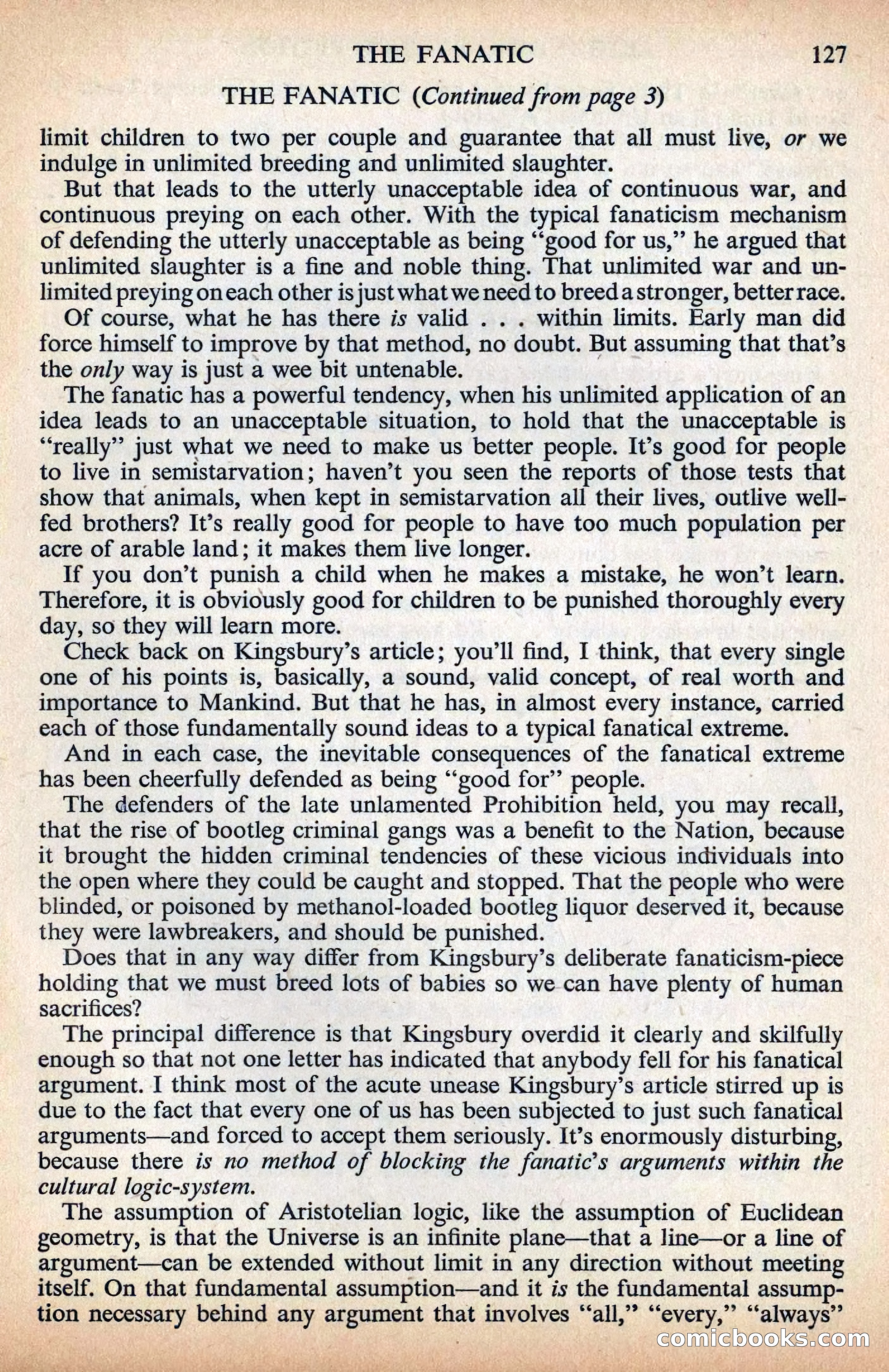
A restored page from Pulp Fiction, 1955. Page through the whole issue in the reader above.
📄 Transcribed text from this page (OCR, searchable)
Machine-transcribed from the original scan — historical spelling and the odd misread are preserved.
THE FANATIC 127 THE FANATIC (Continued from page 3) limit children to two per couple and guarantee that all must live, or we indulge in unlimited breeding and unlimited slaughter. But that leads to the utterly unacceptable idea of continuous war, and continuous preying on each other. With the typical fanaticism mechanism of defending the utterly unacceptable as being “‘good for us,” he argued that unlimited slaughter is a fine and noble thing. That unlimited war and un- limited preying oneach other is just what we need to breeda stronger, better race. Of course, what he has there is valid . . . within limits. Early man did force himself to improve by that method, no doubt. But assuming that that’s the only way is just a wee bit untenable. The fanatic has a powerful tendency, when his unlimited application of an idea leads to an unacceptable situation, to hold that the unacceptable is “‘really’’ just what we need to make us better people. It’s good for people to live in semistarvation; haven't you seen the reports of those tests that show that animals, when ‘kept in semistarvation all their lives, outlive well- fed brothers? It’s really good for people to have too much population per acre of arable land; it makes them live longer. If you don’t punish a child when he makes a mistake, he won’t learn. Therefore, it is obviously good for children to be punished thoroughly every day, so they will learn more. Check back on Kingsbury’s article; you'll find, I think, that every single one of his points is, basically, a sound, valid concept, of real worth and importance to Mankind. But that he has, in almost every instance, carried each of those fundamentally sound ideas to a typical fanatical extreme. And in each case, the inevitable consequences of the fanatical extreme has been cheerfully defended as being “‘good for’’ people. The defenders of the late unlamented Prohibition held, you may recall, that the rise of bootleg criminal gangs was a benefit to the Nation, because it brought the hidden criminal tendencies of these vicious individuals into the open where they could be caught and stopped. That the people who were blinded, or poisoned by methanol-loaded bootleg liquor deserved it, because they were lawbreakers, and should be punished. Does that in any way differ from Kingsbury’s deliberate fanaticism-piece holding that we must breed lots of babies so we can have plenty of human sacrifices? The principal difference is that Kingsbury overdid it clearly and skilfully enough so that not one letter has indicated that anybody fell for his fanatical argument. I think most of the acute unease Kingsbury’s article stirred up is due to the fact that every one of us has been subjected to just such fanatical arguments—and forced to accept them seriously. It’s enormously disturbing, because there is no method of blocking the fanatic’s arguments within the cultural logic-system. The assumption of Aristotelian logic, like the assumption of Euclidean geometry, is that the Universe is an infinite plane—that a line—or a line of argument—can be extended without limit in any direction without meeting itself. On that fundamental assumption—and it is the fundamental assump- tion necessary behind any argument that involves “all,” “every,” “always” ) COMMEROOKS: com