
Pulp Fiction, 1955 · page 9 of 67
Astounding Science Fiction, British Edition — page 9: what you’re looking at
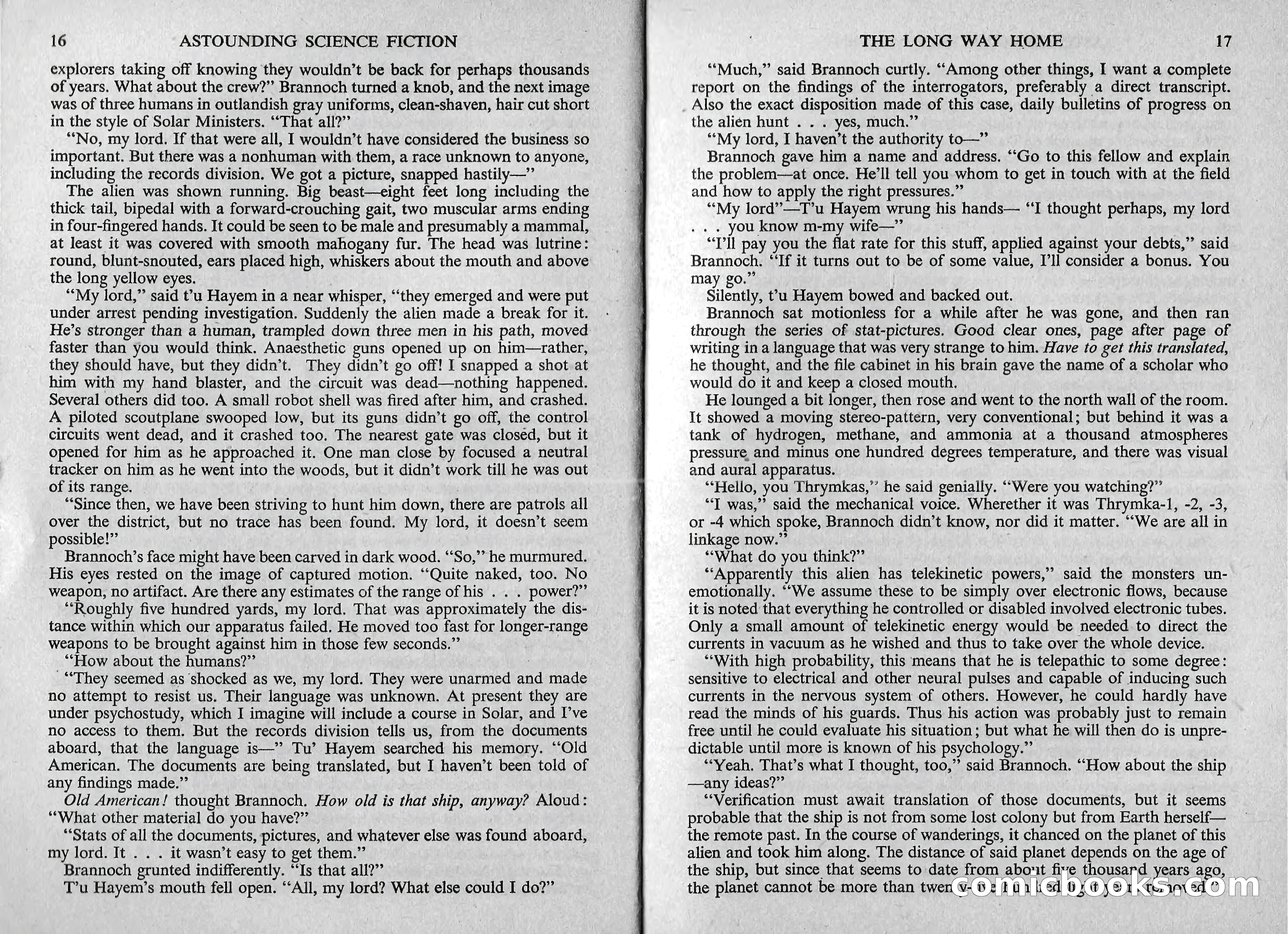
A restored page from Pulp Fiction, 1955. Page through the whole issue in the reader above.
📄 Transcribed text from this page (OCR, searchable)
Machine-transcribed from the original scan — historical spelling and the odd misread are preserved.
16 ASTOUNDING SCIENCE FICTION explorers taking off knowing they wouldn’t be back for perhaps thousands of years. What about the crew?” Brannoch turned a knob, and the next image was of three humans in outlandish gray uniforms, clean-shaven, hair cut short in the style of Solar Ministers. “That all?” “No, my lord. If that were all, I wouldn’t have considered the business so important. But there was a nonhuman with them, a race unknown to anyone, including the records division. We got a picture, snapped hastily—”’ The alien was shown running. Big beast—eight feet long including the thick tail, bipedal with a forward-crouching gait, two muscular arms ending in four-fingered hands. It could be seen to be male and presumably a mammal, at least it was covered with smooth mahogany fur. The head was lutrine: round, blunt-snouted, ears placed high, whiskers about the mouth and above the long yellow eyes. ‘“My lord,” said tu Hayem in a near whisper, “they emerged and were put under arrest pending investigation. Suddenly the alien made a break for it. He’s stronger than a human, trampled down three men in his path, moved faster than you would think. Anaesthetic guns opened up on him—rather, they should have, but they didn’t. They didn’t go off! I snapped a shot at him with my hand blaster, and the circuit was dead—nothing happened. Several others did too. A small robot shell was fired after him, and crashed. A piloted scoutplane swooped low, but its guns didn’t go off, the control circuits went dead, and it crashed too. The nearest gate was closed, but it opened for him as he approached it. One man close by focused a neutral tracker on him as he went into the woods, but it didn’t work till he was out of its range. “Since then, we have been striving to hunt him down, there are patrols all over the district, but no trace has been found. My lord, it doesn’t seem possible!”’ Brannoch’s face might have been carved in dark wood. “So,” he murmured. His eyes rested on the image of captured motion. “Quite naked, too. No weapon, no artifact. Are there any estimates of the range of his . . . power?” “Roughly five hundred yards, my lord. That was approximately the dis- tance within which our apparatus failed. He moved too fast for longer-range weapons to be brought against him in those few seconds.” “How about the humans?”’ | “They seemed as shocked as we, my lord. They were unarmed and made no attempt to resist us. Their language was unknown. At present they are under psychostudy, which I imagine will include a course in Solar, and I’ve no access to them. But the records division tells us, from the documents aboard, that the language is—’ Tu’ Hayem searched his memory. ‘Old American. The documents are being translated, but I haven’t been told of any findings made.” Old American! thought Brannoch. How old is that ship, anyway? Aloud: “What other material do you have?” “Stats of all the documents, pictures, and whatever else was found aboard, my lord. It . . . it wasn’t easy to get them.” Brannoch grunted indifferently. “Is that all?” T’u Hayem’s mouth fell open. “All, my lord? What else could I do?” THE LONG WAY HOME 17 “Much,” said Brannoch curtly. “Among other things, I want a complete report on the findings of the interrogators, preferably a direct transcript. Also the exact disposition made of this case, daily bulletins of progress on the alien hunt . . . yes, much.” ““My lord, I haven’t the authority to—” Brannoch gave him a name and address. “Go to this fellow and explain the problem—at once. He’ll tell you whom to get in touch with at the field and how to apply the right pressures.” “My lord”—T’u Hayem wrung his hands— “I thought perhaps, my lord .. . you know m-my wife—”’ “T’ll pay you the flat rate for this stuff, applied against your debts,” said Brannoch. “‘If it turns out to be of some value, I'll consider a bonus. You may go.” Silently, tu Hayem bowed and backed out. Brannoch sat motionless for a while after he was gone, and then ran through the series of stat-pictures. Good clear ones, page after page of writing in a language that was very strange to him. Have to get this translated, he thought, and the file cabinet in his brain gave the name of a scholar who would do it and keep a closed mouth. He lounged a bit longer, then rose and went to the north wall of the room. It showed a moving stereo-pattern, very conventional; but behind it was a tank of hydrogen, methane, and ammonia at a thousand atmospheres pressure and minus one hundred degrees temperature, and there was visual and aural apparatus. “Hello, you Thrymkas,”’ he said genially. ‘““Were you watching?” “I was,” said the mechanical voice. Wherether it was Thrymka-1, -2, -3, or -4 which spoke, Brannoch didn’t know, nor did it matter. ““We are all in linkage now.” | “What do you think?” ‘Apparently this alien has telekinetic powers,’ said the monsters un- emotionally. ““We assume these to be simply over electronic flows, because it is noted that everything he controlled or disabled involved electronic tubes. Only a small amount of telekinetic energy would be needed to direct the currents in vacuum as he wished and thus to take over the whole device. “With high probability, this means that he is telepathic to some degree: sensitive to electrical and other neural pulses and capable of inducing such currents in the nervous system of others. However, he could hardly have read the minds of his guards. Thus his action was probably just to remain free until he could evaluate his situation; but what he will then do is unpre- dictable until more is known of his psychology.” “Yeah. That’s what I thought, too,” said Brannoch. “How about the ship —any ideas?’ “Verification must await translation of those documents, but it seems probable that the ship is not from some lost colony but from Earth herself— the remote past. In the course of wanderings, it chanced on the planet of this alien and took him along. The distance of said planet depends on the age of b the ship, but since that seems to date from about five thousard years ago, the planet cannot be more than twen v6 2 10) chooks co =}