
Pulp Fiction, 1955 · page 7 of 67
Astounding Science Fiction, British Edition — page 7: what you’re looking at
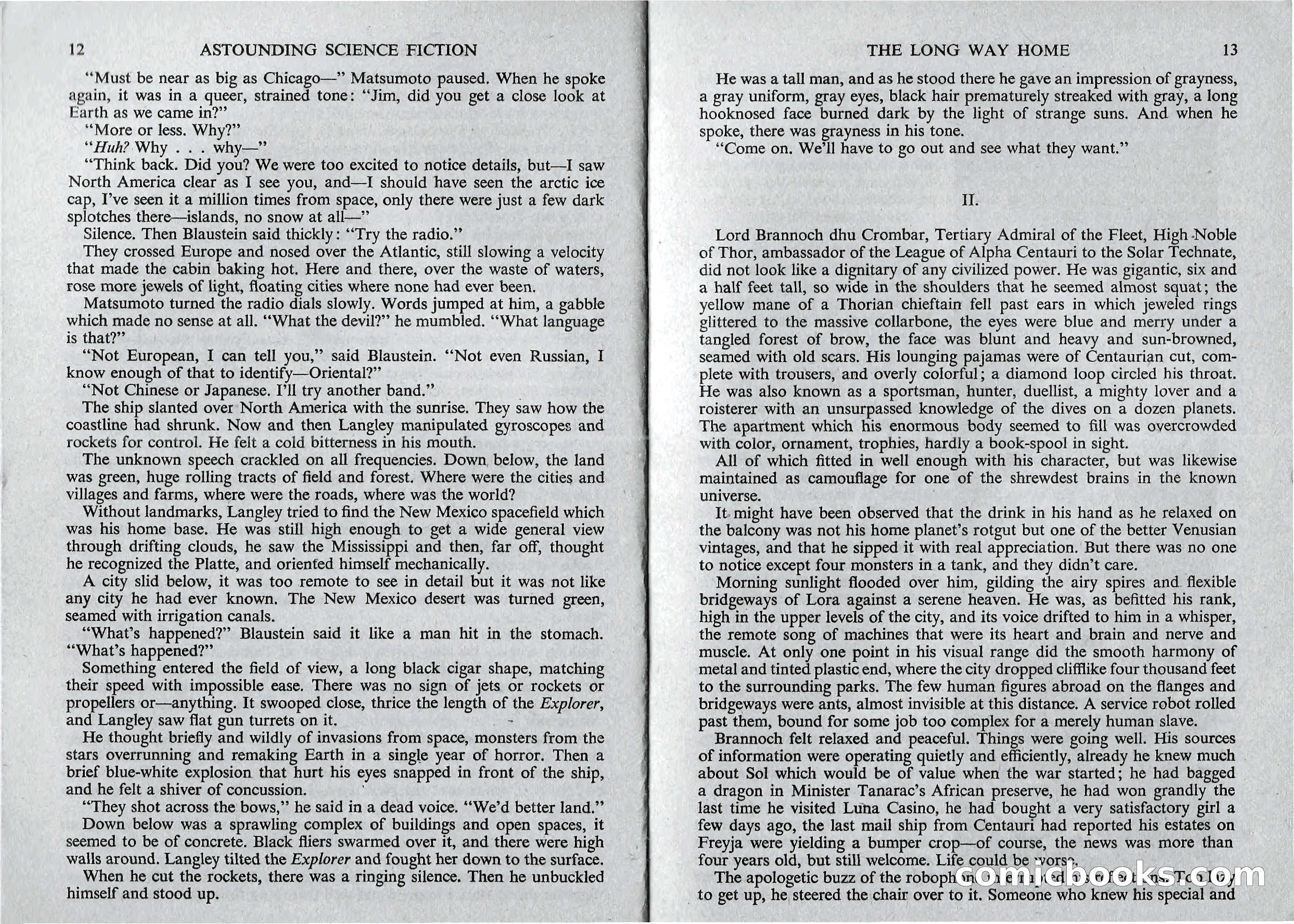
A restored page from Pulp Fiction, 1955. Page through the whole issue in the reader above.
📄 Transcribed text from this page (OCR, searchable)
Machine-transcribed from the original scan — historical spelling and the odd misread are preserved.
12 ASTOUNDING SCIENCE FICTION “Must be near as big as Chicago—” Matsumoto paused, When he spoke again, it was in a queer, strained tone: ‘Jim, did you get a close look at Earth as we came in?” “More or less. Why?” “Huh? Why . . . why— “Think back. Did you? We were too excited to notice details, but—I saw North America clear as I see you, and—I should have seen the arctic ice cap, I’ve seen it a million times from space, only there were just a few dark splotches there—islands, no snow at all—” Silence. Then Blaustein said thickly: “Try the radio.” They crossed Europe and nosed over the Atlantic, still slowing a velocity that made the cabin baking hot. Here and there, over the waste of waters, rose more jewels of light, floating cities where none had ever been. Matsumoto turned the radio dials slowly. Words jumped at him, a gabble which made no sense at all. ““What the devil?”’ he mumbled. “What language is that?” ‘““Not European, I can tell you,” said Blaustein. ““Not even Russian, I know enough of that to identify—Oriental?” “Not Chinese or Japanese. I'll try another band.” The ship slanted over North America with the sunrise. They saw how the coastline had shrunk. Now and then Langley manipulated gyroscopes and rockets for control. He felt a cold bitterness in his mouth. The unknown speech crackled on all frequencies. Down, below, the land was green, huge rolling tracts of field and forest. Where were the cities and villages and farms, where were the roads, where was the world? Without landmarks, Langley tried to find the New Mexico spacefield which was his home base. He was still high enough to get a wide general view through drifting clouds, he saw the Mississippi and then, far off, thought he recognized the Platte, and oriented himself mechanically. A city slid below, it was too remote to see in detail but it was not like any city he had ever known, The New Mexico desert was turned green, seamed with irrigation canals. “What’s happened?” Blaustein said it like a man hit in the stomach. ““What’s happened?” Something entered the field of view, a long black cigar shape, matching their speed with impossible ease. There was no sign of jets or rockets or propellers or—anything. It swooped close, thrice the length of oe Explorer, and Langley saw flat gun turrets on it. He thought briefly and wildly of invasions from space, monsters from the Stars overrunning and remaking Earth in a single year of horror. Then a brief blue-white explosion that hurt his eyes snapped in front of the ship, and he felt a shiver of concussion. ‘“They shot across the bows,” he said in a dead voice. “‘We’d better land.” Down below was a sprawling complex of buildings and open spaces, it seemed to be of concrete. Black fliers swarmed over it, and there were high walls around. Langley tilted the Explorer and fought her down to the surface. When he cut the rockets, there was a ringing silence. Then he unbuckled himself and stood up. 99 THE LONG WAY HOME 13 He was a tall man, and as he stood there he gave an impression of grayness, a gray uniform, gray eyes, black hair prematurely streaked with gray, a long hooknosed face burned dark by the light of strange suns. And when he spoke, there was grayness in his tone. “Come on. We’ll have to go out and see what they want.” IT. Lord Brannoch dhu Crombar, Tertiary Admiral of the Fleet, High -Noble of Thor, ambassador of the League of Alpha Centauri to the Solar Technate, did not look like a dignitary of any civilized power. He was gigantic, six and a half feet tall, so wide in the shoulders that he seemed almost squat; the yellow mane of a Thorian chieftain fell past ears in which jeweled rings glittered to the massive collarbone, the eyes were blue and merry under a tangled forest of brow, the face was blunt and heavy and sun-browned, seamed with old scars. His lounging pajamas were of Centaurian cut, com- plete with trousers, and overly colorful; a diamond loop circled his throat. He was also known as a sportsman, hunter, duellist, a mighty lover and a roisterer with an unsurpassed knowledge of the dives on a dozen planets. The apartment which his enormous body seemed to fill was overcrowded with color, ornament, trophies, hardly a book-spool in sight. All of which fitted in well enough with his character, but was likewise maintained as camouflage for one of the shrewdest brains in the known universe. It. might have been observed that the drink in his hand as he relaxed on the balcony was not his home planet’s rotgut but one of the better Venusian vintages, and that he sipped it with real appreciation. But there was no one to notice except four monsters in a tank, and they didn’t care. Morning sunlight flooded over him, gilding the airy spires and. flexible bridgeways of Lora against a serene heaven. He was, as befitted his rank, high in the upper levels of the city, and its voice drifted to him in a whisper, the remote song of machines that were its heart and brain and nerve and muscle. At only one point in his visual range did the smooth harmony of metal and tinted plastic end, where the city dropped clifflike four thousand feet to the surrounding parks. The few human figures abroad on the flanges and bridgeways were ants, almost invisible at this distance. A service robot rolled past them, bound for some job too complex for a merely human slave. Brannoch felt relaxed and peaceful. Things were going well. His sources of information were operating quietly and efficiently, already he knew much about Sol which would be of value when the war started; he had bagged a dragon in Minister Tanarac’s African preserve, he had won grandly the last time he visited Luna Casino, he had bought a very satisfactory girl a few days ago, the last mail ship from Centauri had reported his estates on Freyja were yielding a bumper crop—of course, the news was more than four years old, but still welcome. Life could be ~vor The apologetic buzz of the roboph % 6 } nicb Tic to get up, he steered the chair over to it. Someone who knew his special and cSCOM