
Pulp Fiction, 1955 · page 5 of 67
Astounding Science Fiction, British Edition — page 5: what you’re looking at
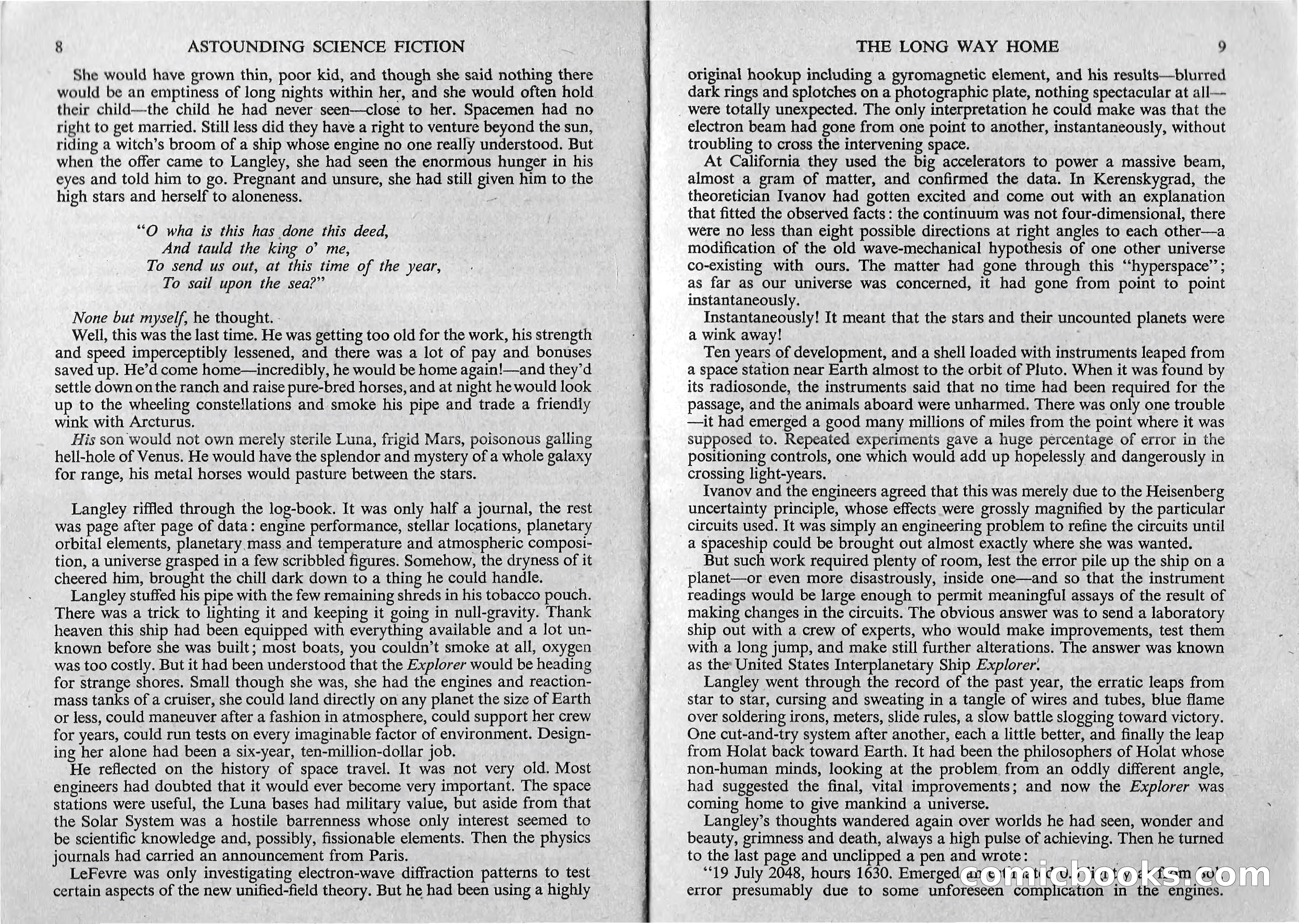
A restored page from Pulp Fiction, 1955. Page through the whole issue in the reader above.
📄 Transcribed text from this page (OCR, searchable)
Machine-transcribed from the original scan — historical spelling and the odd misread are preserved.
8 ASTOUNDING SCIENCE FICTION She would have grown thin, poor kid, and though she said nothing there would be an emptiness of long nights within her, and she would often hold. their child—the child he had never seen—close to her. Spacemen had no right to get married. Still less did they have a right to venture beyond the sun, riding a witch’s broom of a ship whose engine no one really understood. But when the offer came to Langley, she had seen the enormous hunger in his eyes and told him to go. Pregnant and unsure, she had still gen him to the high stars and herself to aloneness. “O wha is this has done this deed, And tauld the king o’ me, To send us out, at this time of the year, To sail upon the sea?” None but myself, he thought. - Well, this was the last time. He was getting too old for the work, his strength and speed imperceptibly lessened, and there was a lot of pay and bonuses saved up. He’d come home—incredibly, he would be home again!—and they'd settle down on the ranch and raise pure-bred horses, and at night he would look | up to the wheeling constellations and smoke his pipe and trade a friendly wink with Arcturus. His son would not own merely sterile Luna, frigid Mars, poisonous galling hell-hole of Venus. He would have the splendor and mystery of a whole galaxy for range, his metal horses would pasture between the stars. Langley riffled through the log-book. It was only half a journal, the rest was page after page of data: engine performance, stellar locations, planetary orbital elements, planetary mass and temperature and atmospheric composi- tion, a universe grasped in a few scribbled figures. Somehow, the dryness of it cheered him, brought the chill dark down to a thing he could handle. Langley stuffed his pipe with the few remaining shreds in his tobacco pouch. There was a trick to lighting it and keeping it going in null-gravity. Thank heaven this ship had been equipped with everything available and a lot un- known before she was built; most boats, you couldn’t smoke at all, oxygen was too costly. But it had been understood that the Explorer would be heading for strange shores. Small though she was, she had the engines and reaction- mass tanks of a cruiser, she could land directly on any planet the size of Earth or less, could maneuver after a fashion in atmosphere, could support her crew for years, could run tests on every imaginable factor of environment. Design- ing her alone had been a six-year, ten-million-dollar job. He reflected on the history of space travel. It was not very old. Most engineers had doubted that it would ever become very important. The space stations were useful, the Luna bases had military value, but aside from that the Solar System was a hostile barrenness whose only interest seemed to be scientific knowledge and, possibly, fissionable elements. Then the physics journals had carried an announcement from Paris. : LeFevre was only investigating electron-wave diffraction patterns to test certain aspects of the new unified-field theory. But he had been using a highly THE LONG WAY HOME 9 original hookup including a gyromagnetic element, and his results—blurred dark rings and splotches on a photographic plate, nothing spectacular at all— were totally unexpected. The only interpretation he could make was that the electron beam had gone from one point to another, instantaneously, without troubling to cross the intervening space. At California they used the big accelerators to power a massive beam, almost a gram of matter, and confirmed the data. In Kerenskygrad, the theoretician Ivanov had gotten excited and come out with an explanation that fitted the observed facts : the continuum was not four-dimensional, there were no less than eight possible directions at right angles to each other—a modification of the old wave-mechanical hypothesis of one other universe co-existing with ours. The matter had gone through this “hyperspace”’; as far as our universe was concerned, it had gone from point to point instantaneously, Instantaneously! It meant that the stars and their uncounted planets were a wink away! Ten years of development, and a shell loaded with instruments leaped from a space station near Earth almost to the orbit of Pluto. When it was found by its radiosonde, the instruments said that no time had been required for the passage, and the animals aboard were unharmed. There was only one trouble —it had emerged a good many millions of miles from the point where it was supposed to. Repeated experiments gave a huge percentage of error in the positioning controls, one which would add up hopelessly and dangerously in crossing light-years. Ivanov and the engineers agreed that this was merely due to the Heisenberg uncertainty principle, whose effects were grossly magnified by the particular circuits used. It was simply an engineering problem to refine the circuits until a spaceship could be brought out almost exactly where she was wanted. But such work required plenty of room, lest the error pile up the ship on a planet—or even more disastrously, inside one—and so that the instrument readings would be large enough to permit meaningful assays of the result of making changes in the circuits. The obvious answer was to send a laboratory ship out with a crew of experts, who would make improvements, test them with a long jump, and make still further alterations. The answer was known as the United States Interplanetary Ship Explorer. Langley went through the record of the past year, the erratic leaps from star to star, cursing and sweating in a tangle of wires and tubes, blue flame over soldering irons, meters, slide rules, a slow battle slogging toward victory. One cut-and-try system after another, each a little better, and finally the leap from Holat back toward Earth. It had been the philosophers of Holat whose non-human minds, looking at the problem from an oddly different angle, had suggested the final, vital improvements; and now the Explorer was coming home to give mankind a universe. Langley’s thoughts wandered again over worlds he had seen, wonder and beauty, grimness and death, always a high pulse of achieving. Then he turned to the last page and unclipped a pen and wrote: “19 July 2048, hours 1630. Emerged/ ai © }l 4 ¢ t C = DOOKS OC error presumably due to some unforeseen complication in yKs engines.