
Pulp Fiction, 1955 · page 49 of 67
Astounding Science Fiction, British Edition — page 49: what you’re looking at
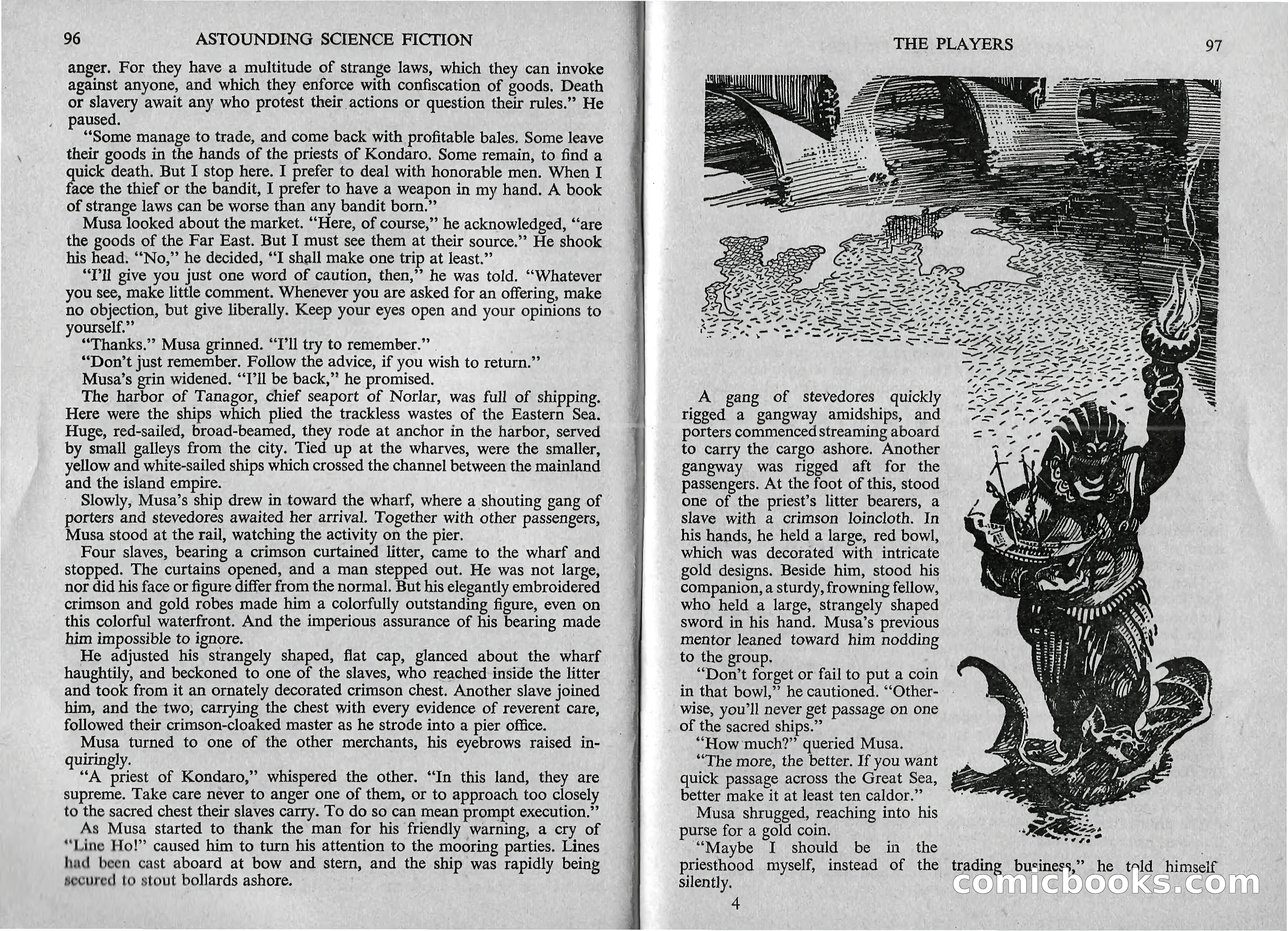
A restored page from Pulp Fiction, 1955. Page through the whole issue in the reader above.
📄 Transcribed text from this page (OCR, searchable)
Machine-transcribed from the original scan — historical spelling and the odd misread are preserved.
96 ASTOUNDING SCIENCE FICTION anger. For they have a multitude of strange laws, which they can invoke against anyone, and which they enforce with confiscation of goods. Death or slavery await any who protest their actions or question their rules.” He aused. : “Some manage to trade, and come back with profitable bales. Some leave their goods in the hands of the priests of Kondaro. Some remain, to find a quick death. But I stop here. I prefer to deal with honorable men. When I face the thief or the bandit, I prefer to have a weapon in my hand. A book of strange laws can be worse than any bandit born.” Musa looked about the market. “Here, of course,” he acknowledged, “‘are the goods of the Far East. But I must see them at their source.’’ He shook his head. “‘No,” he decided, “I shall make one trip at least.” “Tl give you just one word of caution, then,” he was told. “‘Whatever you see, make little comment. Whenever you are asked for an offering, make no objection, but give liberally. Keep your eyes open and your opinions to yourself.” | ““Thanks.”’ Musa grinned. “I'll try to remember.” | | “Don’t just remember. Follow the advice, if you wish to return.”’ Musa’s grin widened. “‘I’ll be back,”’ he promised. The harbor of Tanagor, chief seaport of Norlar, was full of shipping. Here were the ships which plied the trackless wastes of the Eastern Sea. Huge, red-sailed, broad-beamed, they rode at anchor in the harbor, served by small galleys from the city. Tied up at the wharves, were the smaller, yellow and white-sailed ships which crossed the channel between the mainland and the island empire. Slowly, Musa’s ship drew in toward the wharf, where a shouting gang of porters and stevedores awaited her arrival. Together with other passengers, Musa stood at the rail, watching the activity on the pier. Four slaves, bearing a crimson curtained litter, came to the wharf and stopped. The curtains opened, and a man stepped out. He was not large, nor did his face or figure differ from the normal. But his elegantly embroidered crimson and gold robes made him a colorfully outstanding figure, even on this colorful waterfront. And the imperious assurance of his bearing made him impossible to ignore. He adjusted his strangely shaped, flat cap, glanced about the wharf haughtily, and beckoned to one of the slaves, who reached inside the litter and took from it an ornately decorated crimson chest. Another slave joined him, and the two, carrying the chest with every evidence of reverent care, followed their crimson-cloaked master as he strode into a pier office. Musa turned to one of the other merchants, his eyebrows raised in- quiringly. “A priest of Kondaro,”’ whispered the other. “In this land, they are supreme. Take care never to anger one of them, or to approach too closely to the sacred chest their slaves carry. To do so can mean prompt execution.” As Musa started to thank the man for his friendly warning, a cry of “Line Ho!” caused him to turn his attention to the mooring parties. Lines had been cast aboard at bow and stern, and the ship was rapidly being secured to stout bollards ashore. THE PLAYERS A gang of stevedores quickly rigged a gangway amidships, and porters commenced streaming aboard to carry the cargo ashore. Another gangway was rigged aft for the passengers. At the foot of this, stood one of the priest’s litter bearers, a Slave with a crimson loincloth. In his hands, he held a large, red bowl, which was decorated with intricate gold designs. Beside him, stood his companion, a sturdy, frowning fellow, who held a large, strangely shaped sword in his hand. Musa’s previous mentor leaned toward him nodding to the group. “Don’t forget or fail to put a coin in that bowl,” he cautioned. “‘Other- wise, you’ll never get passage on one of the sacred ships.” “How much?” queried Musa. “The more, the better. If you want quick passage across the Great Sea, better make it at least ten caldor.” Musa shrugged, reaching into his purse for a gold coin, “Maybe I should be in the priesthood myself, instead of the silently. 4 sate TTT Lhe 44% ‘a / bay ' . , . ( -_ ‘ 1 Y x \ = aA ~”“ - Pi asrstrnzevs Oy usiness,” he t id “himaele (Ee) eee) cS