
Pulp Fiction, 1955 · page 46 of 67
Astounding Science Fiction, British Edition — page 46: what you’re looking at
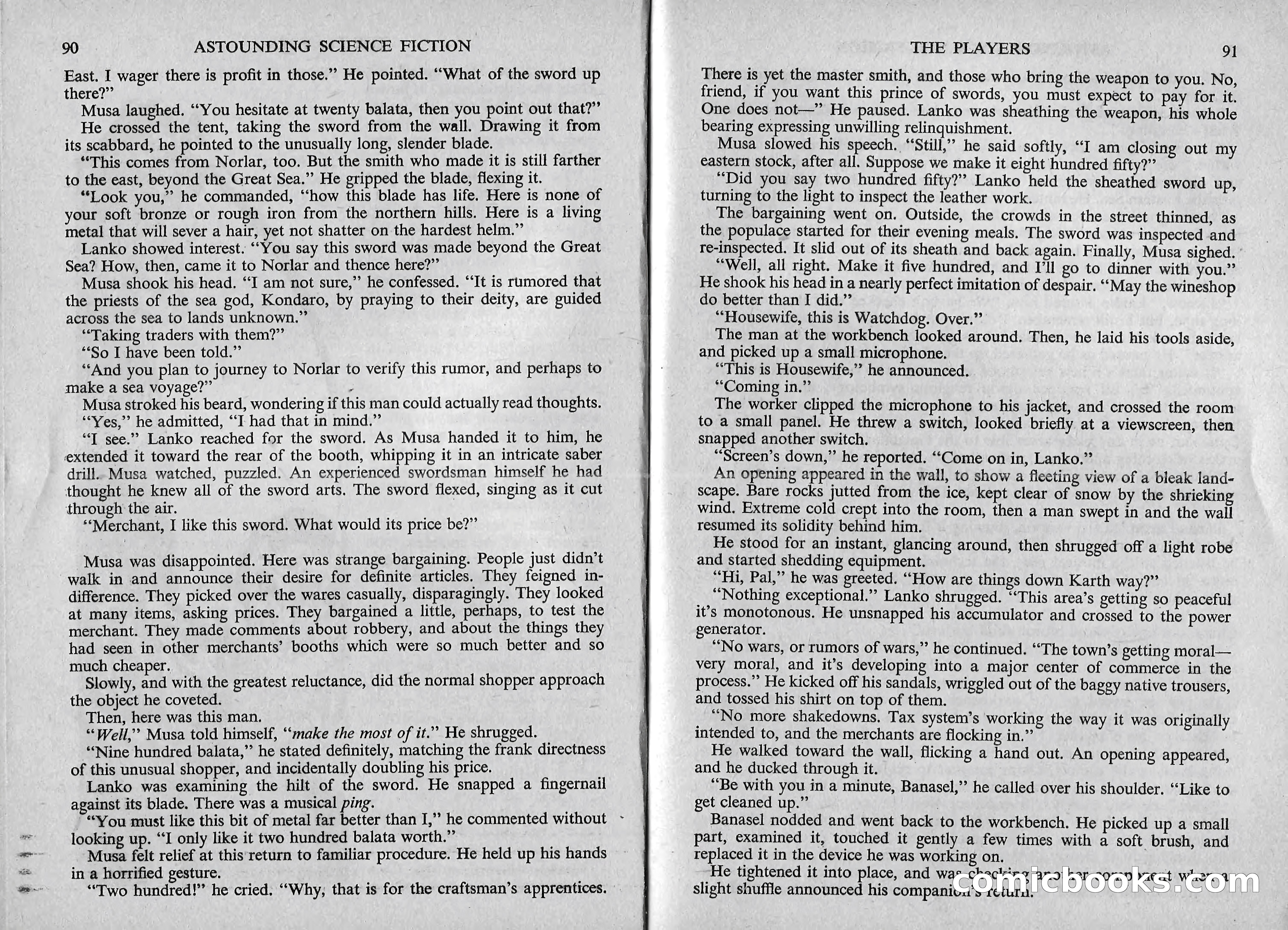
A restored page from Pulp Fiction, 1955. Page through the whole issue in the reader above.
📄 Transcribed text from this page (OCR, searchable)
Machine-transcribed from the original scan — historical spelling and the odd misread are preserved.
90 ASTOUNDING SCIENCE FICTION East. I wager there is profit in those.” He pointed. “What of the sword up there?” Musa laughed. “You hesitate at twenty balata, then you point out that?” He crossed the tent, taking the sword from the wall. Drawing it from its scabbard, he pointed to the unusually long, slender blade. “This comes from Norlar, too. But the smith who made it is still farther to the east, beyond the Great Sea.”’ He gripped the blade, flexing it. “Look you,” he commanded, “how this blade has life. Here is none of your soft bronze or rough iron from the northern hills. Here is a living metal that will sever a hair, yet not shatter on the hardest helm.” Lanko showed interest. ‘““You say this sword was made beyond the Great Sea? How, then, came it to Norlar and thence here?”’ Musa shook his head. “I am not sure,”’ he confessed. “‘It is rumored that the priests of the sea god, Kondaro, by praying to their deity, are guided across the sea to lands unknown.” “Taking traders with them?” “So I have been told.” ; ‘And you plan to journey to Norlar to verify this rumor, and perhaps to make a sea voyage?” ; Musa stroked his beard, wondering if this man could actually read thoughts. ‘““Yes,”’ he admitted, “I had that in mind.” “IT see.” Lanko reached for the sword. As Musa handed it to him, he extended it toward the rear of the booth, whipping it in an intricate saber drill. Musa watched, puzzled. An experienced swordsman himself he had thought he knew all of the sword arts. The sword flexed, singing as it cut through the air. ‘‘Merchant, I like this sword. What would its price be?” Musa was disappointed. Here was strange bargaining. People just didn’t walk in and announce their desire for definite articles. They feigned in- difference. They picked over the wares casually, disparagingly. They looked at many items, asking prices. They bargained a little, perhaps, to test the merchant. They made comments about robbery, and about the things they had seen in other merchants’ booths which were so much better and so much cheaper. Slowly, and with the greatest reluctance, did the normal shopper approach the object he coveted. Then, here was this man. “Well,” Musa told himself, “make the most of it.” He shrugged. _ “Nine hundred balata,” he stated definitely, matching the frank directness of this unusual shopper, and incidentally doubling his price. Lanko was examining the hilt of the sword. He snapped a fingernail against its blade. There was a musical ping. ; “You must like this bit of metal far better than od he commented without looking up. “I only like it two hundred balata worth.” rns fete relief at this'return to familiar procedure. He held up his hands in a horrified gesture. “Two hundred!’ he cried. “Why; that is for the craftsman’s apprentices. — THE PLAYERS 91 There is yet the master smith, and those who bring the weapon to you. No, friend, if you want this prince of swords, you must expect to pay for it. One does not—” He paused. Lanko was sheathing the weapon, his whole bearing expressing unwilling relinquishment. Musa slowed his speech. “‘Still,”’ he said softly, “I am closing out my eastern stock, after all. Suppose we make it eight hundred fifty?” “Did you say two hundred fifty?” Lanko held the sheathed sword up, turning to the light to inspect the leather work. The bargaining went on. Outside, the crowds in the street thinned, as the populace started for their evening meals. The sword was inspected and re-inspected. It slid out of its sheath and back again. Finally, Musa sighed. “Well, all right. Make it five hundred, and I'll go to dinner with you.” He shook his head in a nearly perfect imitation of despair. ““May the wineshop do better than I did.” “Housewife, this is Watchdog. Over.” The man at the workbench looked around. Then, he laid his tools aside, and picked up a small microphone. “This is Housewife,” he announced. “Coming in.” The worker clipped the microphone to his jacket, and crossed the room to a small panel. He threw a switch, looked briefly at a viewscreen, then snapped another switch. “Screen’s down,” he reported. “Come on in, Lanko.” An opening appeared in the wall, to show a fleeting view of a bleak land- scape. Bare rocks jutted from the ice, kept clear of snow by the shrieking wind. Extreme cold crept into the room, then a man swept in and the wall resumed its solidity behind him. , He stood for an instant, glancing around, then shrugged off a light robe and started shedding equipment. “Hi, Pal,”’ he was greeted. ‘““How are things down Karth way?” ~ Nothing exceptional.” Lanko shrugged. “This area’s getting so peaceful it’s monotonous. He unsnapped his accumulator and crossed to the power generator. “No wars, or rumors of wars,” he continued. ‘The town’s getting moral— very moral, and it’s developing into a major center of commerce in the process.” He kicked off his sandals, wriggled out of the baggy native trousers, and tossed his shirt on top of them. | “No more shakedowns. Tax system’s working the way it was originally intended to, and the merchants are flocking in.” He walked toward the wall, flicking a hand out. An opening appeared, and he ducked through it. | “Be with you in a minute, Banasel,’’ he called over his shoulder. “Like to get cleaned up.” | Banasel nodded and went back to the workbench. He picked up a small part, examined it, touched it gently a few times with a soft brush, and replaced it in the device he was working on. He tightened it into place, and was-chact | slight shuffle announced his 7s COMIC 8) D D <S ‘com