
Pulp Fiction, 1955 · page 43 of 67
Astounding Science Fiction, British Edition — page 43: what you’re looking at
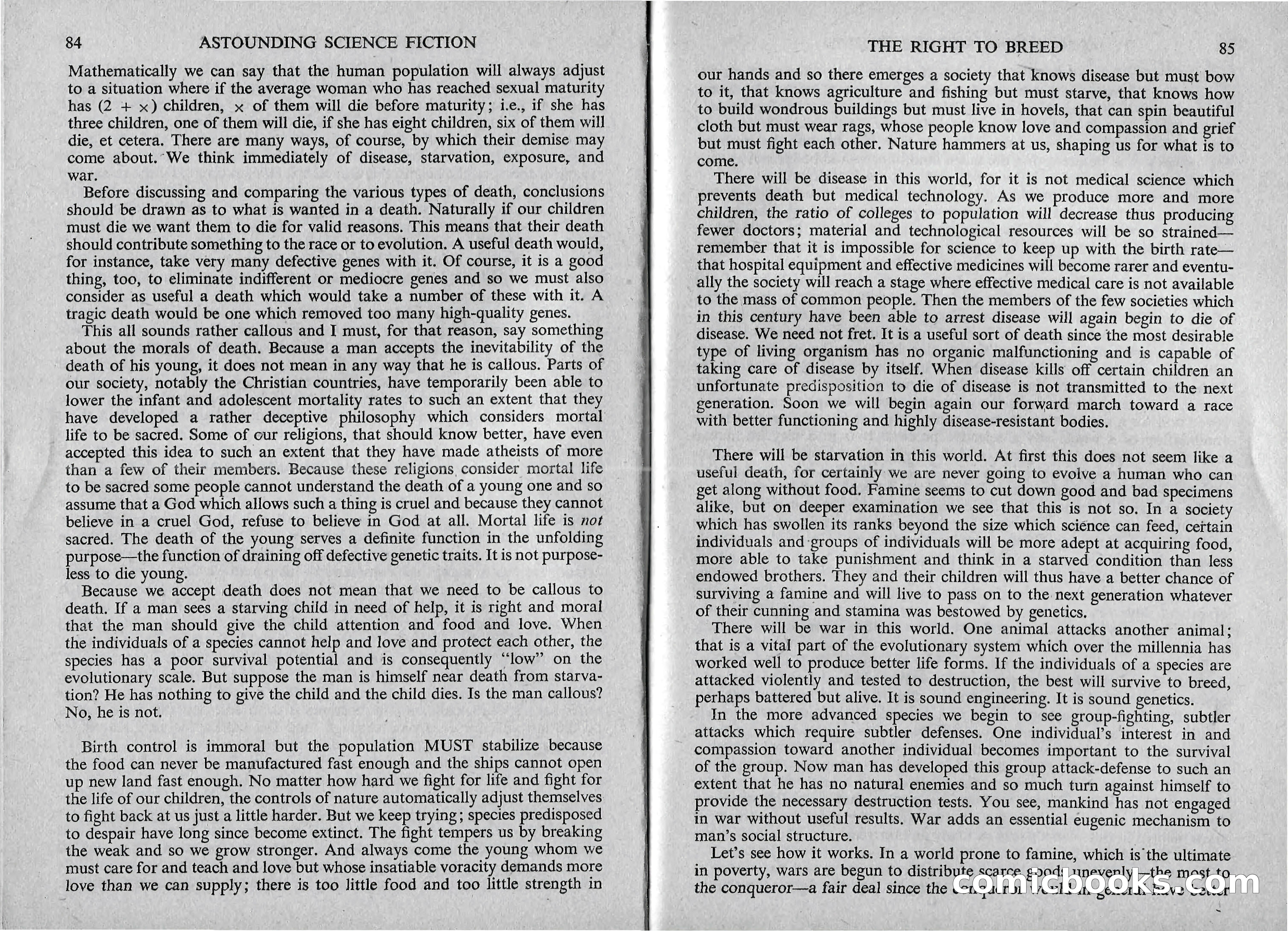
A restored page from Pulp Fiction, 1955. Page through the whole issue in the reader above.
📄 Transcribed text from this page (OCR, searchable)
Machine-transcribed from the original scan — historical spelling and the odd misread are preserved.
84 ASTOUNDING SCIENCE FICTION Mathematically we can say that the human population will always adjust to a situation where if the average woman who has reached sexual maturity has (2 + x) children, x of them will die before maturity; i.e., if she has three children, one of them will die, if she has eight children, six of them will die, et cetera. There are many ways, of course, by which their demise may come about." We think immediately of disease, starvation, exposure, and war. Before discussing and comparing the various types of death, conclusions should be drawn as to what is wanted in a death. Naturally if our children must die we want them to die for valid reasons. This means that their death should contribute something to the race or to evolution. A useful death would, for instance, take very many defective genes with it. Of course, it is a good thing, too, to eliminate indifferent or mediocre genes and so we must also consider as useful a death which would take a number of these with it. A tragic death would be one which removed too many high-quality genes. This all sounds rather callous and I must, for that reason, say something about the morals of death. Because a man accepts the inevitability of the death of his young, it does not mean in any way that he is callous. Parts of our society, notably the Christian countries, have temporarily been able to lower the infant and adolescent mortality rates to such an extent that they have developed a rather deceptive philosophy which considers mortal life to be sacred. Some of our religions, that should know better, have even accepted this idea to such an extent that they have made atheists of more than a few of their members. Because these religions consider mortal life to be sacred some people cannot understand the death of a young one and so assume that a God which allows such a thing is cruel and because they cannot believe in a cruel God, refuse to believe in God at all. Mortal life is not sacred. The death of the young serves a definite function in the unfolding purpose—the function of draining off defective genetic traits. It is not purpose- less to die young. Because we accept death does not mean that we need to be callous to death. If a man sees a starving child in need of help, it is right and moral that the man should give the child attention and food and love. When the individuals of a species cannot help and love and protect each other, the species has a poor survival potential and is consequently “low” on the evolutionary scale. But suppose the man is himself near death from starva- tion? He has nothing to give the child and the child dies. Is the man callous? No, he is not. Birth control is immoral but the population MUST stabilize because the food can never be manufactured fast enough and the ships cannot open up new land fast enough. No matter how hard we fight for life and fight for the life of our children, the controls of nature automatically adjust themselves to fight back at us just a little harder. But we keep trying; species predisposed to despair have long since become extinct. The fight tempers us by breaking the weak and so we grow stronger. And always come the young whom we must care for and teach and love but whose insatiable voracity demands more love than we can supply; there is too little food and too little strength in THE RIGHT TO BREED 85 our hands and so there emerges a society that knows disease but must bow to it, that knows agriculture and fishing but must starve, that knows how to build wondrous buildings but must live in hovels, that can spin beautiful cloth but must wear rags, whose people know love and compassion and grief but must fight each other. Nature hammers at us, shaping us for what is to come. | There will be disease in this world, for it is not medical science which prevents death but medical technology. As we produce more and more children, the ratio of colleges to population will decrease thus producing fewer doctors; material and technological resources will be so strained— remember that it is impossible for science to keep up with the birth rate— that hospital equipment and effective medicines will become rarer and eventu- ally the society will reach a stage where effective medical care is not available to the mass of common people. Then the members of the few societies which in this century have been able to arrest disease will again begin to die of disease. We need not fret. It is a useful sort of death since the most desirable type of living organism has no organic malfunctioning and is capable of taking care of disease by itself. When disease kills off certain children an unfortunate predisposition to die of disease is not transmitted to the next generation. Soon we will begin again our forward march toward a race with better functioning and highly disease-resistant bodies. There will be starvation in this world. At first this does not seem like a useful death, for certainly we are never going to evolve a human who can get along without food. Famine seems to cut down good and bad specimens alike, but on deeper examination we see that this is not so. In a society which has swollen its ranks beyond the size which science can feed, certain individuals and ‘groups of individuals will be more adept at acquiring food, more able to take punishment and think in a starved condition than less endowed brothers. They and their children will thus have a better chance of surviving a famine and will live to pass on to the next generation whatever of their cunning and stamina was bestowed by genetics. There will be war in this world. One animal attacks another animal; that is a vital part of the evolutionary system which over the millennia has worked well to produce better life forms. If the individuals of a species are attacked violently and tested to destruction, the best will survive to breed, perhaps battered but alive. It is sound engineering. It is sound genetics. In the more advanced species we begin to see group-fighting, subtler attacks which require subtler defenses. One individual’s interest in and compassion toward another individual becomes important to the survival of the group. Now man has developed this group attack-defense to such an extent that he has no natural enemies and so much turn against himself to provide the necessary destruction tests. You see, mankind has not engaged in war without useful results. War adds an essential eugenic mechanism to man’s social structure. Let’s see how it works. In a world prone to famine, which is the ultimate in poverty, wars are begun to distribpte ‘e neve the conqueror—a fair deal since the com jopore,