
Pulp Fiction, 1955 · page 32 of 67
Astounding Science Fiction, British Edition — page 32: what you’re looking at
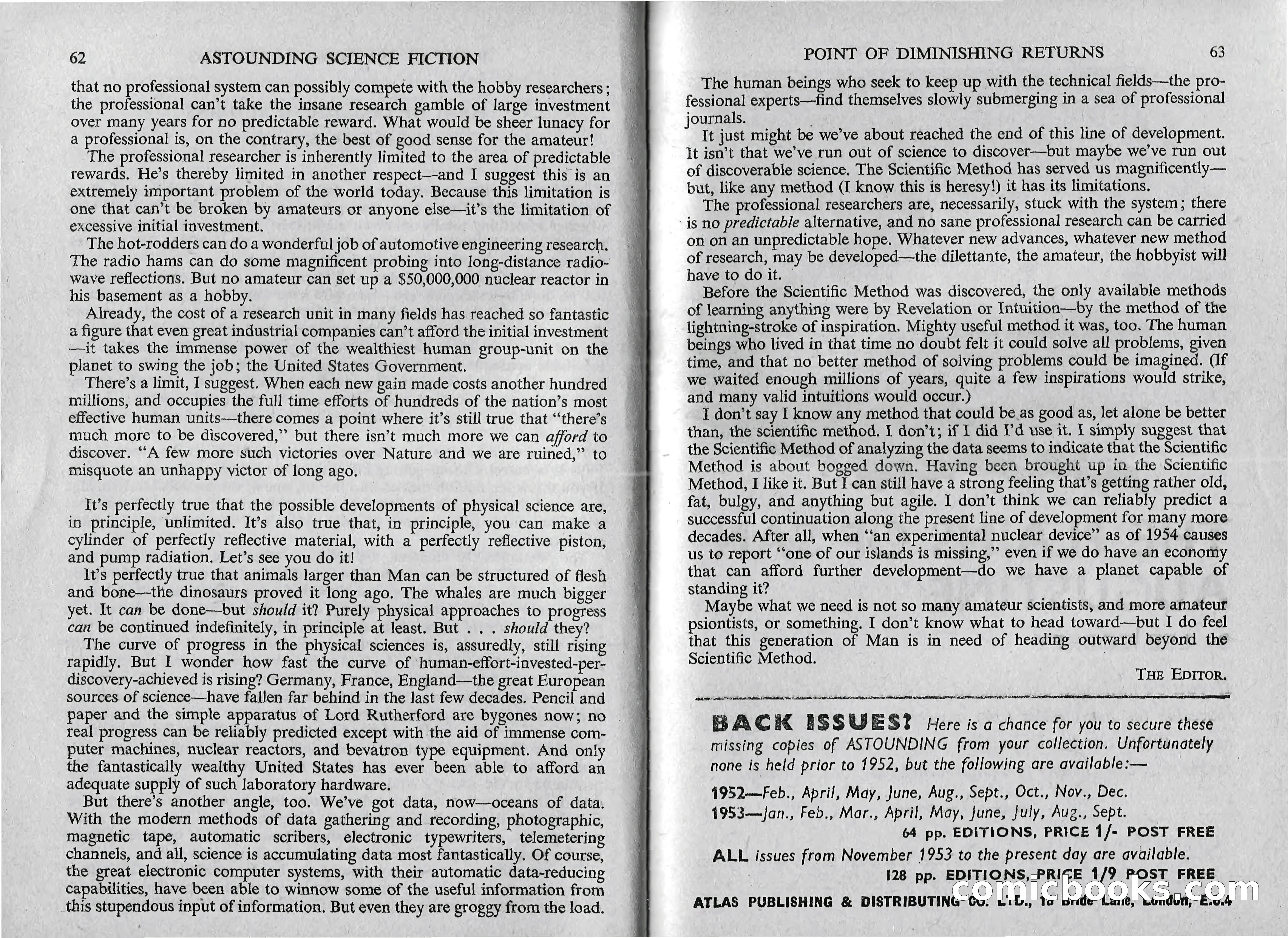
A restored page from Pulp Fiction, 1955. Page through the whole issue in the reader above.
📄 Transcribed text from this page (OCR, searchable)
Machine-transcribed from the original scan — historical spelling and the odd misread are preserved.
62 ASTOUNDING SCIENCE FICTION that no professional system can possibly compete with the hobby researchers ; the professional can’t take the insane research gamble of large investment over many years for no predictable reward. What would be sheer lunacy for a professional is, on the contrary, the best of good sense for the amateur! The professional researcher is inherently limited to the area of predictable rewards, He’s thereby limited in another respect—and I suggest this is an extremely important problem of the world today. Because this limitation is one that can’t be broken by amateurs or anyone else—it’s the limitation of excessive initial investment. . The hot-rodders can do a wonderful job of automotive engineering research. The radio hams can do some magnificent probing into long-distance radio- wave reflections, But no amateur can set up a $50,000,000 nuclear reactor in his basement as a hobby. Already, the cost of a research unit in many fields has reached so fantastic a figure that even great industrial companies can’t afford the initial investment —it takes the immense power of the wealthiest human group-unit on the planet to swing the job; the United States Government. There’s a limit, I suggest. When each new gain made costs another hundred millions, and occupies the full time efforts of hundreds of the nation’s most effective human units—there comes a point where it’s still true that “‘there’s much more to be discovered,” but there isn’t much more we can afford to discover. ““A few more such victories over Nature and we are ruined,” to misquote an unhappy victor of long ago. It’s perfectly true that the possible developments of physical science are, in principle, unlimited. It’s also true that, in principle, you can make a cylinder of perfectly reflective material, with a perfectly reflective piston, and pump radiation. Let’s see you do it! It’s perfectly true that animals larger than Man can be structured of flesh and bone-——the dinosaurs proved it long ago. The whales are much bigger yet. It can be done—but should it? Purely physical approaches to progress can be continued indefinitely, in principle at least. But . . . should they? The curve of progress in the physical sciences is, assuredly, still rising rapidly. But I wonder how fast the curve of human-effort-invested-per- discovery-achieved is rising? Germany, France, England—the great European sources of science—have fallen far behind in the last few decades. Pencil and paper and the simple apparatus of Lord Rutherford are bygones now; no | real progress can be reliably predicted except with the aid of immense com- puter machines, nuclear reactors, and bevatron type equipment. And only the fantastically wealthy United States has ever been able to afford an adequate supply of such laboratory hardware. But there’s another angle, too. We’ve got data, now—oceans of data. With the modern methods of data gathering and recording, photographic, magnetic tape, automatic scribers, electronic typewriters, telemetering channels, and all, science is accumulating data most fantastically. Of course, the great electronic computer systems, with their automatic data-reducing capabilities, have been able to winnow some of the useful information from this stupendous input of information. But even they are grogey from the load. POINT OF DIMINISHING RETURNS 63 The human beings who seek to keep up with the technical fields—the pro- fessional experts—find themselves slowly submerging in a sea of professional journals. It just might be we’ve about reached the end of this line of development. It isn’t that we’ve run out of science to discover—but maybe we've run out of discoverable science. The Scientific Method has served us magnificently— but, like any method (I know this is heresy!) it has its limitations, The professional researchers are, necessarily, stuck with the system; there is no predictable alternative, and no sane professional research can be carried on on an unpredictable hope. Whatever new advances, whatever new method of research, may be developed—the dilettante, the amateur, the hobbyist will have to do it. — Before the Scientific Method was discovered, the only available methods of learning anything were by Revelation or Intuition—by the method of the lightning-stroke of inspiration. Mighty useful method it was, too. The human beings who lived in that time no doubt felt it could solve all problems, given time, and that no better method of solving problems could be imagined. (If we waited enough millions of years, quite a few inspirations would strike, and many valid intuitions would occur.) I don’t say I know any method that could be as good as, let alone be better than, the scientific method. 1 don’t; if 1 did Vd use it. L simply suggest that the Scientific Method of analyzing the data seems to indicate that the Scientific Method is about bogged down. Having been brought up in the Scientific Method, I like it. But I can still have a strong feeling that’s getting rather old, fat, bulgy, and anything but agile. I don’t think we can reliably predict a successful continuation along the present line of development for many more decades. After all, when “‘an experimental nuclear device” as of 1954 causes us to report ‘“‘one of our islands is missing,” even if we do have an economy that can afford further development—do we have a planet capable of standing it? Maybe what we need is not so many amateur scientists, and more amateur psiontists, or something. I don’t know what to head toward—but I do feel that this generation of Man is in need of heading outward beyond the Scientific Method. | _ THE Eprror, EACH EFSSUWES? Here is a chance for you to secure these missing copies of ASTOUNDING from your collection. Unfortunately none is held prior to 1952, but the following are available:— 1952—Feb., April, May, June, Aug., Sept., Oct., Nov., Dec. 1953—Jan., Feb., Mar., April, May, June, July, Aug., Sept. 64 pp. EDITIONS, PRICE 1/- POST FREE ALL issues from November 1953 to the present day are available. 128 pp. ‘comicb 1/9 ksicc 0 roo) @ ATLAS PUBLISHING & Scans = EO i) iC e, “com