
Pulp Fiction, 1955 · page 24 of 67
Astounding Science Fiction, British Edition — page 24: what you’re looking at
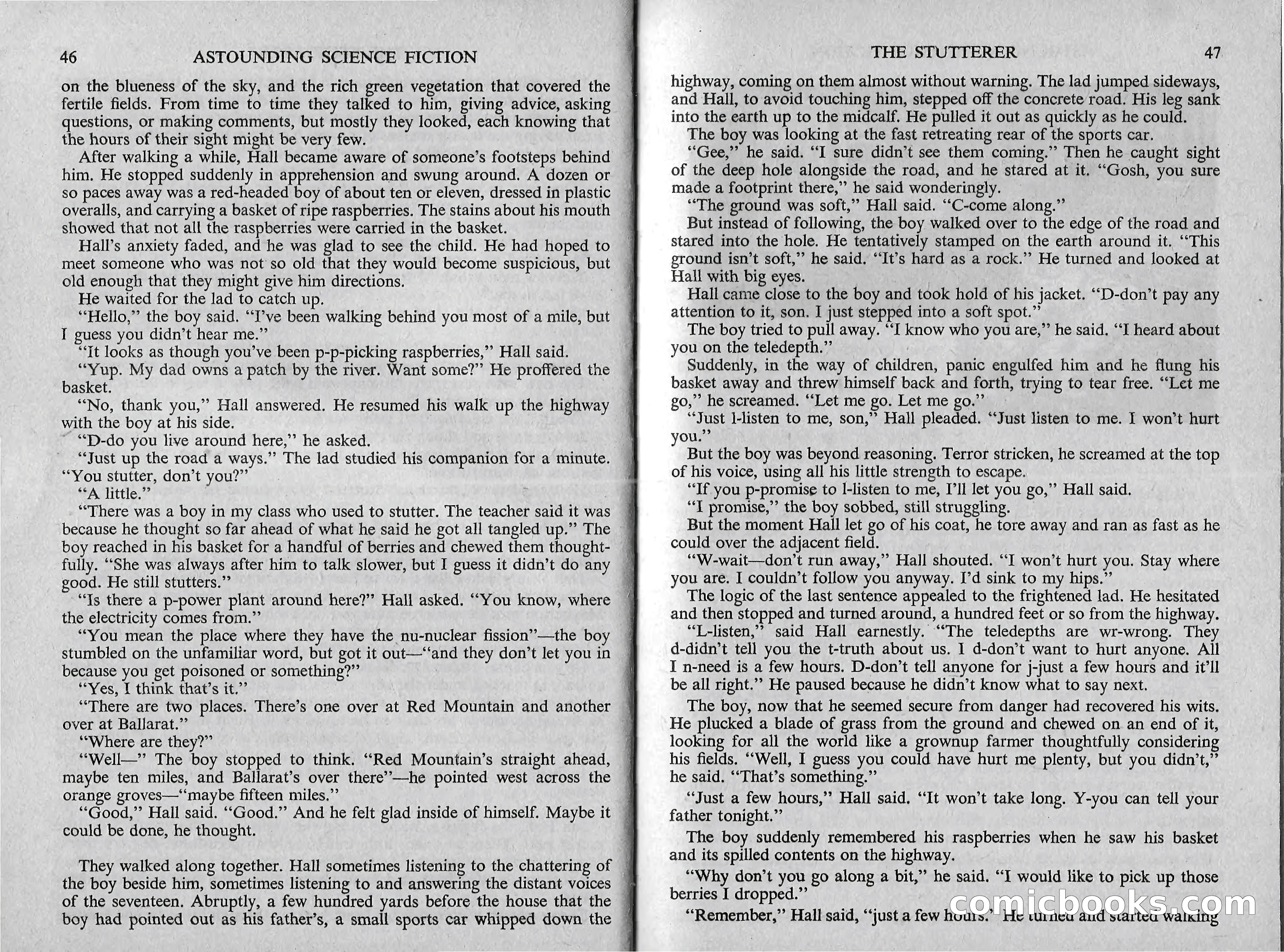
A restored page from Pulp Fiction, 1955. Page through the whole issue in the reader above.
📄 Transcribed text from this page (OCR, searchable)
Machine-transcribed from the original scan — historical spelling and the odd misread are preserved.
46 ASTOUNDING SCIENCE FICTION on the blueness of the sky, and the rich green vegetation that covered the fertile fields. From time to time they talked to him, giving advice, asking questions, or making comments, but mostly they looked, each knowing that the hours of their sight might be very few. After walking a while, Hall became aware of someone’s footsteps behind him. He stopped suddenly in apprehension and swung around. A dozen or SO paces away was a red-headed boy of about ten or eleven, dressed in plastic overalls, and carrying a basket of ripe raspberries. The stains about his mouth showed that not all the raspberries were carried in the basket. Hall’s anxiety faded, and he was glad to see the child. He had hoped to meet someone who was not so old that they would become suspicious, but old enough that they might give him directions. He waited for the lad to catch up. “Hello,” the boy said. “T've been walking behind you most of a mile, but I guess you didn’t hear me.’ “It looks as though you've been p-p-picking raspberries,” Hall said. “Yup. My dad owns a patch by the river. Want some?”’ He proffered the basket. ‘No, thank you,” Hall answered. He resumed his walk up the highway with the boy at his side. _ “P-do you live around here,”’ he asked. “Just up the road a ways.” The lad studied his companion for a minute. “You stutter, don’t you?” **A little.” “There was a boy in my class who used to stutter. The teacher said it was because he thought so far ahead of what he said he got all tangled up.” The boy reached in his basket for a handful of berries and chewed them thought- fully. “She was always | after him to talk slower, but I guess it didn’t do any good. He still stutters.” “Ts there a p-power plant around here?” Hall asked. “You know, where the electricity comes from.” “You mean the place where they have the nu-nuclear fission”—the boy stumbled on the unfamiliar word, but got it out—‘“‘and they don’t let you in because you get poisoned or something?” “Yes, I think that’s it.” “There are two places. There’s one over at Red Mountain and another over at Ballarat.’ ‘Where are they?” “Well—”’ The boy stopped to think. “Red Mountain’s straight ahead, maybe ten miles, and Ballarat’s over there’—-he pointed west across the orange groves—‘‘maybe fifteen miles.”’ “Good,” Hall said. “Good.” And he felt glad inside of himself. Maybe it could be done, he thought. They walked along together. Hall sometimes listening to the chattering of j the boy beside him, sometimes listening to and answering the distant voices of the seventeen. Abruptly, a few hundred yards before the house that the } boy had pointed out as his father’s, a small sports car whipped down the THE STUTTERER 47 highway, coming on them almost without warning. The lad jumped sideways, and Hall, to avoid touching him, stepped off the concrete road. His leg sank into the earth up to the midcalf. He pulled it out as quickly as he could. The boy was looking at the fast retreating rear of the sports car. “Gee,” he said. “I sure didn’t see them coming.” Then he caught sight of the deep hole alongside the road, and he stared at it. “Gosh, you sure made a footprint there,” he said wonderingly. “The ground was soft,” Hall said. ““C-come along.” But instead of following, the boy walked over to the edge of the road and stared into the hole. He tentatively stamped on the earth around it. ‘“This ground isn’t soft,” he said. “It’s hard as a rock.’ He turned and looked at Hall with big eyes. Hall came close to the boy and took hold of his jacket. ““D-don’t pay any attention to it, son. I just stepped into a soft spot.” The boy tried to pull away. “I know who you are,” he said. “I heard about you on the teledepth.” Suddenly, in the way of children, panic engulfed him and he flung his basket away and threw himself back and forth, trying to tear free. “Let me go,” he screamed. “Let me go. Let me go.” “Just I-listen to me, son,” Hall pleaded. “Just listen to me. I won't hurt ou.” : But the boy was beyond reasoning. Terror stricken, he screamed at the top of his voice, using all his little strength to escape. “If you Pp-promise to I-listen to me, I’ll let you go,” Hall said. “I promise,” the boy sobbed, still struggling. But the moment Hall let go of his coat, he tore away and ran as fast as he could over the adjacent field. ‘““W-wait—don’t run away,” Hall shouted. “I won’t hurt you. Stay where you are. I couldn’t follow you anyway. I'd sink to my hips.” The logic of the last sentence appealed to the frightened lad. He hesitated and then stopped and turned around, a hundred feet or so from the highway. “L-listen,’’ said Hall earnestly. ““The teledepths are wr-wrong. They d-didn’t tell you the t-truth about us. I d-don’t want to hurt anyone. All I n-need is a few hours. D-don’t tell anyone for j-just a few hours and it’ll be all right.”” He paused because he didn’t know what to say next. The boy, now that he seemed secure from danger had recovered his wits. He plucked a blade of grass from the ground and chewed on an end of it, looking for all the world like a grownup farmer thoughtfully considering his fields. “Well, I guess you could have hurt me plenty, but you didn’t,” he said. ““That’s ‘something, if “Just a few hours,” Hall said, “It won’t take tong: Y-you can tell your father tonight.” The boy suddenly remembered his raspberries when he saw his basket and its spilled contents on the highway. “Why don’t you go along a bit,” he said. “I would like to pick up those berries I CFOPP ee: | | ““Remember,”’ Hall said, “‘just a few Sno? mn lel o0Ks;co m