
Pulp Fiction, 1955 · page 2 of 67
Astounding Science Fiction, British Edition — page 2: what you’re looking at
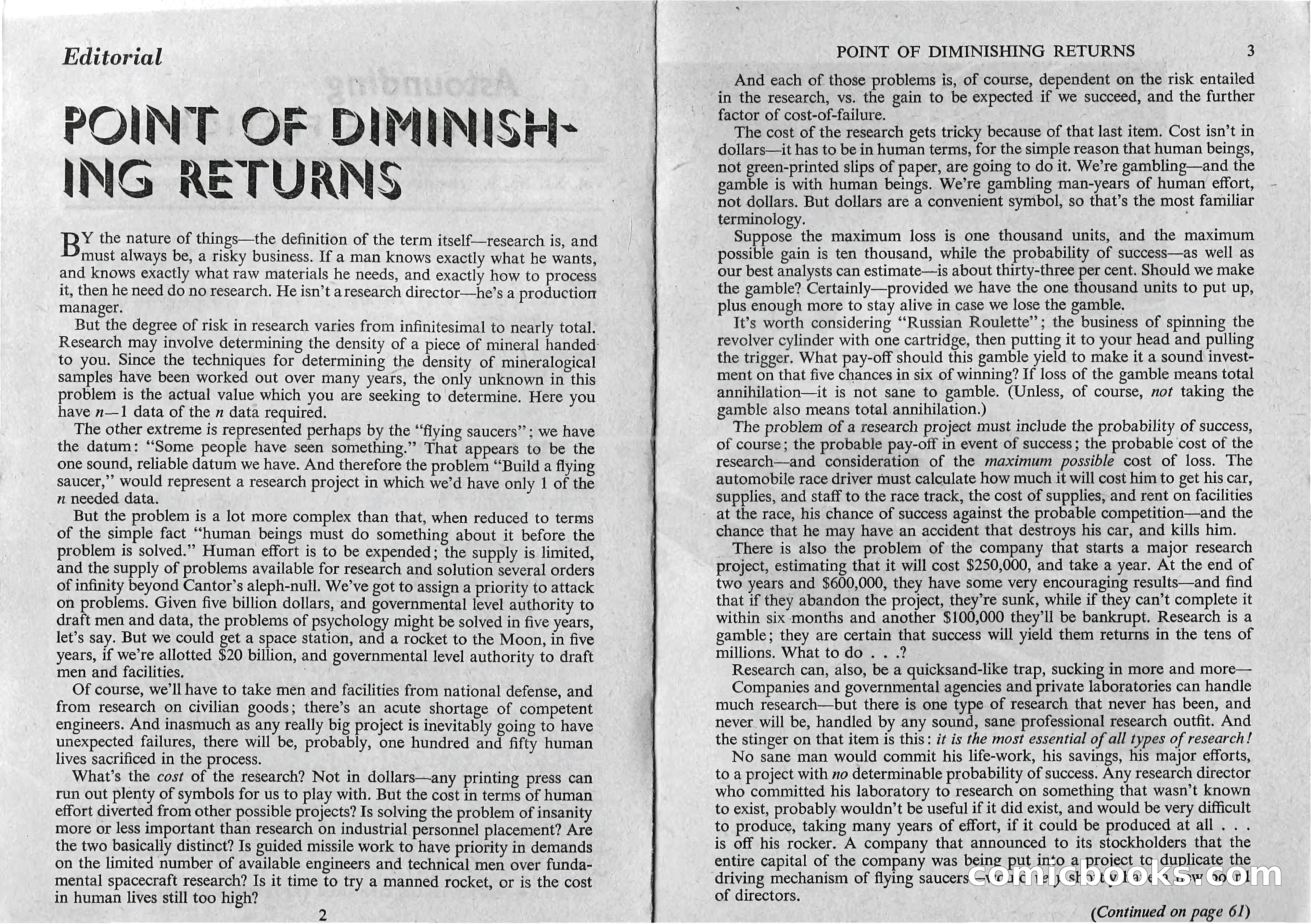
A restored page from Pulp Fiction, 1955. Page through the whole issue in the reader above.
📄 Transcribed text from this page (OCR, searchable)
Machine-transcribed from the original scan — historical spelling and the odd misread are preserved.
Editorial POINT OF DIMINISH: ING RETURNS BY the nature of things—the definition of the term itself—research is, and must always be, a risky business. If a man knows exactly what he wants, and knows exactly what raw materials he needs, and exactly how to process it, then he need do no research. He isn’t aresearch director—he’s a production manager. But the degree of risk in research varies from infinitesimal to nearly total. Research may involve determining the density of a piece of mineral handed: to you. Since the techniques for determining the density of mineralogical samples have been worked out over many years, the only unknown in this problem is the actual value which you are seeking to determine. Here you have n—1 data of the n data required. The other extreme is represented perhaps by the “‘flying saucers”; we have the datum: “Some people have seen something.” That appears to be the one sound, reliable datum we have. And therefore the problem “Build a flying saucer,’’ would represent a research project in which we’d have only 1 of the n needed data. But the problem is a lot more complex than that, when reduced to terms of the simple fact “human beings must do something about it before the problem is solved.” Human effort is to be expended; the supply is limited, and the supply of problems available for research and solution several orders of infinity beyond Cantor’s aleph-null. We’ve got to assign a priority to attack on problems. Given five billion dollars, and governmental level authority to draft men and data, the problems of psychology might be solved in five years, let’s say. But we could get a space station, and a rocket to the Moon, in five years, if we're allotted $20 billion, and governmental level authority to draft men and facilities. dey" Of course, we'll have to take men and facilities from national defense, and from research on civilian goods; there’s an acute shortage of competent engineers. And inasmuch as any really big project is inevitably going to have unexpected failures, there will be, probably, one hundred and fifty human lives sacrificed in the process. What’s the cost of the research? Not in dollars—any printing press can run out plenty of symbols for us to play with. But the cost in terms of human effort diverted from other possible projects? Is solving the problem of insanity more or less important than research on industrial personnel placement? Are the two basically distinct? Is guided missile work to have priority in demands on the limited number of available engineers and technical men over funda- mental spacecraft research? Is it time to try a manned rocket, or is the cost in human lives still too high? 2 entire capital of the company was being put into a) project tc duplicate the driving mechanism of flying anced Cl @ | é 42 ‘boo! cS. (99 1 POINT OF DIMINISHING RETURNS 3 And each of those problems is, of course, dependent on the risk entailed in the research, vs. the gain to be expected if we succeed, and the further factor of cost-of-failure. The cost of the research gets tricky because of that last item. Cost isn’t in dollars—it has to be in human terms, for the simple reason that human beings, not green-printed slips of paper, are going to do it. We’re gambling—and the gamble is with human beings. We’re gambling man-years of human effort, not dollars. But dollars are a convenient symbol, so that’s the most familiar terminology. | Suppose the maximum loss is one thousand units, and the maximum possible gain is ten thousand, while the probability of success—as well as our best analysts can estimate—is about thirty-three per cent. Should we make the gamble? Certainly—provided we have the one thousand units to put up, plus enough more to stay alive in case we lose the gamble, It’s worth considering “Russian Roulette”; the business of spinning the revolver cylinder with one cartridge, then putting it to your head and pulling the trigger. What pay-off should this gamble yield to make it a sound invest- ment on that five chances in six of winning? If loss of the gamble means total annihilation—it is not sane to gamble. (Unless, of course, not taking the gamble also means total annihilation.) The problem of a research project must include the probability of success, of course; the probable pay-off in event of success; the probable cost of the research—and consideration of the maximum possible cost of loss. The automobile race driver must calculate how much it will cost him to get his car, supplies, and staff to the race track, the cost of supplies, and rent on facilities - at the race, his chance of success against the probable competition—and the chance that he may have an accident that destroys his car, and kills him. _ There is also the problem of the company that starts a major research project, estimating that it will cost $250,000, and take a year. At the end of two years and $600,000, they have some very encouraging results—and find that if they abandon the project, they’re sunk, while if they can’t complete it within six months and another $100,000 theyll be bankrupt. Research is a gamble; they are certain that success will yield them returns in the tens of millions. What to do. . .? ) Research can, also, be a quicksand-like trap, sucking in more and more— Companies and governmental agencies and private laboratories can handle much research—but there is one type of research that never has been, and never will be, handled by any sound, sane professional research outfit. And the stinger on that item is this: it is the most essential of all types of research! No sane man would commit his life-work, his savings, his major efforts, to a project with xo determinable probability of success. Any research director who committed his laboratory to research on something that wasn’t known to exist, probably wouldn’t be useful if it did exist, and would be very difficult to produce, taking many years of effort, if it could be produced at all. . . is off his rocker. A company that announced to its stockholders that the ° m =~) of directors. (Continued on page 61)