
Pulp Fiction, 1955 · page 16 of 67
Astounding Science Fiction, British Edition — page 16: what you’re looking at
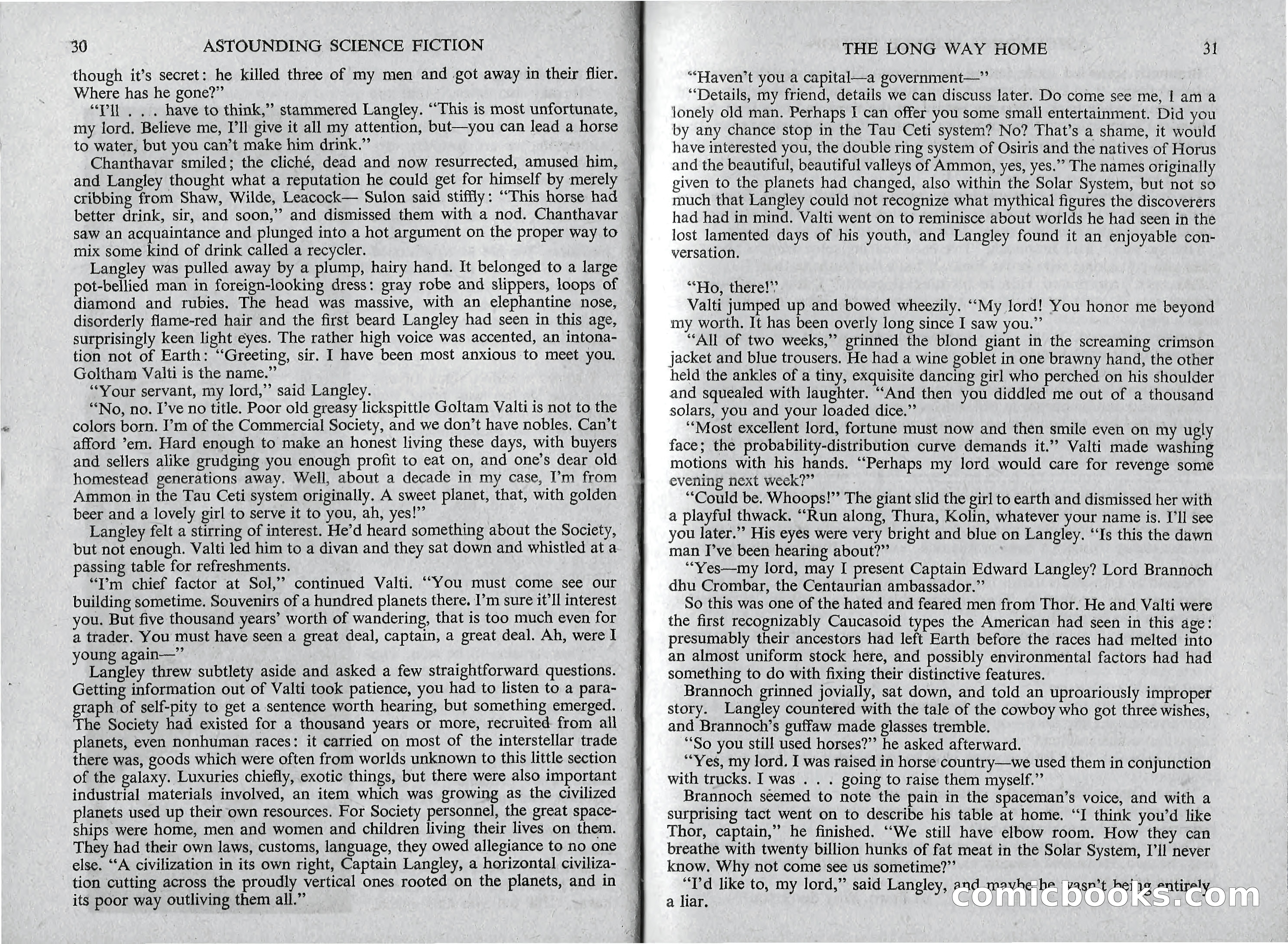
A restored page from Pulp Fiction, 1955. Page through the whole issue in the reader above.
📄 Transcribed text from this page (OCR, searchable)
Machine-transcribed from the original scan — historical spelling and the odd misread are preserved.
30 ASTOUNDING SCIENCE FICTION though it’s secret: he killed three of my men and got away in their flier. Where has he gone?” | “Til... have to think,” stammered Langley. “This is most unfortunate, my lord, Believe me, I'll give it all my attention, but—you can lead a horse to water, but you can’t make him drink.” ck Chanthavar smiled; the cliché, dead and now resurrected, amused him, and Langley thought what a reputation he could get for himself by merely cribbing from Shaw, Wilde, Leacock— Sulon said stiffly: “This horse had better drink, sir, and soon,” and dismissed them with a nod. Chanthavar saw an acquaintance and plunged into a hot argument on the proper way to mix some kind of drink called a recycler. Langley was pulled away by a plump, hairy hand. It belonged to a large pot-bellied man in foreign-looking dress: gray robe and slippers, loops of diamond and rubies. The head was massive, with an elephantine nose, disorderly flame-red hair and the first beard Langley had seen in this age, surprisingly keen light eyes. The rather high voice was accented, an intona- tion not of Earth: “‘Greeting, sir. I have been most anxious to meet you. Goltham Vaiti is the name.” | ‘Your servant, my lord,” said Langley. “No, no. I’ve no title. Poor old greasy lickspittle Goltam Valti is not to the colors born. I’m of the Commercial Society, and we don’t have nobles, Can’t afford ’em. Hard enough to make an honest living these days, with buyers and sellers alike grudging you enough profit to eat on, and one’s dear old homestead generations away. Well, about a decade in my case, I’m from Ammon in the Tau Ceti system originally. A sweet planet, that, with golden beer and a lovely girl to serve it to you, ah, yes!”’ Langley felt a stirring of interest. He’d heard something about the Society, but not enough. Valti led him to a divan and they sat down and whistled at a passing table for refreshments. “I’m chief factor at Sol,’ continued Valti. ““You must come see our building sometime. Souvenirs of a hundred planets there. I’m sure it'll interest you. But five thousand years’ worth of wandering, that is too much even for a trader. You must have seen a great deal, captain, a great deal. Ah, were I young again—”’ Langley threw subtlety aside and asked a few straightforward questions. Getting information out of Valti took patience, you had to listen to a para- graph of self-pity to get a sentence worth hearing, but something emerged. | The Society had existed for a thousand years or more, recruited from all planets, even nonhuman races: it carried on most of the interstellar trade there was, goods which were often from worlds unknown to this little section of the galaxy. Luxuries chiefly, exotic things, but there were also important industrial materials involved, an item which was growing as the civilized planets used up their own resources. For Society personnel, the great space- ships were home, men and women and children living their lives on them. They had their own laws, customs, language, they owed allegiance to no one else. “A civilization in its own right, Captain Langley, a horizontal civiliza- _ tion cutting across the proudly vertical ones rooted on the planets, and in its poor way outliving them all.” THE LONG WAY HOME | 31 ““Haven’t you a capital—a government—” : “Details, my friend, details we can discuss later. Do come see me, | am a lonely old man. Perhaps I can offer you some small entertainment. Did you by any chance stop in the Tau Ceti system? No? That’s a shame, it would have interested you, the double ring system of Osiris and the natives of Horus and the beautiful, beautiful valleys of Ammon, yes, yes.” The names originally given to the planets had changed, also within the Solar System, but not so much that Langley could not recognize what mythical figures the discoverers had had in mind. Valti went on to reminisce about worlds he had seen in the lost lamented days of his youth, and Langley found it an enjoyable con- versation. | ““Ho, there!” , Valti jumped up and bowed wheezily. “My Jord! You honor me beyond my worth. It has been overly long since I saw you.” “All of two weeks,” grinned the blond giant in the screaming crimson jacket and blue trousers. He had a wine goblet in one brawny hand, the other held the ankles of a tiny, exquisite dancing girl who perched on his shoulder and squealed with laughter. “And then you diddled me out of a thousand solars, you and your loaded dice.”’ “Most excellent lord, fortune must now and then smile even on my ugly face; the probability-distribution curve demands it.’’ Valti made washing motions with his hands. “Perhaps my lord would care for revenge some evening next week?” “Could be. Whoops!” The giant slid the girl to earth and dismissed her with a playful thwack. “Run along, Thura, Kolin, whatever your name is. I’ll see you later.’ His eyes were very bright and blue on Langley. ‘‘Is this the dawn man I’ve been hearing about?” “Yes—my lord, may I present Captain Edward Langley? Lord Brannoch dhu Crombar, the Centaurian ambassador.” So this was one of the hated and feared men from Thor. He and Valti were the first recognizably Caucasoid types the American had seen in this age: presumably their ancestors had left Earth before the races had melted into an almost uniform stock here, and possibly environmental factors had had something to do with fixing their distinctive features. Brannoch grinned jovially, sat down, and told an uproariously improper story. Langley countered with the tale of the cowboy who got three wishes, and Brannoch’s guffaw made glasses tremble. “So you still used horses?” he asked afterward. “Yes, my lord. I was raised in horse country—we used them in conjunction with trucks. I was . . . going to raise them myself.” Brannoch seemed to note the pain in the spaceman’s voice, and with a surprising tact went on to describe his table at home. “I think you'd like Thor, captain,” he finished. “We still have elbow room. How they can breathe with twenty billion hunks of fat meat in the Solar System, I’ll never know. Why not come see us sometime?” E Be like to, my lord,” said Langley, Eom a Fire bo oks:.co