
Pulp Fiction, 1955 · page 74 of 133
Astounding Science Fiction, August 1955 (British Edition) — page 74: what you’re looking at
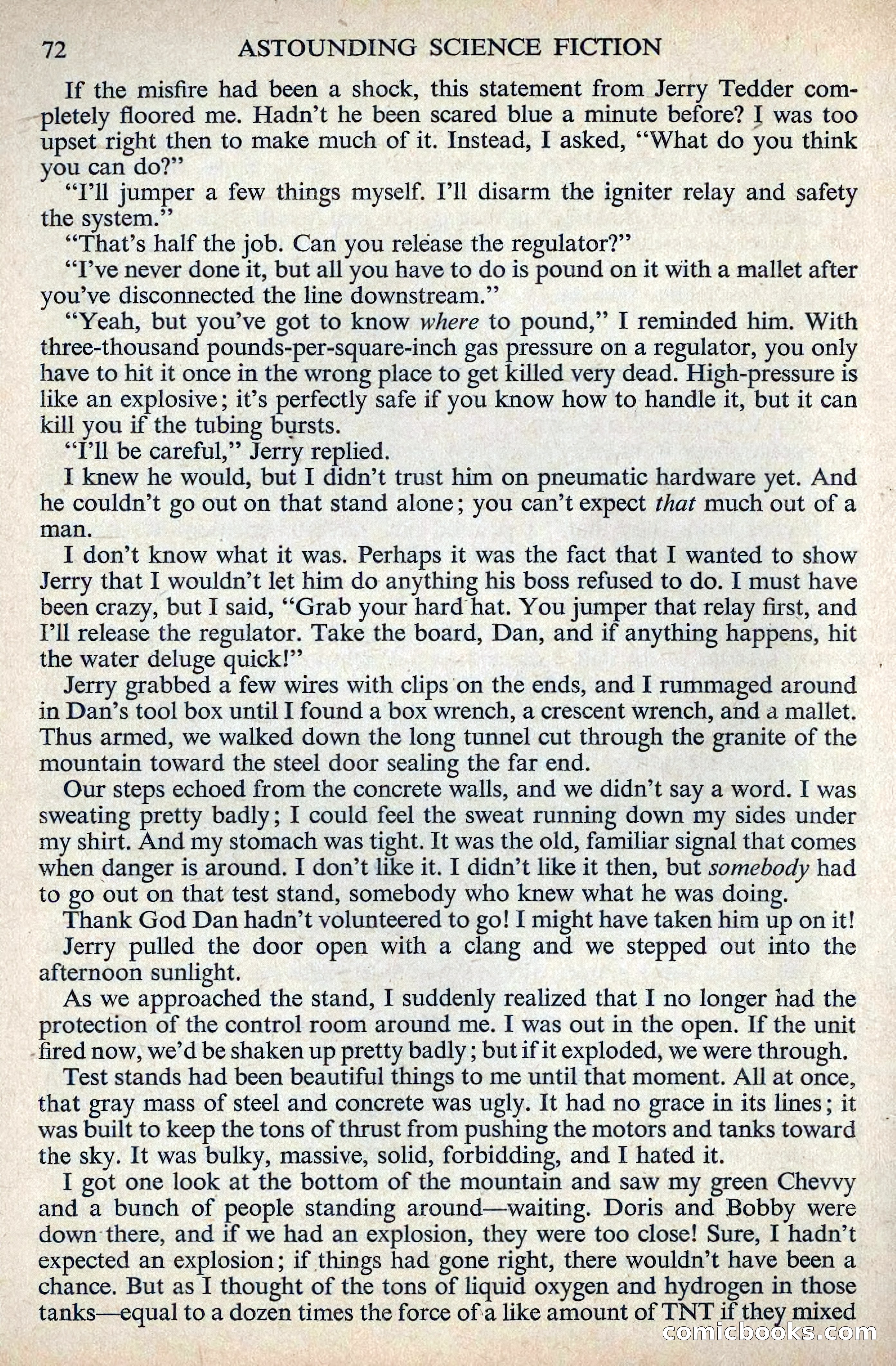
A restored page from Pulp Fiction, 1955. Page through the whole issue in the reader above.
📄 Transcribed text from this page (OCR, searchable)
Machine-transcribed from the original scan — historical spelling and the odd misread are preserved.
72 ASTOUNDING SCIENCE FICTION If the misfire had been a shock, this statement from Jerry Tedder com- pletely floored me. Hadn’t he been scared blue a minute before? I was too upset right then to make much of it. Instead, I asked, ““What do you think you can do?” oe jumper a few things myself. I'll disarm the igniter relay and safety the system.” “That’s half the job. Can you release the regulator?” ““T’ve never done it, but all you have to do is pound on it with a mallet after you’ve disconnected the line downstream.”’ “Yeah, but you’ve got to know where to pound,” I reminded him. With three-thousand pounds-per-square-inch gas pressure on a regulator, you only have to hit it once in the wrong place to get killed very dead. High-pressure is like an explosive; it’s perfectly safe if you know how to handle it, but it can kill you if the tubing bursts. “Tl be careful,” Jerry replied. I knew he would, but I didn’t trust him on pneumatic hardware yet. And he couldn’t go out on that stand alone; you can’t expect that much out of a man. I don’t know what it was. Perhaps it was the fact that I wanted to show Jerry that I wouldn’t let him do anything his boss refused to do. I must have been crazy, but I said, “‘Grab your hard hat. You jumper that relay first, and Pll release the regulator. Take the board, Dan, and if anything happens, hit the water deluge quick!” Jerry grabbed a few wires with clips on the ends, and I rummaged around in Dan’s tool box until I found a box wrench, a crescent wrench, and a mallet. Thus armed, we walked down the long tunnel cut through the granite of the mountain toward the steel door sealing the far end. Our steps echoed from the concrete walls, and we didn’t say a word. I was sweating pretty badly; I could feel the sweat running down my sides under my shirt. And my stomach was tight. It was the old, familiar signal that comes when danger is around. I don’t like it. I didn’t like it then, but somebody had to go out on that test stand, somebody who knew what he was doing. Thank God Dan hadn’t volunteered to go! I might have taken him up on it! Jerry pulled the door open with a clang and we stepped out into the afternoon sunlight. As we approached the stand, I suddenly realized that I no longer nad the protection of the control room around me. I was out in the open. If the unit -fired now, we’d be shaken up pretty badly ; but if it exploded, we were through. Test stands had been beautiful things to me until that moment. All at once, that gray mass of steel and concrete was ugly. It had no grace in its lines; it was built to keep the tons of thrust from pushing the motors and tanks toward the sky. It was bulky, massive, solid, forbidding, and I hated it. I got one look at the bottom of the mountain and saw my green Chevvy and a bunch of people standing around—waiting. Doris and Bobby were down there, and if we had an explosion, they were too close! Sure, I hadn’t expected an explosion; if things had gone right, there wouldn’t have been a chance. But as I thought of the tons of liquid oxygen and hydrogen in those tanks—equal to a dozen times the force ofa like amount of TNT if they mixed COMMCHOOOKS.COM