
Pulp Fiction, 1955 · page 127 of 133
Astounding Science Fiction, August 1955 (British Edition) — page 127: what you’re looking at
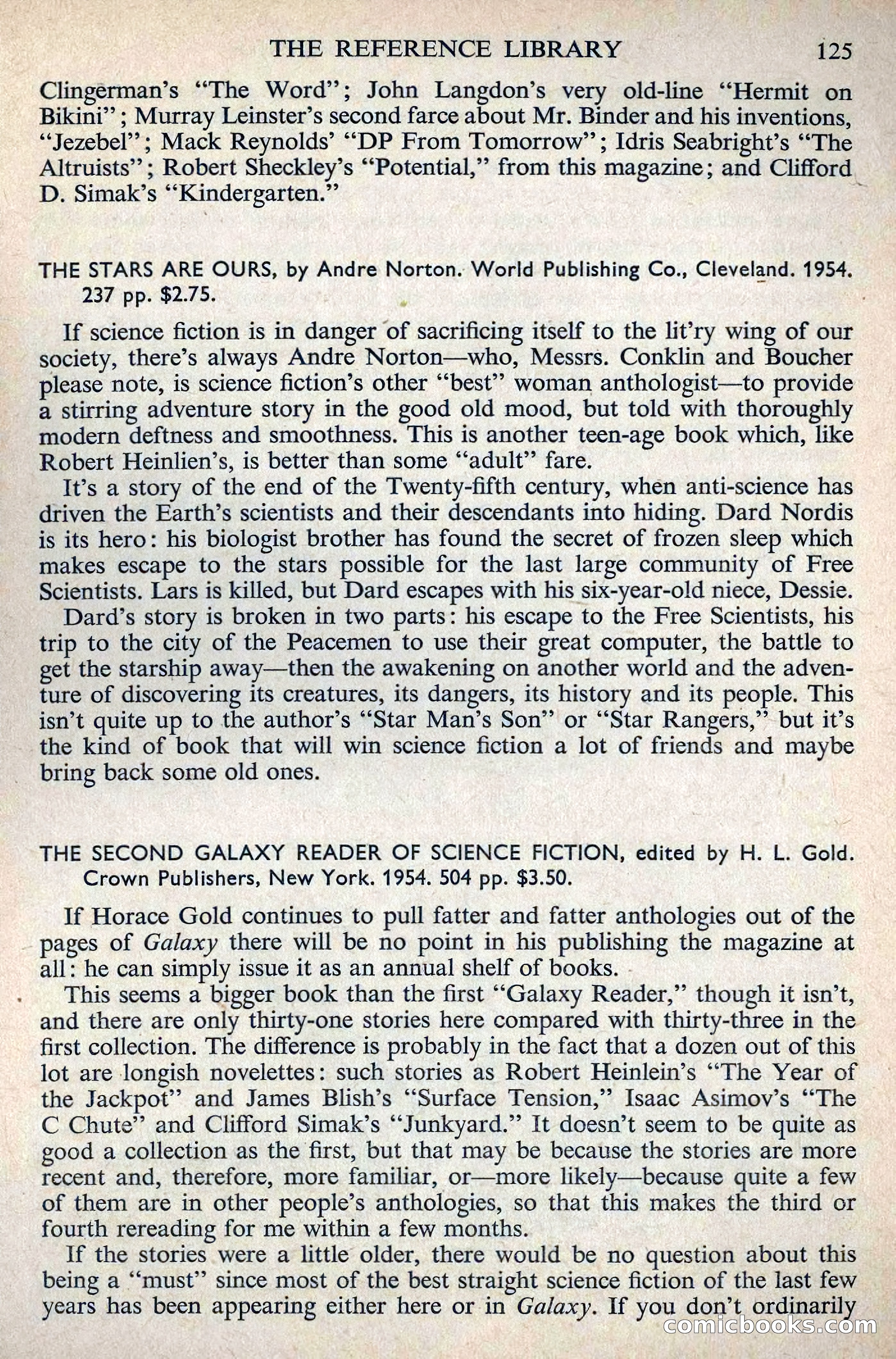
A restored page from Pulp Fiction, 1955. Page through the whole issue in the reader above.
📄 Transcribed text from this page (OCR, searchable)
Machine-transcribed from the original scan — historical spelling and the odd misread are preserved.
THE REFERENCE LIBRARY 125 Clingerman’s “The Word’’; John Langdon’s very old-line “Hermit on Bikini” ; Murray Leinster’s second farce about Mr. Binder and his inventions, “Jezebel”; Mack Reynolds’ “DP From Tomorrow” ; Idris Seabright’s ‘“The Altruists” ; Robert Sheckley’s “‘Potential,” from this magazine; and Clifford D. Simak’s “‘Kindergarten.”’ ‘ THE STARS ARE OURS, by Andre Norton. World Publishing Co., Cleveland. 1954, 237 pp. $2.75. If science fiction is in danger of sacrificing itself to the lit’ry wing of our society, there’s always Andre Norton—who, Messrs. Conklin and Boucher please note, is science fiction’s other “best”? woman anthologist—to provide a stirring adventure story in the good old mood, but told with thoroughly modern deftness and smoothness. This is another teen-age book which, like Robert Heinlien’s, is better than some “‘adult”’ fare. It’s a story of the end of the Twenty-fifth century, when anti-science has driven the Earth’s scientists and their descendants into hiding. Dard Nordis is its hero: his biologist brother has found the secret of frozen sleep which makes escape to the stars possible for the last large community of Free Scientists. Lars is killed, but Dard escapes with his six-year-old niece, Dessie. Dard’s story is broken in two parts: his escape to the Free Scientists, his trip to the city of the Peacemen to use their great computer, the battle to get the starship away—then the awakening on another world and the adven- ture of discovering its creatures, its dangers, its history and its people. This isn’t quite up to the author’s “Star Man’s Son” or “Star Rangers,” but it’s the kind of book that will win science fiction a lot of friends and maybe bring back some old ones. THE SECOND GALAXY READER OF SCIENCE FICTION, edited by H. L. Gold. Crown Publishers, New York. 1954. 504 pp. $3.50. If Horace Gold continues to pull fatter and fatter anthologies out of the pages of Galaxy there will be no point in his publishing the magazine at all: he can simply issue it as an annual shelf of books. . This seems a bigger book than the first ““Galaxy Reader,” though it isn’t, and there are only thirty-one stories here compared with thirty-three in the first collection. The difference is probably in the fact that a dozen out of this lot are longish novelettes: such stories as Robert Heinlein’s “The Year of the Jackpot” and James Blish’s “Surface Tension,” Isaac Asimoy’s “The C Chute” and Clifford Simak’s “Junkyard.” It doesn’t seem to be quite as good a collection as the first, but that may be because the stories are more recent and, therefore, more familiar, or—more likely—because quite a few of them are in other people’s anthologies, so that this makes the third or fourth rereading for me within a few months. If the stories were a little older, there would be no question about this being a “‘must”’ since most of the best straight science fiction of the last few years has been appearing either here or in Galaxy. If you don’t, ordinaril COMMCENIOOS COLL