
Pulp Fiction, 1955 · page 5 of 69
Astounding Science Fiction (British Edition) — page 5: what you’re looking at
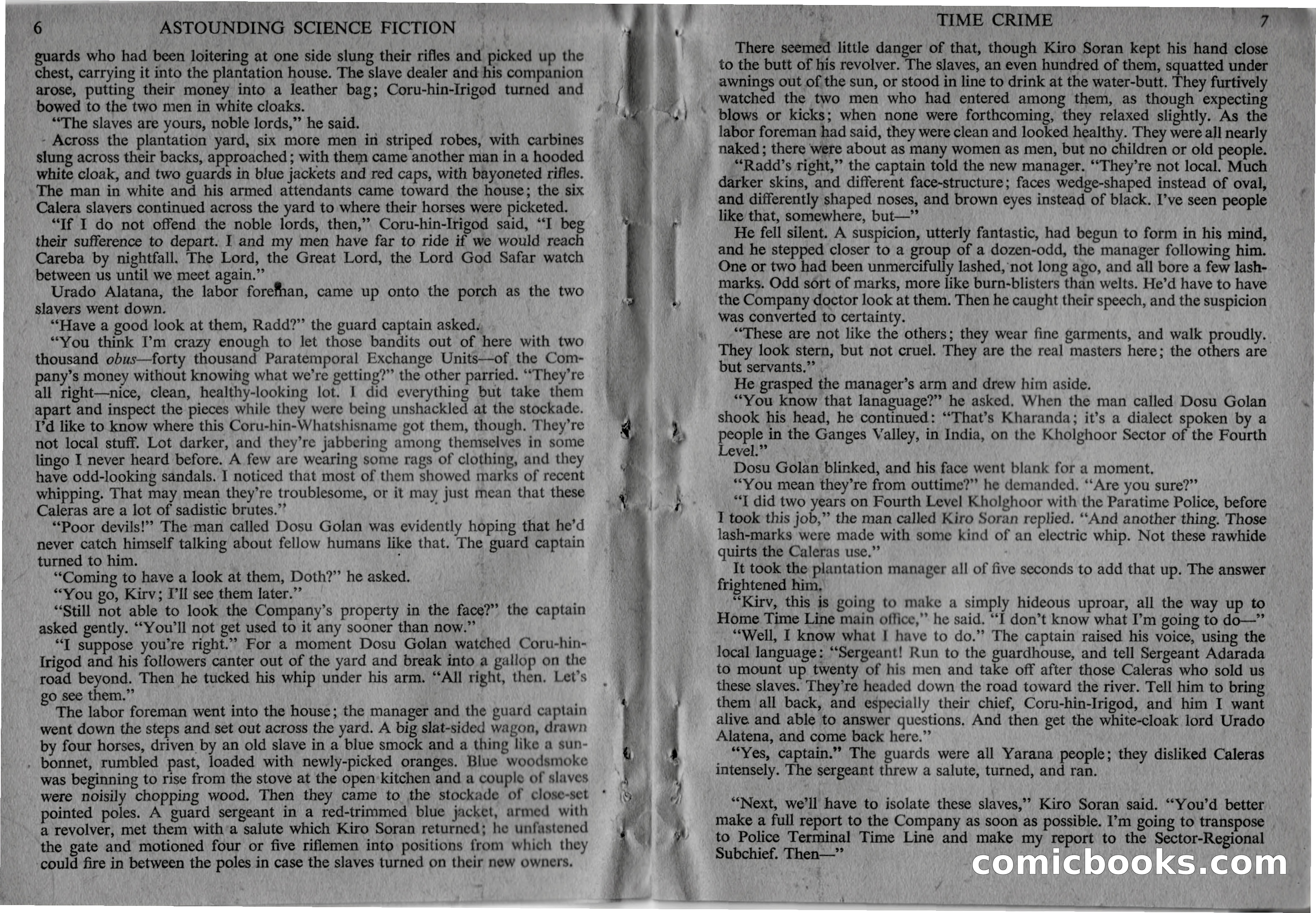
A restored page from Pulp Fiction, 1955. Page through the whole issue in the reader above.
📄 Transcribed text from this page (OCR, searchable)
Machine-transcribed from the original scan — historical spelling and the odd misread are preserved.
6 ASTOUNDING SCIENCE FICTION guards who had been loitering at one side slung their rifles and picked up the chest, carrying it into the plantation house. The slave dealer and his companion arose, putting their money into a leather bag; Coru-hin-Irigod turned and bowed to the two men in white cloaks. “The slaves are yours, noble lords,” he said. - Across the plantation yard, six more men in striped robes, with carbines slung across their backs, approached ; with them came another man in a hooded white cloak, and two guards in blue jackets and red caps, with bayoneted rifles. The man in white and his armed attendants came toward the house; the six Calera slavers continued across the yard to where their horses were picketed. “If I do not offend the noble lords, then,” Coru-hin-Irigod said, “I beg their sufference to depart. I and my men have far to ride if we would reach Careba by nightfall. The Lord, the Great Lord, the Lord God Safar watch between us until we meet again.” Urado Alatana, the labor forefhan, came up onto the porch as the two slavers went down. “Have a good look at them, Radd?”’ the guard captain asked,, “You think I’m crazy enough to let those bandits out of here with two thousand obus—forty thousand Paratemporal Exchange Units—of the Com- pany’s money without knowihg what we’re getting?” the other parried. ““They’re all right—nice, clean, healthy-looking lot. I did everything but take them apart and inspect the pieces while they were being unshackled at the stockade. I’d like to know where this Coru-hin-Whatshisname got them, though. They’re not local stuff. Lot darker, and they’re jabbering among themselves in some lingo I never heard before. A few are wearing some rags of clothing, and they have odd-looking sandals. I noticed that most of them showed marks of recent whipping. That may mean they’re troublesome, or it may just mean that these Caleras are a lot of sadistic brutes.”’ , “Poor devils!” The man called Dosu Golan was evidently hoping that he’d never catch himself talking about fellow humans like that. The guard captain turned to him. ; “Coming to have a look at them, Doth?’ he asked. “You go, Kirv; Pil see them later.”’ “Still not able to look the Company’s property in the face?” the captain asked gently. ““You’ll not get used to it any sooner than now.” “I suppose you're right.” For a moment Dosu Golan watched Coru-hin- [rigod and his followers canter out of the yard and break into a gallop on the road beyond. Then he tucked his whip under his arm. “All right, then, Let's go see them.” The labor foreman went into the house; the manager and the guard captain went down the steps and set out across the yard. A big slat-sided wagon, drawn by four horses, driven by an old slave in a blue smock and a thing like a sun- . bonnet, rumbled past, loaded with newly-picked oranges. Blue woodsmoke was beginning to rise from the stove at the open kitchen and a couple of slaves were noisily chopping wood. Then they came to the stockade of close-set pointed poles. A guard sergeant in a red-trimmed blue jacket, armed with a revolver, met them with’a salute which Kiro Soran returned; he unfastened the gate and motioned four or five riflemen into positions from which they could fire in between the poles in case the slaves turned on their new owners. Ld TIME CRIME > RNG There seemed little danger of that, though Kiro Soran kept his hand close to the butt of his revolver. The slaves, an even hundred of them, squatted under awnings out of the sun, or stood in line to drink at the water-butt. They furtively watched the two men who had entered among them, as though expecting * blows or kicks; when none were forthcoming, they relaxed slightly. As the labor foreman had said, they were clean and looked healthy. They were all nearly _ naked; there were about as many women as men, but no children or old people. “Radd’s right,” the captain told the new manager. ‘‘They’re not local. Much darker skins, and different face-structure; faces wedge-shaped instead of oval, and differently shaped noses, and brown eyes instead of black. I’ve seen people like that, somewhere, but—” He fell silent. A suspicion, utterly fantastic, had begun to form in his mind, and he stepped closer to a group of a dozen-odd, the manager following him. One or two had been unmercifully lashed, not long ago, and all bore a few lash- » marks. Odd sort of marks, more like burn-blisters than welts. He’d have to have the Company doctor look at them. Then he caught their speech, and the suspicion was converted to certainty. “These are not like the others; they wear fine garments, and walk proudly. They look stern, but not cruel. They are the real masters here; the others are but servants,” He grasped the manager’s arm and drew him aside. “You know that lanaguage?” he asked. When the man called Dosu Golan shook his head, he continued: ““That’s Kharanda; it’s a dialect spoken by a people in the Ganges Valley, in India, on the Kholghoor Sector of the Fourth Level.” Dosu Golan blinked, and his face went blank for a moment. “You mean they’re from outtime?” he demanded. “‘Are you sure?’’ “I did two years on Fourth Level Kholghoor with the Paratime Police, before I took this job,” the man called Kiro Soran replied. “And another thing. Those lash-marks were made with some kind of an electric whip. Not these rawhide quirts the Caleras use,” It took the plantation manager all of five seconds to add that up. The answer frightened him, “Kirv, this is going to make a simply hideous uproar, all the way up to Home Time Line main office,” he said. “I don’t know what I’m going to do—” “Well, I know what I have to do.’ The captain raised his voice, using the local language: “‘Sergeant! Run to the guardhouse, and tell Sergeant Adarada to mount up twenty of his men and take off after those Caleras who sold us these slaves. They’re headed down the road toward the river. Tell him to bring them all back, and especially their chief, Coru-hin-Irigod, and him I want alive and able to answer questions. And then get the white-cloak lord Urado Alatena, and come back here.”’ “Yes, captain.” The guards were all Yarana people; they disliked Caleras intensely. The sergeant threw a salute, turned, and ran. “Next, we'll have to isolate these slaves,’’ Kiro Soran said. ‘““You’d better make a full report to the Company as soon as possible. I’m going to transpose to Police Terminal Time Line and make my report to the Sector-Regional Subchief. Then—” COMIC 00 OKS com