
Pulp Fiction, 1955 · page 3 of 69
Astounding Science Fiction (British Edition) — page 3: what you’re looking at
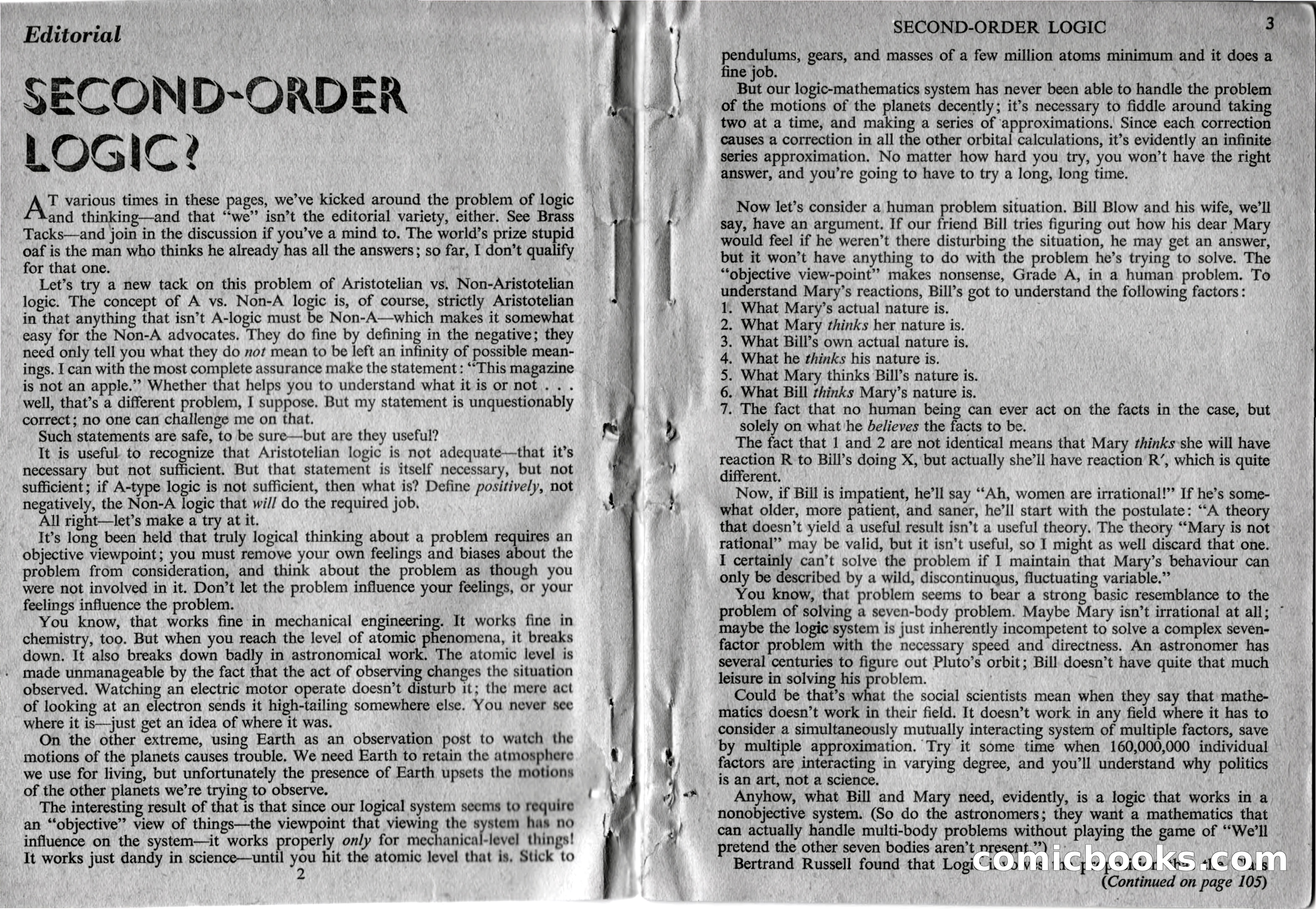
A restored page from Pulp Fiction, 1955. Page through the whole issue in the reader above.
📄 Transcribed text from this page (OCR, searchable)
Machine-transcribed from the original scan — historical spelling and the odd misread are preserved.
Editorial SECOND-ORDER LOGIC? At various times in these pages, we’ve kicked around the problem of logic and thinking—and that “we” isn’t the editorial variety, either. See Brass Tacks—and join in the discussion if you’ve a mind to. The world’s prize stupid oaf is the man who thinks he already has all the answers; so far, I don’t qualify for that one. Let’s try a new tack on this problem of Aristotelian vs. Non-Aristotelian logic. The concept of A vs. Non-A logic is, of course, strictly Aristotelian in that anything that isn’t A-logic must be Non-A—which makes it somewhat easy for the Non-A advocates. They do fine by defining in the negative; they need only tell you what they do not mean to be left an infinity of possible mean- ings. I can with the most complete assurance make the statement: “‘This magazine is not an apple.” Whether that helps you to understand what itis or not... well, that’s a different problem, I suppose. But my statement is unquestionably correct; no one can challenge me on that. Such statements are safe, to be sure—but are they useful? It is useful to recognize that Aristotelian logic is not adequate—that it’s necessary but not sufficient. But that statement is itself necessary, but not sufficient; if A-type logic is not sufficient, then what is? Define positively, not negatively, the Non-A logic that wi// do the required job. All right—let’s make a try at it. It’s long been held that truly logical thinking about a problem requires an objective viewpoint; you must remove your own feelings and biases about the problem from consideration, and think about the problem as though you were not involved in it. Don’t let the problem influence your feelings, or your feelings influence the problem. You know, that works fine in mechanical engineering. It works fine in chemistry, too. But when you reach the level of atomic phenomena, it breaks down. It also breaks down badly in astronomical work. The atomic level is made unmanageable by the fact that the act of observing changes the situation observed. Watching an electric motor operate doesn’t disturb it; the mere act of looking at an electron sends it high-tailing somewhere else. You never see where it is—just get an idea of where it was. On the other extreme, using Earth as an observation post to watch the motions of the planets causes trouble. We need Earth to retain the atmosphere we use for living, but unfortunately the presence of Earth upsets the motions of the other planets we’re trying to observe. The interesting result of that is that since our logical system seems to require an “objective” view of things—the viewpoint that viewing the va has no influence on the system—it works properly only for mechanical-level things! It works just dandy in science—until you hit the atomic level that is, Stick to 2 SECOND-ORDER LOGIC Michal Stas pendulums, gears, and masses of a few million atoms minimum and it does a fine job. Bilt our logic-mathematics system has never been able to handle the problem of the motions of the planets decently; it’s necessary to fiddle around taking two at a time, and making a series of approximations. Since each correction causes a correction in all the other orbital calculations, it’s evidently an infinite series approximation. No matter how hard you try, you won’t have the right answer, and you're going to have to try a long, long time. Now let’s consider a human problem situation. Bill Blow and his wife, we’ll say, have an argument. If our friend Bill tries figuring out how his dear Mary would feel if he weren’t there disturbing the situation, he may get an answer, but it won’t have anything to do with the problem he’s trying to solve. The “objective view-point” makes nonsense, Grade A, in a human problem. To understand Mary’s reactions, Bill’s got to understand the following factors : . What Mary’s actual nature is. What Mary thinks her nature is. . What Bill’s own actual nature is, . What he thinks his nature is. What Mary thinks Bill’s nature is. . What Bill thinks Mary’s nature is. . The fact that no human being can ever act on the facts in the case, but solely on what he believes the facts to be. The fact that 1 and 2 are not identical means that Mary thinks she will have reaction R to Bill’s doing X, but actually she’ll have reaction R’, which is quite different. Now, if Bill is impatient, he’ll say “Ah, women are irrational!” If he’s some- what older, more patient, and saner, he'll start with the postulate: “A theory that doesn’t yield a useful result isn’t a useful theory, The theory “Mary is not rational’? may be valid, but it isn’t useful, so I might as well discard that one. I certainly can’t solve the problem if I maintain that Mary’s behaviour can only be described by a wild, discontinugus, fluctuating variable.” You know, that problem seems to bear a strong basic resemblance to the problem of solving a seven-body problem. Maybe Mary isn’t irrational at all; ~ maybe the logic system is just inherently incompetent to solve a complex seven- factor problem with the necessary speed and directness. An astronomer has several centuries to figure out Pluto’s orbit; Bill doesn’t have quite that much leisure in solving his problem. | Could be that’s what the social scientists mean when they say that mathe- matics doesn’t work in their field. It doesn’t work in any field where it has to consider a simultaneously mutually interacting system of multiple factors, save by multiple approximation. Try it some time when 160,000,000 individual factors are interacting in varying degree, and you'll understand why politics is an art, not a science. Anyhow, what Bill and Mary need, evidently, is a logic that works in a nonobjective system. (So do the astronomers; they want a mathematics that can actually handle multi-body problems without playing the game of “We'll pretend the other seven bodies aren’t e Bertrand Russell found that ok 1 ° 088 | (ey 9001 Coe COMm ss (Continued on page 105)