
Pulp Fiction, 1953 · page 61 of 68
Astounding British Edition, Vol. 9, No. 10 — page 61: what you’re looking at
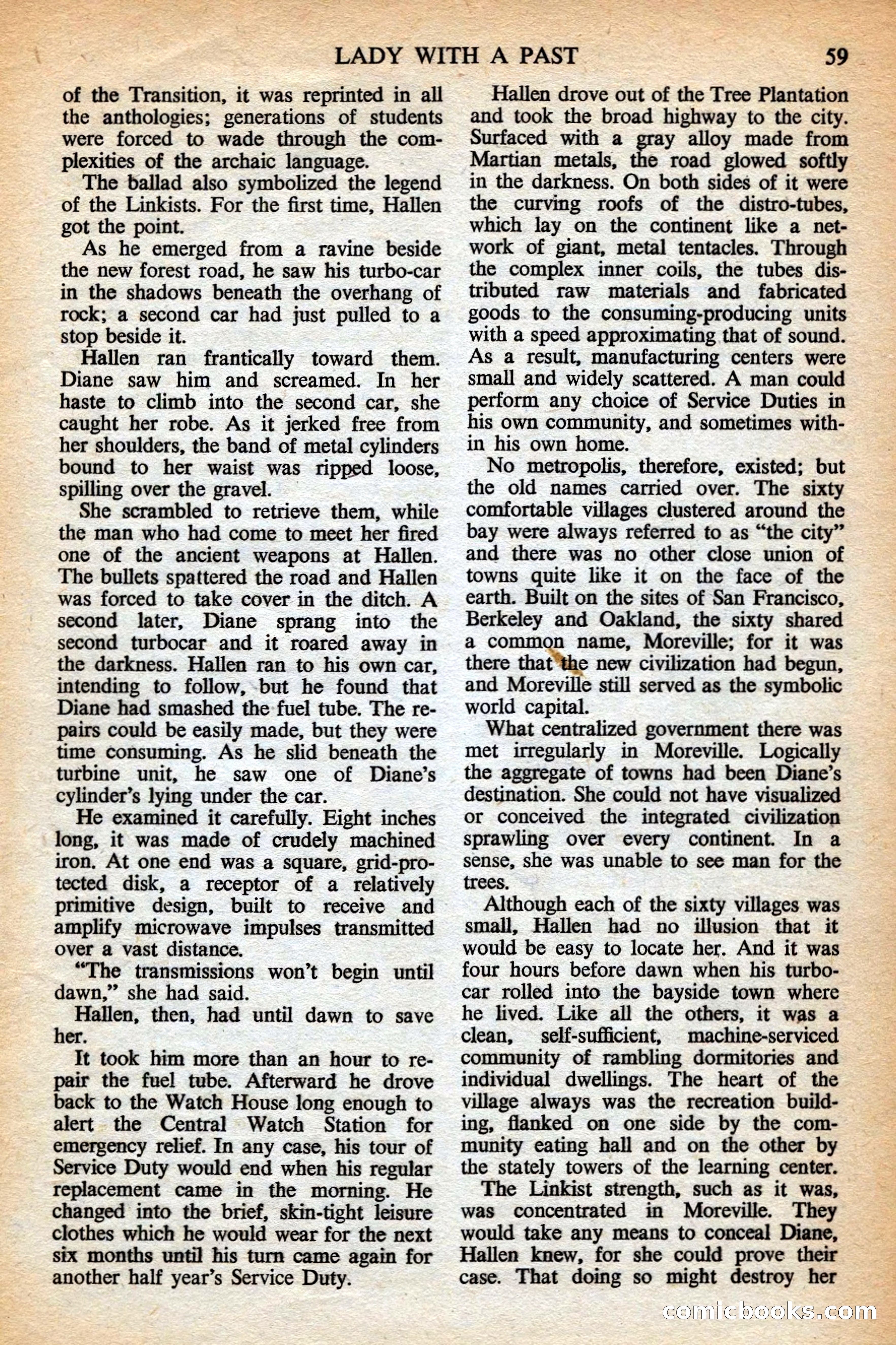
A restored page from Pulp Fiction, 1953. Page through the whole issue in the reader above.
📄 Transcribed text from this page (OCR, searchable)
Machine-transcribed from the original scan — historical spelling and the odd misread are preserved.
LADY WITH A PAST of the Transition, it was reprinted in all the anthologies; generations of students were forced to wade through the com- plexities of the archaic language. The ballad also symbolized the legend of the Linkists. For the first time, Hallen got the point. As he emerged from a ravine beside the new forest road, he saw his turbo-car in the shadows beneath the overhang of rock; a second car had just pulled to a stop beside it. Hallen ran frantically toward them. Diane saw him and screamed. In her haste to climb into the second car, she caught her robe. As it jerked free from her shoulders, the band of metal cylinders bound to her waist was ripped loose, spilling over the grave]. — She scrambled to retrieve them, while the man who had come to meet her fired one of the ancient weapons at Hallen. The bullets spattered the road and Hallen was forced to take cover in the ditch. A second later, Diane sprang into the second turbocar and it roared away in the darkness. Hallen ran to his own car, intending to follow, but he found that Diane had smashed the fuel tube. The re- pairs could be easily made, but they were time consuming. As he slid beneath the turbine unit, he saw one of Diane’s cylinder’s lying under the car. He examined it carefully. Eight inches long, it was made of crudely machined iron, At one end was a square, grid-pro- tected disk, a receptor of a relatively primitive design, built to receive and amplify microwave impulses transmitted over a vast distance. “The transmissions won’t begin until dawn,” she had said. Hallen, then, had until dawn to save her. 2 It took him more than an hour to re- pair the fuel tube. Afterward he drove back to the Watch House long enough to alert the Central Watch Station for emergency relief. In any case, his tour of Service Duty would end when his regular replacement came in the morning. He changed into the brief, skin-tight leisure clothes which he would wear for the next six months until his turn came again for another half year’s Service Duty. Hallen drove out of the Tree Plantation and took the broad highway to the city. Surfaced with a ey alloy made from Martian metals, the road glowed softly in the darkness. On both sides of it were the curving roofs of the distro-tubes, which lay on the continent like a net- work of giant, metal tentacles. Through the complex inner coils, the tubes dis- tributed raw materials and fabricated goods to the consuming-producing units with a speed approximating that of sound. As a result, manufacturing centers were small and widely scattered. A man could perform any choice of Service Duties in his own community, and sometimes with- in his own home. No metropolis, therefore, existed; but the old names carried over. The sixty comfortable villages clustered around the bay were always referred to as “the city” and there was no other close union of towns quite like it on the face of the earth. Built on the sites of San Francisco, Berkeley and Oakland, the sixty shared a common name, Moreville; for it was there that new civilization had begun, and Moreville still served as the symbolic world capital. What centralized government there was met irregularly in Moreville. Logically the aggregate of towns had been Diane’s destination. She could not have visualized or conceived the integrated civilization sprawling over every continent. In a sense, she was unable to see man for the trees. Although each of the sixty villages was small, Hallen had no illusion that it would be easy to locate her. And it was four hours before dawn when his turbo- car rolled into the bayside town where he lived. Like all the others, it was a clean, self-sufficient, | machine-serviced community of rambling dormitories and individual dwellings. The heart of the village always was the recreation build- ing, flanked on one side by the com- munity eating hall and on the other by the stately towers of the learning center. The Linkist strength, such as it was, was concentrated in Moreville. would take any means to conceal Diane, Hallen knew, for she could prove their case. That doing so might destroy her Eomichooks. co i S, -- ae =s —* a os