
Pulp Fiction, 1953 · page 54 of 68
Astounding British Edition, Vol. 9, No. 10 — page 54: what you’re looking at
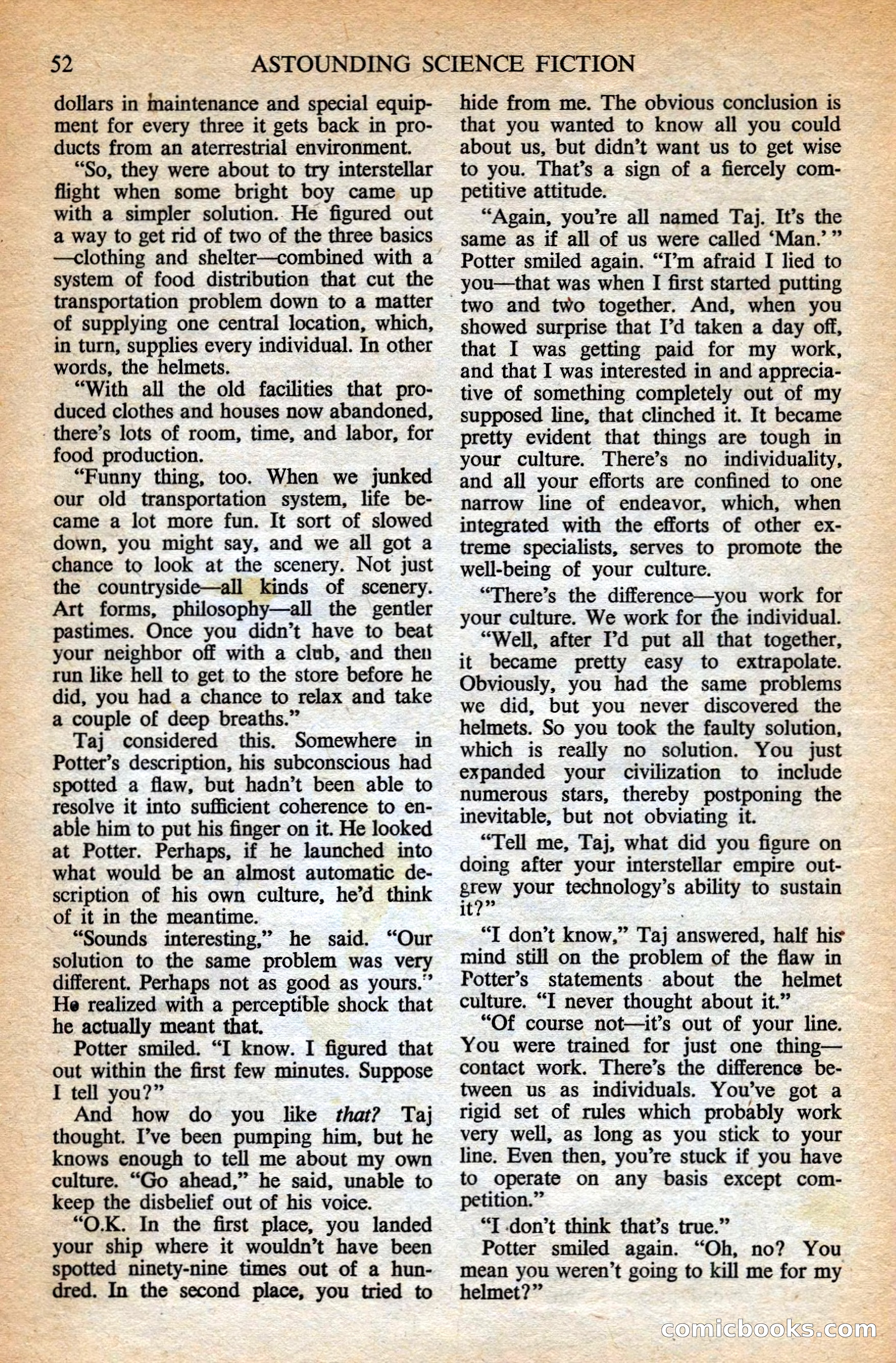
A restored page from Pulp Fiction, 1953. Page through the whole issue in the reader above.
📄 Transcribed text from this page (OCR, searchable)
Machine-transcribed from the original scan — historical spelling and the odd misread are preserved.
Ae fh bh uy sie * A Ae ¥" an Wige A te We hy ; 6) 4 - 744 : v\ ey ASTOUNDING SCIENCE FICTION dollars in maintenance and special equip- ment for every three it gets back in pro- ducts from an aterrestrial environment. “So, they were about to try interstellar flight when some bright boy came up with a simpler solution.. He figured out a way to get rid of two of the three basics —clothing and shelter—combined with a system of food distribution that cut the transportation problem down to a matter of supplying one central location, which, in turn, supplies every individual. In other words, the helmets. “With all the old facilities that pro- duced clothes and houses now abandoned, - there’s lots of room, time, and labor, for food production. “Funny thing, too. When we junked our old transportation system, life be- came a lot more fun. It sort of slowed down, you might say, and we all got a ‘chance to look at the scenery. Not just the countryside—all kinds of scenery. Art forms, philosophy—all the gentler pastimes. Once you didn’t have to beat your neighbor off with a club, and then run like hell to get to the store before he did, you had a chance to relax and take a couple of deep breaths.” Taj considered this. Somewhere in Potter’s description, his subconscious had spotted a flaw, but hadn’t been able to resolve it into sufficient coherence to en- able him to put his finger on it. He looked at Potter. Perhaps, if he launched into what would be an almost automatic de- scription of his own culture, he’d think of it in the meantime. “Sounds interesting,’ he said. “Our solution to the same problem was very different. Perhaps not as good as yours.” He realized with a perceptible shock that he actually meant that. _ Potter smiled. “I know. I figured that out within the first few minutes. Suppose I tell you?” And how do you like that? Taj thought. I’ve been pumping him, but he knows enough to tell me about my own culture. “Go ahead,” he said, unable to keep the disbelief out of his voice. “O.K. In the first place, you landed your ship where it wouldn’t have been spotted ninety-nine times out of a hun- dred. In the second place, you tried to hide from me. The obvious conclusion is that you wanted to know all you could about us, but didn’t want us to get wise to you. That’s a sign of a fiercely com- petitive attitude. “Again, you’re all named Taj. It’s the same as if all of us were called ‘Man.’” Potter smiled again. “I’m afraid I lied to you—that was when I first started putting two and two together. And, when you showed surprise that I’d taken a day off, that I was getting paid for my work, and that I was interested in and apprecia- tive of something completely out of my supposed line, that clinched it. It became pretty evident that things are tough in your culture. There’s no individuality, and all your efforts are confined to one narrow line of endeavor, which, when integrated with the efforts of other ex- treme specialists, serves to promote the well-being of your culture. “There’s the difference—you work for your culture. We work for the individual. “Well, after I'd put all that together, it became pretty easy to extrapolate. Obviously, you had the same problems we did, but you never discovered the helmets. So you took the faulty solution, which is really no solution. You just expanded your civilization to include numerous stars, thereby postponing the inevitable, but not obviating it. “Tell me, Taj, what did you figure on doing after your interstellar empire out- ie your technology’s ability to sustain it?” : “T don’t know,” Taj answered, half his mind still on the problem of the flaw in Potter’s statements. about the helmet culture. “I never thought about it.” “Of course not—it’s out of your line. You were trained for just one thing— contact work. There’s the difference be- tween us as individuals. You’ve got a rigid set of rules which probably work very well, as long as you stick to your line. Even then, you’re stuck if you have to operate on any basis except com- petition.” “T .don’t think that’s true.” Potter smiled again. “Oh, no? You mean you weren’t going to kill me for my helmet?” oO COMME OOOKS»€O)