
Pulp Fiction, 1953 · page 48 of 68
Astounding British Edition, Vol. 9, No. 10 — page 48: what you’re looking at
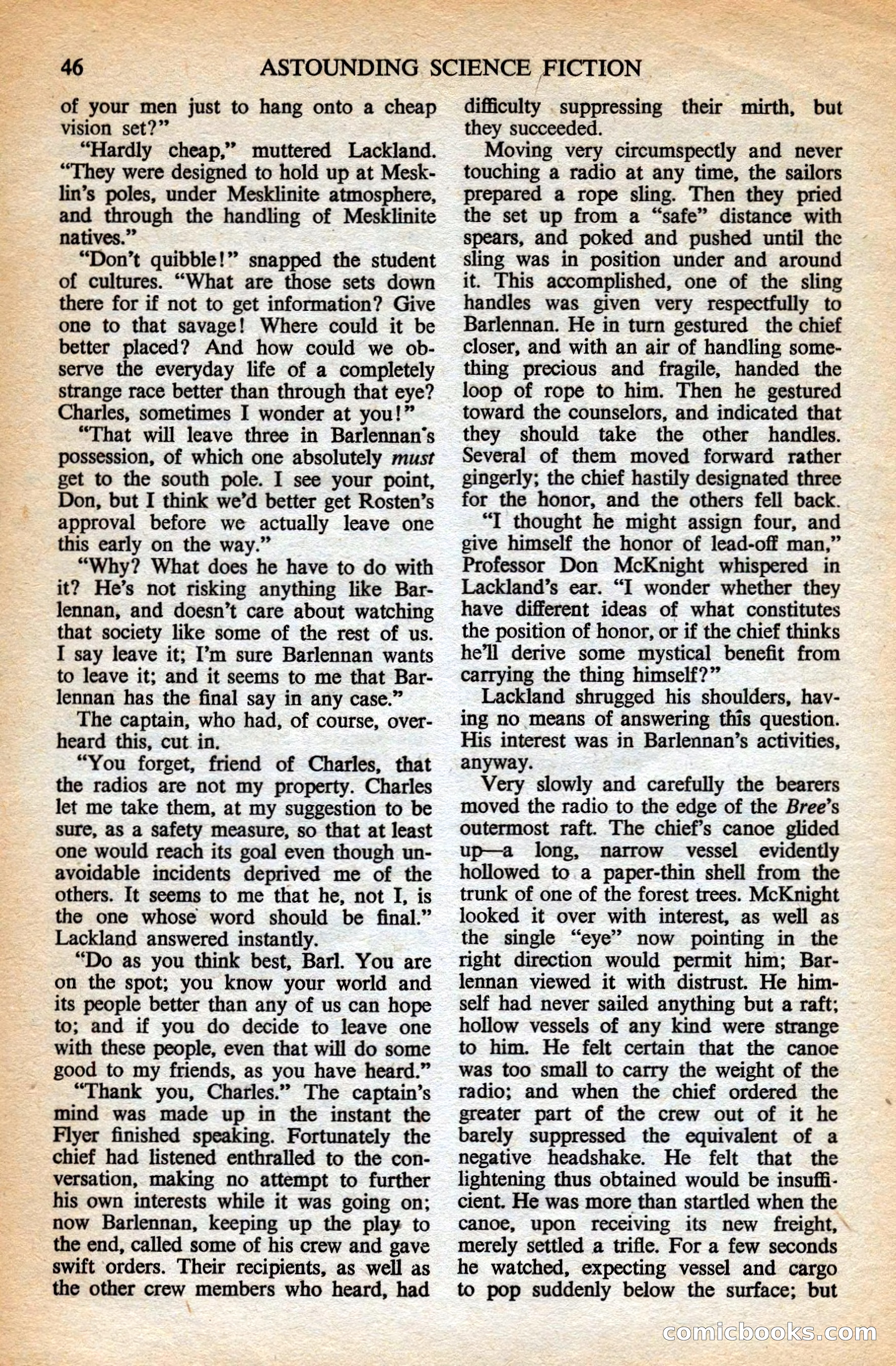
A restored page from Pulp Fiction, 1953. Page through the whole issue in the reader above.
📄 Transcribed text from this page (OCR, searchable)
Machine-transcribed from the original scan — historical spelling and the odd misread are preserved.
of your men just to hang onto a cheap vision set?” “Hardly cheap,” muttered Lackland. “They were designed to hold up at Mesk- lin’s poles, under Mesklinite atmosphere, and through the handling of Mesklinite natives.” “Don’t quibble!” snapped the student of cultures. “What are those sets down there for if not to get information? Give one to that savage! Where could it be better placed? And how could we ob- serve the everyday life of a completely strange race better than through that eye? Charles, sometimes I wonder at you!” “That will leave three in Barlennan‘s possession, of which one absolutely must get to the south pole. I see your point, Don, but I think we’d better get Rosten’s approval before we actually leave one this early on the way.” “Why? What does he have to do with it? He’s not risking anything like Bar- lennan, and doesn’t care about watching that society like some of the rest of us. I say leave it; I’m sure Barlennan wants to leave it; and it seems to me that Bar- Jennan has the final say in any case.” The captain, who had, of course, over- heard this, cut. in. “You forget, friend of Charles, that the radios are not my property. Charles let me take them, at my suggestion to be sure, as a safety measure, so that at least one would reach its goal even though un- avoidable incidents deprived me of the others. It seems to me that he, not I, is the one whose word should be final.” Lackland answered instantly. “Do as you think best, Barl. You are on the spot; you know your world and its people better than any of us can hope to; and if you do decide to leave one with these people, even that will do some good to my friends, as you have heard.” “Thank you, Charles.” The captain’s mind was made up in the instant the Flyer finished speaking. Fortunately the chief had listened enthralled to the con- versation, making no attempt to further his own interests while it was going on; now Barlennan, keeping up the play to the end, called some of his crew and gave swift orders. Their recipients, as well as the other crew members who heard, had the single “eye” ASTOUNDING SCIENCE FICTION difficulty .suppressing their mirth, but they succeeded. Moving very circumspectly and never touching a radio at any time, the sailors prepared a rope sling. Then they pried the set up from a “safe” distance with spears, and poked and pushed until the sling was in position under and around it. This accomplished, one of the sling handles was given very respectfully to Barlennan. He in turn gestured the chief closer, and with an air of handling some- thing precious and fragile, handed the loop of rope to him. Then he gestured toward the counselors, and indicated that they should take the other handles. Several of them moved forward rather gingerly; the chief hastily designated three for the honor, and the others fell back. “I thought he might assign four, and give himself the honor of lead-off man,” Professor Don McKnight whispered in Lackland’s ear. “I wonder whether they have different ideas of what constitutes the position of honor, or if the chief thinks he'll derive some mystical benefit from carrying the thing himself?” Lackland shrugged his shoulders, hav- ing no means of answering this question. His interest was in Barlennan’s activities, anyway. Very slowly and carefully the bearers moved the radio to the edge of the Bree’s outermost raft. The chief’s canoe glided up—a long, narrow vessel evidently hollowed to a paper-thin shell from the trunk of one of the forest trees. McKnight looked it over with interest, as well as now pointing in the right direction would permit him; Bar- lennan viewed it with distrust. He him- self had never sailed anything but a raft; hollow vessels of any kind were strange to him. He felt certain that the canoe was too small to carry the weight of the radio; and when the chief ordered the greater part of the crew out of it he barely suppressed the equivalent of a negative headshake. He felt that the lightening thus obtained would be insuffi- cient. He was more than startled when the canoe, upon receiving its new freight, merely settled a trifle. For a few seconds he watched, expecting vessel and cargo to pop suddenly below the surface; but GOmMmIichbooksnco