
Pulp Fiction, 1953 · page 4 of 68
Astounding British Edition, Vol. 9, No. 10 — page 4: what you’re looking at
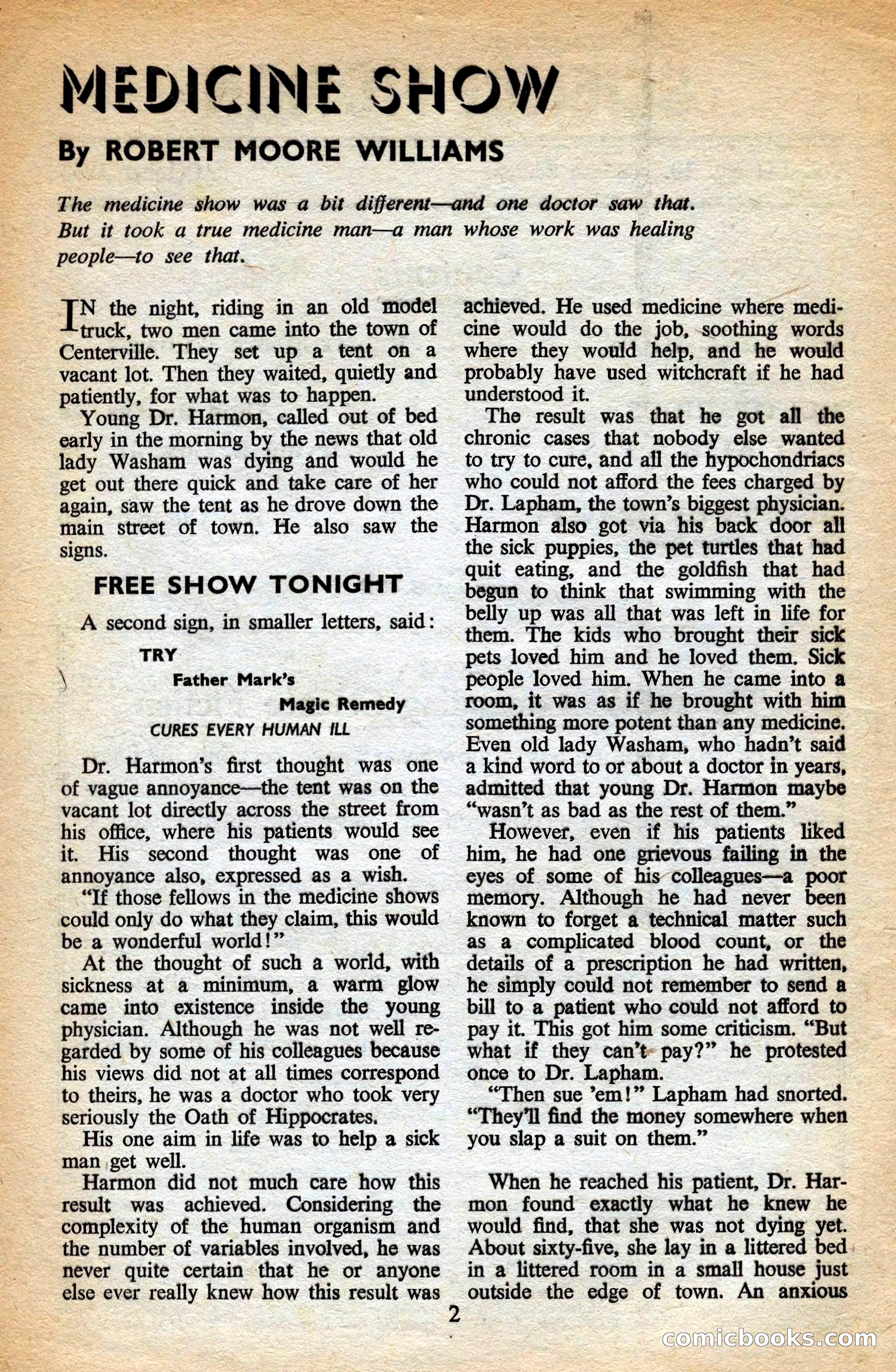
A restored page from Pulp Fiction, 1953. Page through the whole issue in the reader above.
📄 Transcribed text from this page (OCR, searchable)
Machine-transcribed from the original scan — historical spelling and the odd misread are preserved.
By ROBERT MOORE WILLIAMS The medicine show was a bit different—and one doctor saw that. But it took a true medicine man—a man whose work was healing people—to see that. 5 the night, riding in an old model truck, two men came into the town of Centerville. They set up a tent on a vacant lot. Then they waited, quietly and patiently, for what was to happen. Young Dr. Harmon, called out of bed early in the morning by the news that old lady Washam was dying and would he get out there quick and take care of her again, saw the tent as he drove down the main street of town. He also saw the signs. FREE SHOW TONIGHT A second sign, in smaller letters, said: TRY \ Father Mark’s Magic Remedy CURES EVERY HUMAN ILL Dr. Harmon’s first thought was one of vague annoyance—the tent was on the vacant lot directly across the street from his office, where his patients would see it. His second thought was one of annoyance also, expressed as a wish. “If those fellows in the medicine shows could only do what they claim, this would be a wonderful world!” At the thought of such a world, with sickness at a minimum, a warm glow came into existence inside the young physician. Although he was not well re- garded by some of his colleagues because his views did not at all times correspond to theirs, he was a doctor who took very seriously the Oath of Hippocrates. His one aim in life was to help a sick man get well. Harmon did not much care how this result was achieved. Considering the complexity of the human organism and the number of variables involved, he was never quite certain that he or anyone else ever really knew how this result was achieved. He used medicine where medi- cine would do the job, -soothing words where they would help, and he would probably have used witchcraft if he had understood it. The result was that he got all the chronic cases that nobody else wanted — to try to cure, and all the hypochondriacs who could not afford the fees charged by Dr. Lapham, the town’s biggest physician. Harmon also got via his back door all the sick puppies, the pet turtles that had quit eating, and the goldfish that had begun to think that swimming with the belly up was all that was left in life for them. The kids who brought their sick pets loved him and he loved them. Sick people loved him. When he came into a room, it was as if he brought with him something more potent than any medicine. Even old lady Washam, who hadn’t said a kind word to or about a doctor in years, admitted that young Dr. Harmon maybe “wasn’t as bad as the rest of them.” However, even if his patients liked him, he had one grievous failing in the eyes of some of his colleagues—a poor memory. Although he had never been known to forget a technical matter such as a complicated blood count, or the details of a prescription he had written, he simply could not remember to send a bill to a patient who could not afford to pay it. This got him some criticism. “But what if they can’t- pay?” he protested once to Dr. Lapham. “Then sue em!” Lapham had snorted. “They'll find the money somewhere when you slap a suit on them.” | When he reached his patient, Dr. Har- mon found exactly what he knew he would find, that she was not dying’ yet. About sixty-five, she lay in a littered bed. in a littered room in a small house just outside the edge of town. An anxious Gomichbooks.co sie so = z ~< * i= m= . : tye ae *<s 7 ‘ ara ws ae 7 cs “ =