
Pulp Fiction, 1953 · page 32 of 68
Astounding British Edition, Vol. 9, No. 10 — page 32: what you’re looking at
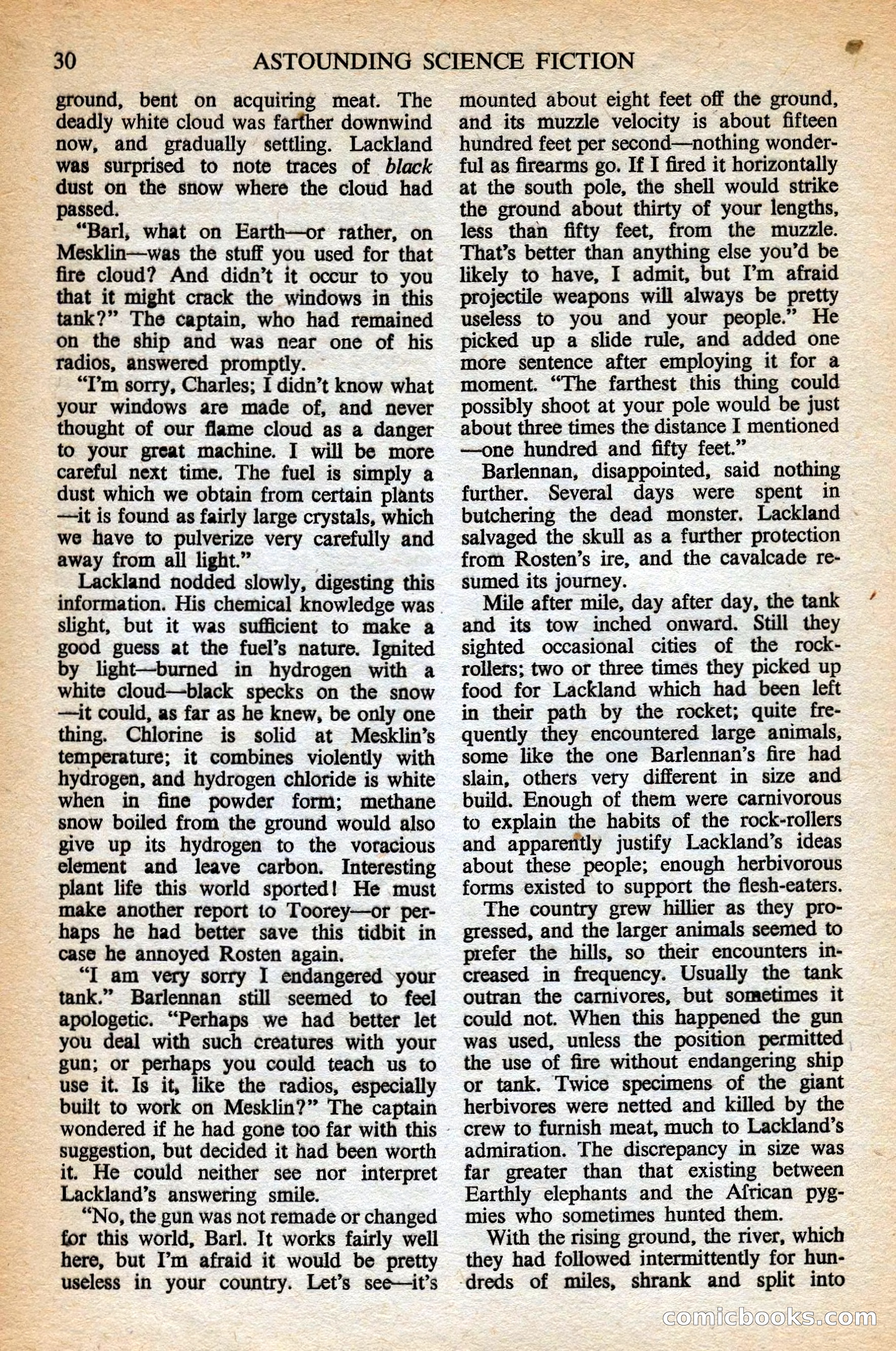
A restored page from Pulp Fiction, 1953. Page through the whole issue in the reader above.
📄 Transcribed text from this page (OCR, searchable)
Machine-transcribed from the original scan — historical spelling and the odd misread are preserved.
30 ASTOUNDING SCIENCE FICTION ground, bent on acquiring meat. The deadly white cloud was farther downwind now, and gradually settling. Lackland was surprised to note traces of black dust on the snow where the cloud had passed. “Barl, what on Earth—or rather, on Mesklin—was the stuff you used for that fire cloud? And didn’t it occur to you that it might crack the windows in this tank?” The captain, who had remained on the ship and was near one of his radios, answered promptly. “I’m sorry, Charles; I didn’t know what your windows are made of, and never thought of our flame cloud as a danger to your great machine. I will be more careful next time. The fuel is simply a dust which we obtain from certain plants —it is found as fairly large crystals, which we have to pulverize very carefully and away from all light.” Lackland nodded slowly, digesting this information. His chemical knowledge was | slight, but it was sufficient to make a good guess at the fuel’s nature. Ignited by light—burned in hydrogen with a white cloud—black specks on the snow —dit could, as far as he knew, be only one thing. Chlorine is solid at Méesklin’s temperature; it combines violently with hydrogen, and hydrogen chloride is white when in fine powder form; methane snow boiled from the ground would also give up its hydrogen to the voracious element and leave carbon. Interesting plant life this world sported! He must make another report to Toorey—or per- haps he had better save this tidbit in case he annoyed Rosten again. “I am very sorry I endangered -your tank.” Barlennan still seemed to feel apologetic. “Perhaps we had better let you deal with such creatures with your gun; or perhaps you could teach us to use it. Is it, like the radios, especially built to work on Mesklin?” The captain wondered if he had gone too far with this - suggestion, but decided it had been worth it. He could neither see nor interpret Lackland’s answering smile. “No, the gun was not remade or changed for this world, Barl. It works fairly well here, but I’m afraid it would be pretty useless in your country. Let’s see—it’s mounted about eight feet off the ground, and its muzzle velocity is about fifteen hundred feet per second—nothing wonder- ful as firearms go. If I fired it horizontally at the south pole, the shell would strike the ground about thirty of your lengths, less than fifty feet, from the muzzle. That’s better than anything else you’d be likely to have, I admit, but I’m afraid projectile weapons will always be pretty useless to you and your people.” He picked up a slide rule, and added one more sentence after employing it for a moment. “The farthest this thing could possibly shoot at your pole would be just about three times the distance I mentioned —one hundred and fifty feet.” Barlennan, disappointed, said nothing further. Several days were spent in butchering the dead monster. Lackland . salvaged the skull as a further protection from Rosten’s ire, and the cavalcade re- sumed its journey. Mile after mile, day after day, the tank and its tow inched onward. Still they sighted occasional cities of the rock- rollers; two or three times they picked up food for Lackland which had been left in their path by the rocket; quite fre- quently they encountered large animals, some like the one Barlennan’s fire had slain, others very different in size and build. Enough of them were carnivorous to explain the habits of the rock-rollers and appareritly justify Lackland’s ideas about these people; enough herbivorous forms existed to support the flesh-eaters. The country grew hillier as they pro- gressed, and the larger animals seemed to prefer the hills, so their encounters in- creased in frequency. Usually the tank outran the carnivores, but sometimes it could not. When this happened the gun was used, unless the position permitted the use of fire without endangering ship or tank. Twice specimens of the giant herbivores were netted and killed by the crew to furnish meat, much to Lackland’s admiration. The discrepancy in size was far greater than that existing between Earthly elephants and the African pyg- mies who sometimes hunted them. With the rising ground, the river, which they had followed intermittently for hun- -dreds of miles, shrank and split into GoOmichbookssco