
Pulp Fiction, 1953 · page 26 of 68
Astounding British Edition, Vol. 9, No. 10 — page 26: what you’re looking at
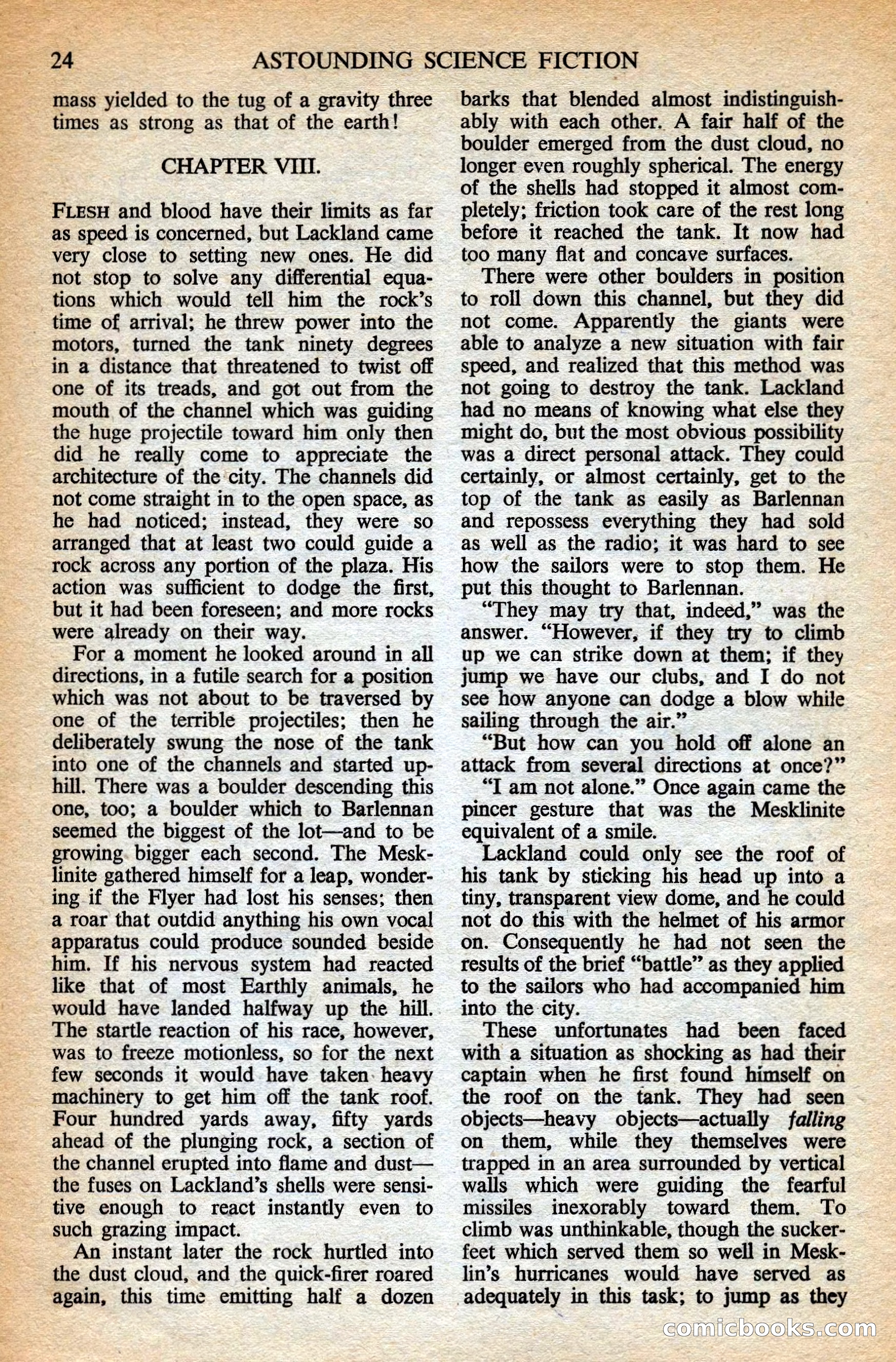
A restored page from Pulp Fiction, 1953. Page through the whole issue in the reader above.
📄 Transcribed text from this page (OCR, searchable)
Machine-transcribed from the original scan — historical spelling and the odd misread are preserved.
3 mass yielded to the tug of a gravity three times as strong as that of the earth! CHAPTER VIII. FLESH and blood have their limits as far as speed is concerned, but Lackland came very close to setting new ones. He did not stop to solve any differential equa- tions which would tell him the rock’s _ time of arrival; he threw power into the motors, turned the tank ninety degrees in a distance that threatened to twist off one of its treads, and got out from the mouth of the channel which was guiding the huge projectile toward him only then did he really come to appreciate the architecture of the city. The channels did not come straight in to the open space, as he had noticed; instead, they were so arranged that at least two could guide a rock across any portion of the plaza. His action was sufficient to dodge the first, but it had been foreseen; and more rocks were already on their way. For a moment he looked around in all directions, in a futile search for a position which was not about to be traversed by one of the terrible projectiles; then he deliberately swung the nose of the tank into one of the channels and started up- hill. There was a boulder descending this one, too; a boulder which to Barlennan seemed the biggest of the lot—and to be growing. bigger each second. The Mesk- linite gathered himself for a leap, wonder- ing if the Flyer had lost his senses; then a roar that outdid anything his own vocal apparatus could produce sounded beside him. If his nervous system had reacted like that of most Earthly animals, he would have landed halfway up the hill. The startle reaction of his race, however, was to freeze motionless, so for the next few seconds it would have taken: heavy machinery to get him off the tank roof. Four hundred yards away, fifty yards ahead of the plunging rock, a section of the channel erupted into flame and dust— the fuses on Lackland’s shells were sensi- tive enough to react instantly even to such grazing impact. An instant later the rock hurtled into the dust cloud, and the quick-firer roared again, this time emitting half a dozen ASTOUNDIN G SCIENCE FICTION barks that blended almost indistinguish- ably with each other. A fair half of the boulder emerged from the dust cloud, no longer even roughly spherical. The energy of the shells had stopped it almost com- pletely; friction took care of the rest long before it reached the tank. It now had too many flat and concave surfaces. There were other boulders in position to roll down this channel, but they did not come. Apparently the giants were able to analyze a new situation with fair speed, and realized that this method was not going to destroy the tank. Lackland had no means of knowing what else they might do, but the most obvious possibility was a direct personal attack. They could certainly, or almost certainly, get to the top of the tank as easily as Barlennan and repossess everything they had sold as well as the radio; it was hard to see how the sailors were to stop them. He put this thought to Barlennan. “They may try that, indeed,” was the answer. “However, if they try to climb up we can strike down at them; if they jump we have our clubs, and I do not see how anyone can dodge a blow while sailing through the air.” “But how can you hold off alone an attack from several directions at once?” “I am not alone.” Once again came the pincer gesture that was the Mesklinite equivalent of a smile. Lackland could only see the roof of his tank by sticking his head up into a tiny, transparent view dome, and he could not do this with the helmet of his armor on. Consequently he had not seen the results of the brief “battle” as they applied to the sailors who had accompanied him into the city. These unfortunates had been faced with a situation as shocking as had their captain when he first found himself on the roof on the tank. They had seen objects—heavy objects—actually falling on them, while they themselves were trapped in an area surrounded by vertical walls which were guiding the fearful missiles inexorably toward them. To climb was unthinkable, though the sucker- feet which served them so well in Mesk- lin’s hurricanes would have served as adequately in this task; to jump as they GEomichbooks (E@)