
Pulp Fiction, 1953 · page 18 of 68
Astounding British Edition, Vol. 9, No. 10 — page 18: what you’re looking at
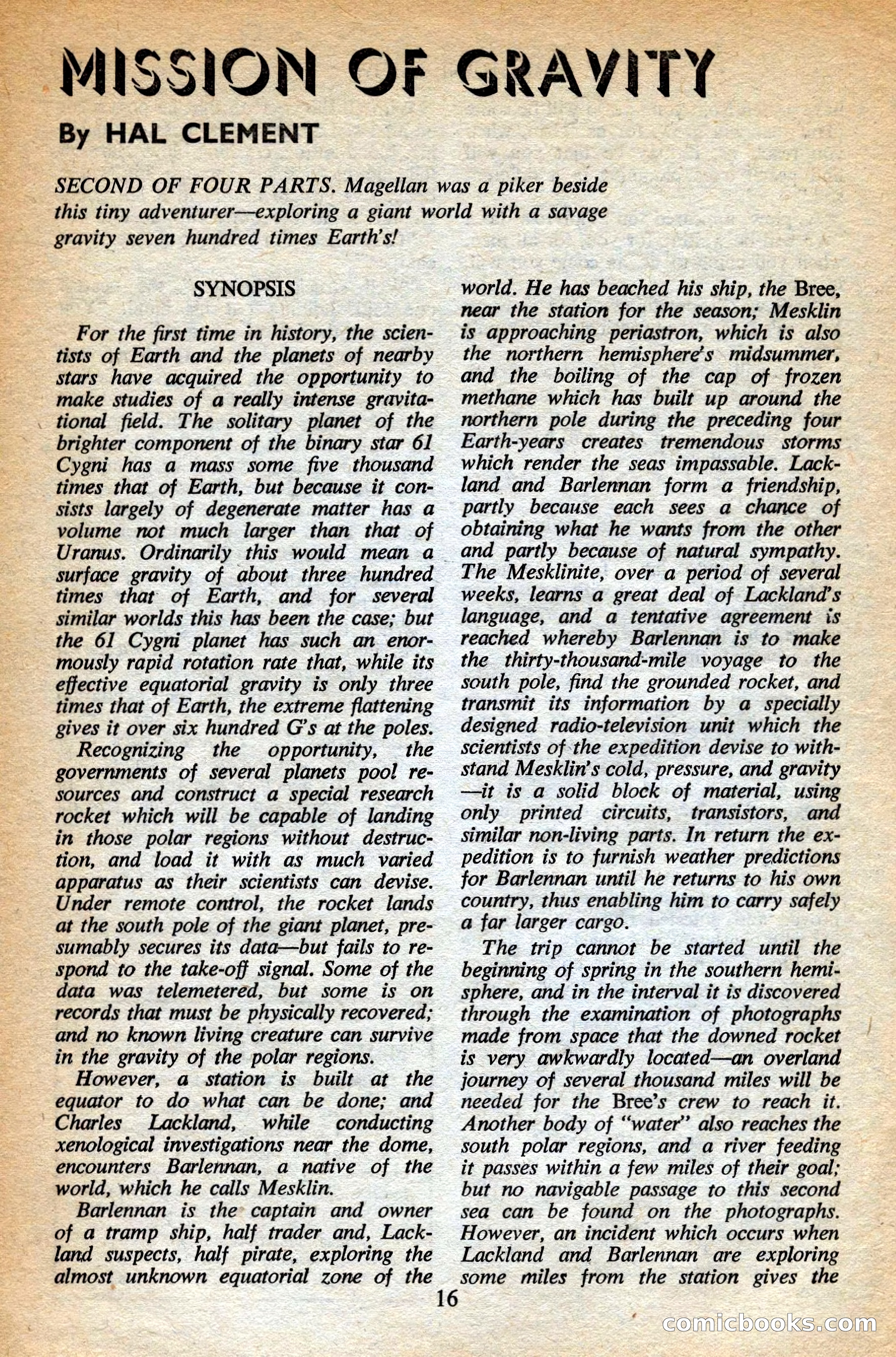
A restored page from Pulp Fiction, 1953. Page through the whole issue in the reader above.
📄 Transcribed text from this page (OCR, searchable)
Machine-transcribed from the original scan — historical spelling and the odd misread are preserved.
—? Hod acer Sn ee oe Prd TP aes tai nie he eee * > 3 2S ee oe Ke re <= ae oy tet eS ees > .- -, a - a > cas - yt By HAL CLEMENT “MISSION OF GRAVITY SECOND OF FOUR PARTS. Magellan was a piker beside this tiny adventurer—exploring a giant world with a savage gravity seven hundred times Earth's! SYNOPSIS For the first time in history, the scien- tists of Earth and the planets of nearby stars have acquired the opportunity to make studies of a really intense gravita- tional field. The solitary planet of the brighter component of the binary star 61 Cygni has a mass some five thousand times that of Earth, but because it con- sists largely of degenerate matter has a volume not much larger than that of Uranus. Ordinarily this would mean a surface gravity of about three hundred times that of Earth, and for several _ similar worlds this has been the case; but ~ Charles the 61 Cygni planet has such an enor- mously rapid rotation rate that, while its effective equatorial gravity is only three times that of Earth, the extreme flattening gives it over six hundred G's at the poles. Recognizing the opportunity, the governments of several planets pool re- sources and construct a special research rocket which will be capable of landing in those polar regions without destruc- tion, and load it with as much varied apparatus as their scientists can devise. Under remote control, the rocket lands at the south pole of the giant planet, pre- sumably secures its data—but fails to re- spond to the take-off signal. Some of the data was telemetered, but some is on records that must be physically recovered; and no known living creature can survive in the gravity of the polar regions. However, a station is built at the equator to do what can be done; and Lackland, while conducting xenological investigations near the dome, encounters Barlennan, a native of the world, which he calls Mesklin. Barlennan is the: captain and owner of a tramp ship, half trader and, Lack- land suspects, half pirate, exploring the almost unknown equatorial zone of the 16 world. He has beached his ship, the Bree, near the station for the season; Mesklin is approaching periastron, which is also the northern hemisphere’s midsummer, and the boiling of the cap of frozen methane which has built up around the northern pole during the preceding four Earth-years creates tremendous storms which render the seas impassable. Lack- land and Barlennan form a_ friendship, partly because each sees a chance of obtaining what he wants from the other and partly because of natural sympathy. The Mesklinite, over a period of several weeks, learns a great deal of Lackland’s © language, and a tentative agreement is reached whereby Barlennan is to make the thirty-thousand-mile voyage to the south pole, find the grounded rocket, and transmit its information by a_ specially designed radio-television unit which the scientists of the expedition devise to with- stand Mesklin’s cold, pressure, and gravity —it is a solid block of material, using only printed circuits, transistors, and similar non-living parts. In return the ex- pedition is to furnish weather predictions for Barlennan until he returns to his own country, thus enabling him to carry safely a far larger cargo. The trip cannot be started until the beginning of spring in the southern hemi- sphere, and in the interval it is discovered through the examination of photographs made from space that the downed rocket is very awkwardly located—an overland journey of several thousand miles will be needed for the Bree’s crew to reach it. Another body of “‘water’’ also reaches the south polar regions, and a river feeding it passes within a few miles of their goal; but no navigable passage to this second sea can be found on the photographs. However, an incident which occurs when Lackland and Barlennan are exploring some miles from the station gives the GOMIGdoOo SS (EO) j