
Pulp Fiction, 1953 · page 64 of 68
Astounding British Edition, Vol. 9, No. 7 — page 64: what you’re looking at
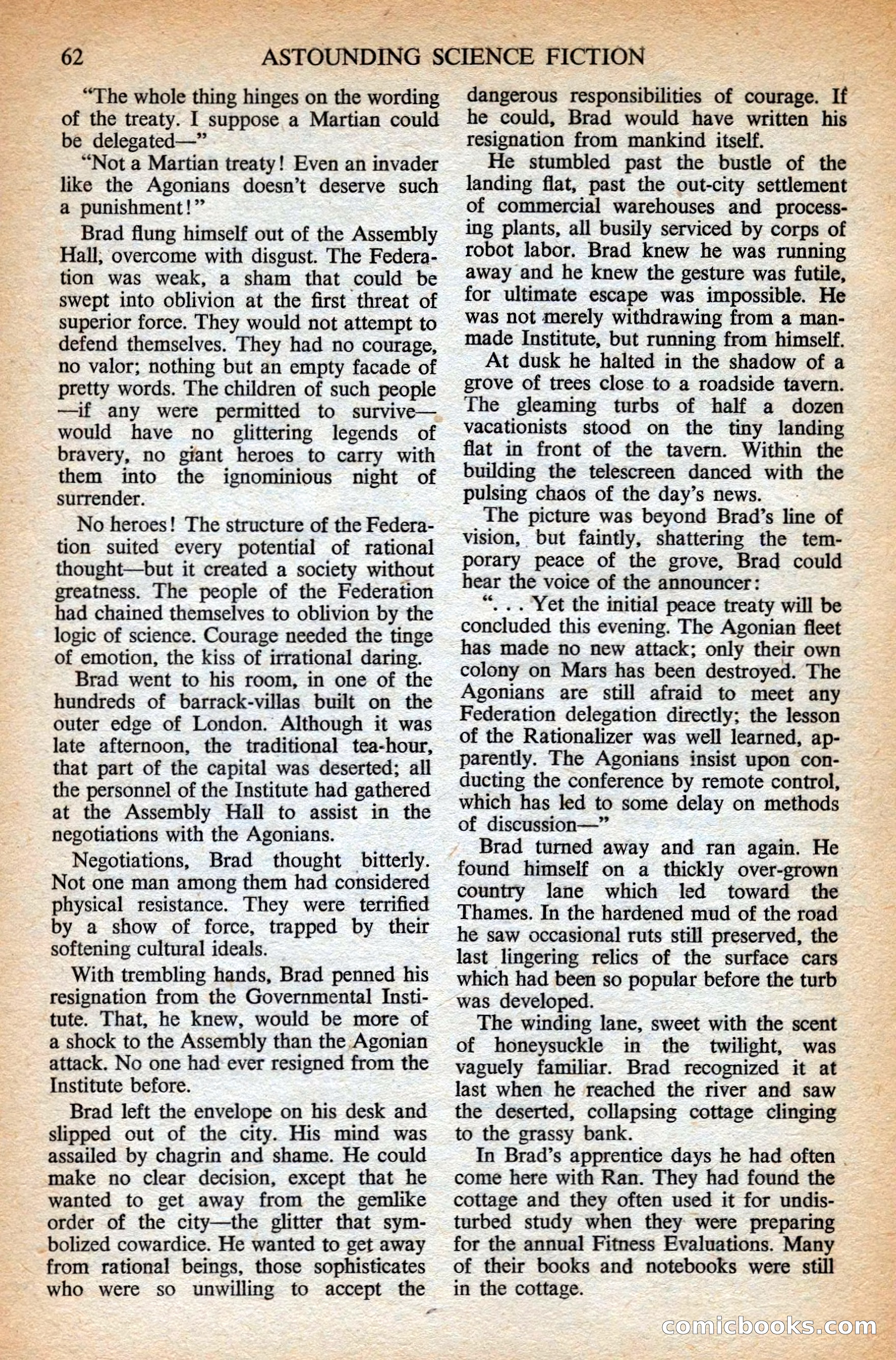
A restored page from Pulp Fiction, 1953. Page through the whole issue in the reader above.
📄 Transcribed text from this page (OCR, searchable)
Machine-transcribed from the original scan — historical spelling and the odd misread are preserved.
ASTOUNDING SCIENCE FICTION | “The whole thing hinges on the wording of the treaty. I suppose a Martian could be delegated—” “Not a Martian treaty! Even an invader like the Agonians doesn’t deserve such a punishment!” Brad flung himself out of the Assembly Hall; overcome with disgust. The Federa- tion was weak, a sham that could be swept into oblivion at the first threat of superior force. They would not attempt to defend themselves. They had no courage, no valor; nothing but an empty facade of pretty words. The children of such people —if any were permitted to survive— would have no glittering legends of bravery, no giant heroes to carry with them into the ignominious night | of surrender. No heroes! The structure of the Federa- tion suited every potential of rational thought—but it created a society without greatness. The people of the Federation had chained themselves to oblivion by the logic of science. Courage needed the tinge of emotion, the kiss of irrational daring. Brad went to his room, in one of the hundreds of barrack-villas built on the outer edge of London. Although it was late afternoon, the traditional tea-hour, that part of the capital was deserted; all the personnel of the Institute had gathered at the Assembly Hall to assist in the negotiations with the Agonians. Negotiations, Brad thought bitterly. Not one man among them had considered physical resistance. They were terrified by a show of force, trapped by their softening cultural ideals. With trembling hands, Brad penned his resignation from the Governmental Insti- tute. That, he knew, would be more of a shock to the Assembly than the Agonian attack. No one had ever resigned from the Institute before. Brad left the envelope on his desk and slipped out of the city. His mind was assailed by chagrin and shame. He could make no clear decision, except that he wanted to get away from the gemlike order of the city—the glitter that sym- _bolized cowardice. He wanted to get away from rational beings, those sophisticates who were so unwilling to accept the dangerous responsibilities of courage. If he could, Brad would have written his resignation from mankind itself. He stumbled past the bustle of the landing flat, past the out-city settlement of commercial warehouses and process- ing plants, all busily serviced by corps of robot labor. Brad knew he was running away and he knew the gesture was futile, for ultimate escape was impossible. He was not merely withdrawing from a man- made Institute, but running from himself. At dusk he halted in the shadow of a grove of trees close to a roadside tavern. The gleaming turbs of half a dozen vacationists stood on the tiny landing flat in front of the tavern. Within the building the telescreen danced with the pulsing chaos of the day’s news. The picture was beyond Brad’s line of vision, but faintly, shattering the tem- porary peace of the grove, Brad could hear the voice of the announcer: . Yet the initial peace treaty will be concluded this evening. The Agonian fleet has made no new attack; only their own colony on Mars has been destroyed. The Agonians are still afraid to meet any Federation delegation directly; the lesson of the Rationalizer was well learned, ap- parently. The Agonians insist upon con- ducting the conference by remote control, which has led to some delay on methods of discussion—” Brad turned away and ran again. He found himself on a thickly over-grown country lane which led toward the Thames. In the hardened mud of the road he saw occasional ruts still preserved, the last lingering relics of the surface cars which had been so popular before the turb was developed. The winding lane, sweet with the scent of honeysuckle in the twilight, was vaguely familiar. Brad recognized it at last when he reached the river and saw the deserted, collapsing cottage clinging to the grassy bank. In Brad’s apprentice days he had often . come here with Ran. They had found the cottage and they often used it for undis- turbed study when they were preparing for the annual Fitness Evaluations. Many of their books and notebooks were still in the cottage. oO GoOmichooks. co