
Pulp Fiction, 1953 · page 62 of 68
Astounding British Edition, Vol. 9, No. 7 — page 62: what you’re looking at
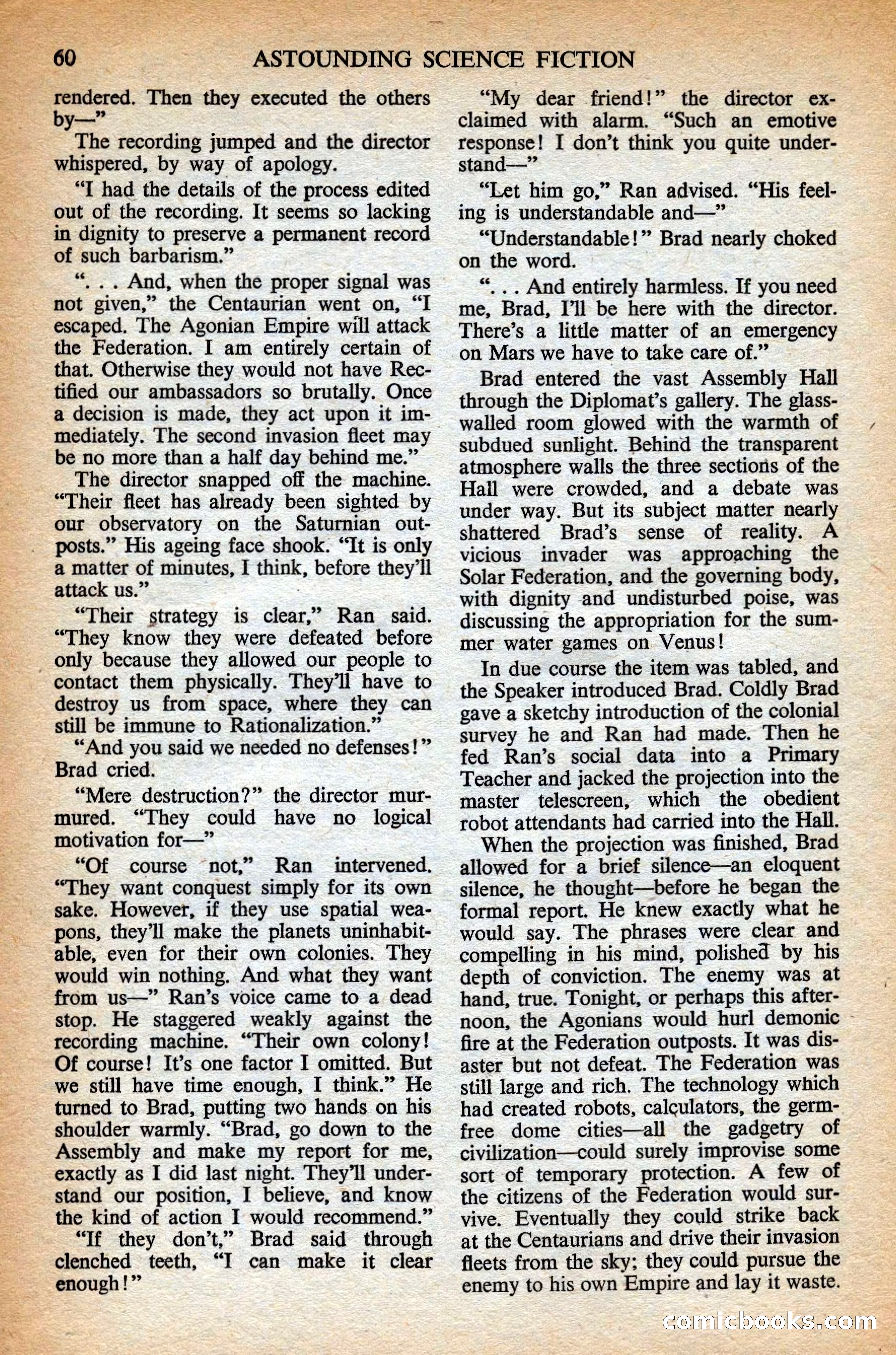
A restored page from Pulp Fiction, 1953. Page through the whole issue in the reader above.
📄 Transcribed text from this page (OCR, searchable)
Machine-transcribed from the original scan — historical spelling and the odd misread are preserved.
; ty ue le sa oe oe A 2 Oe ee 5%, é, oe ay ee? Ae C. = 7. tf es ) Ee Cte DT oS oa > we Tas OA AA ae Wats ty ath ¥ ry weeny sive Asad | a eA TE pe RAD s S ACs et my at Vee ay eee aa by TUS ee eS UIA AS es * ; a havin Poy [HY Ar > . ue p ; ’ Sy) 47h ‘ 5 . ¥ ‘ 4 J - ; , 4 uy i a naan ~ Neh a2 - ss 60 ~—~—s ASTOUNDING SCIENCE FICTION at rendered. Then they executed the others The recording jumped and the director whispered, by way of apology. “I had the details of the process edited out of the recording. It seems so lacking in dignity to preserve a permanent record of such barbarism.” “.. And, when the proper signal was not given,” the Centaurian went on, “I escaped. The Agonian Empire will attack the Federation. I am entirely certain of that. Otherwise they would not have Rec- tified our ambassadors so brutally. Once a decision is made, they act upon it im- mediately. The second invasion fleet may be no more than a half day behind me.” The director snapped off the machine. “Their fleet has already been sighted by our observatory on the Saturnian out- posts.” His ageing face shook. “It is only a matter of minutes, I think, before they'll attack us.” 3 “Their strategy is clear,’ Ran said. “They know they were defeated before _ only because they allowed our people to contact them physically. They'll have to destroy us from space, where they can still be immune to Rationalization.” __ “And you said we needed no defenses!” Brad cried. “Mere destruction?” the director mur- mured. “They could have no _ logical motivation for—” “Of course not,” Ran _ intervened. “They want conquest simply for its own sake. However, if they use spatial wea- pons, they’ll make the planets uninhabit- able, even for their own colonies. They would win nothing. And what they want from us—” Ran’s voice came to a dead stop. He staggered weakly against the recording machine. “Their own colony! Of course! It’s one factor I omitted. But we still have time enough, I think.” He turned to Brad, putting two hands on his shoulder warmly. “Brad, go down to the Assembly and make my report for me, exactly as I did last night. They'll under- stand our position, I believe, and know the kind of action I would recommend.” “If they don’t,” Brad said through clenched teeth, “I can make it clear enough!” “My dear friend!” the director ex- claimed with alarm. “Such an emotive response! I don’t think you quite under- stand—” “Let him go,” Ran advised. “His feel- ing is understandable and—” “Understandable!” Brad nearly choked on the word. “... And entirely harmless. If you need me, Brad, I'll be here with the director. There’s a little matter of an emergency on Mars we have to take care of.” Brad entered the vast Assembly Hall through the Diplomat’s gallery. The glass- walled room glowed with the warmth of subdued sunlight. Behind the transparent atmosphere walls the three sections of the Hall were crowded, and a debate was under way. But its subject matter nearly shattered Brad’s sense of reality. A vicious invader was approaching the Solar Federation, and the governing body, with dignity and undisturbed poise, was discussing the appropriation for the sum- mer water games on Venus! In due course the item was tabled, and the Speaker introduced Brad. Coldly Brad gave a sketchy introduction of the colonial survey he and Ran had made. Then he fed Ran’s social data into a Primary Teacher and jacked the projection into the master telescreen, which the obedient robot attendants had carried into the Hall. When the projection was finished, Brad allowed for a brief silence—an eloquent silence, he thought—before he began the formal report. He knew exactly what he would say. The phrases were clear and compelling in his mind, polished by his depth of conviction. The enemy was at hand, true. Tonight, or perhaps this after- noon, the Agonians would hurl demonic - fire at the Federation outposts. It was dis- aster but not defeat. The Federation was still large and rich. The technology which had created robots, calculators, the germ- free dome cities—all the gadgetry of civilization—could surely improvise some sort of temporary protection. A few of the citizens of the Federation would sur- vive. Eventually they could strike back at the Centaurians and drive their invasion fleets from the sky; they could pursue the enemy to his own Empire and lay it waste. ComicbooksrEol