
Pulp Fiction, 1953 · page 47 of 68
Astounding British Edition, Vol. 9, No. 7 — page 47: what you’re looking at
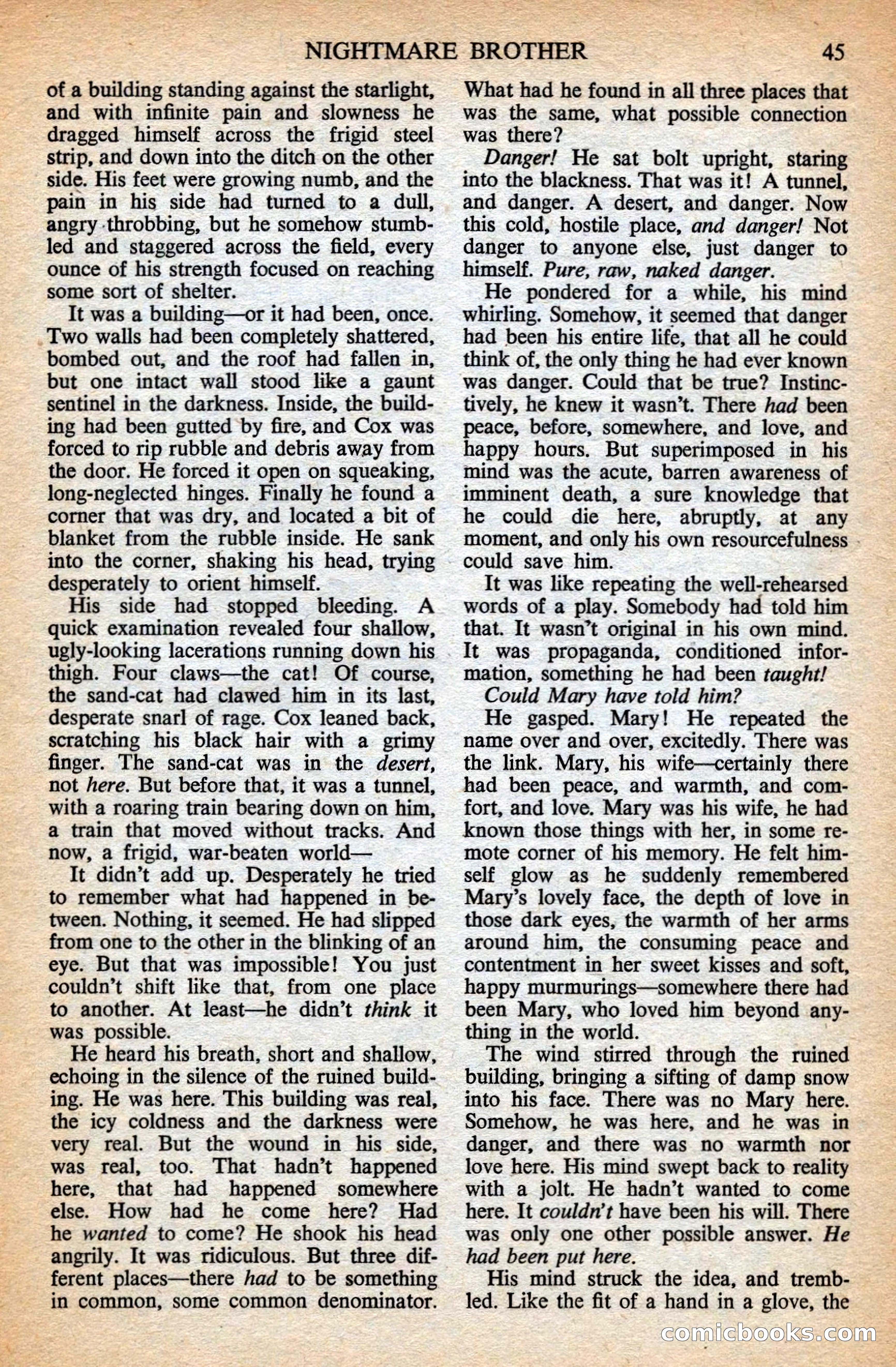
A restored page from Pulp Fiction, 1953. Page through the whole issue in the reader above.
📄 Transcribed text from this page (OCR, searchable)
Machine-transcribed from the original scan — historical spelling and the odd misread are preserved.
—~ P ai 3, OO Bo - > ~ . — as - — athe’ = ; += * NIGHTMARE BROTHER of a building standing against the starlight, and with infinite pain and slowness he dragged himself across the frigid steel strip, and down into the ditch on the other side. His feet were growing numb, and the pain in his side had turned to a dull, angry ‘throbbing, but he somehow stumb- led and staggered across the field, every ounce of his strength focused on reaching some sort of shelter. It was a building—or it had been, once. _Two walls had been completely shattered, bombed out, and the roof had fallen in, but one intact wall stood like a gaunt sentinel in the darkness. Inside, the build- ing had been gutted by fire, and Cox was forced to rip rubble and debris away from the door. He forced it open on squeaking, long-neglected hinges. Finally he found a corner that was dry, and located a bit of blanket from the rubble inside. He sank into the corner, shaking his head, trying desperately to orient himself. His side had stopped bleeding. A quick examination revealed four shallow, ugly-looking lacerations running down his thigh. Four claws—the cat! Of course, the sand-cat had clawed him in its last, desperate snarl of rage. Cox leaned back, scratching his black hair with a grimy finger. The sand-cat was in the desert, not here. But before that, it was a tunnel, with a roaring train bearing down on him, a train that moved without tracks. And now, a frigid, war-beaten world— It didn’t add up. Desperately he tried to remember what had happened in be- tween. Nothing, it seemed. He had slipped from one to the other in the blinking of an eye. But that was impossible! You just couldn’t shift like that, from one place to another. At least—he didn’t think it was possible. He heard his breath, short and shallow, echoing in the silence of the ruined build- ing. He was here. This building was real, the icy coldness and the darkness were very real. But the wound in his side, was real, too. That hadn’t happened here, that had happened somewhere else. How had he come here? Had he wanted to come? He shook his head angrily. It was ridiculous. But three dif- ferent places—there had to be something in common, some common denominator. ~~ ——- —— ~ a. _—— <= a" -< a De _ * ee i ee b we en Paes 5 3 = . soe a2 ane oe oe, Se 45 What had he found in all three places that was the same, what possible connection was there? Danger! He sat bolt upright, staring into the blackness. That was it! A tunnel, and danger. A desert, and danger. Now this cold, hostile place, and danger! Not danger to anyone else, just danger to himself. Pure, raw, naked danger. He pondered for a while, his mind whirling. Somehow, it seemed that danger had been his entire life, that all he could think of, the only thing he had ever known was danger. Could that be true? Instinc- tively, he knew it wasn’t. There had been peace, before, somewhere, and love, and happy hours. But superimposed in his mind was the acute, barren awareness of imminent death, a sure knowledge that he could die here, abruptly, at any moment, and only his own resourcefulness - could save him. It was like repeating the well-rehearsed words of a play. Somebody had told him that. It wasn’t original in his own mind. It was propaganda, conditioned infor- mation, something he had been taught! Could Mary have told him? He gasped. Mary! He repeated the name over and over, excitedly. There was the link. Mary, his wife—certainly there had been peace, and warmth, and com- fort, and love. Mary was his wife, he had known those things with her, in some re- mote corner of his memory. He felt him- self glow as he suddenly remembered Mary’s lovely face, the depth of love in those dark eyes, the warmth of her arms around him, the consuming peace and contentment in her sweet kisses and soft, happy murmurings—somewhere there had been Mary, who loved him beyond any- thing in the world. The wind stirred through the ruined building, bringing a sifting of damp snow into his face. There was no Mary here. Somehow, he was here, and he was in danger, and there was no warmth nor love here. His mind swept back to reality with a jolt. He hadn’t wanted to come here. It couldn’t have been his will. There was only one other possible answer. He had been put here. His mind struck the idea, and tremb- led. Like the fit of a hand in a glove, the COMMEMOOKSaeO