
Pulp Fiction, 1953 · page 40 of 68
Astounding British Edition, Vol. 9, No. 7 — page 40: what you’re looking at
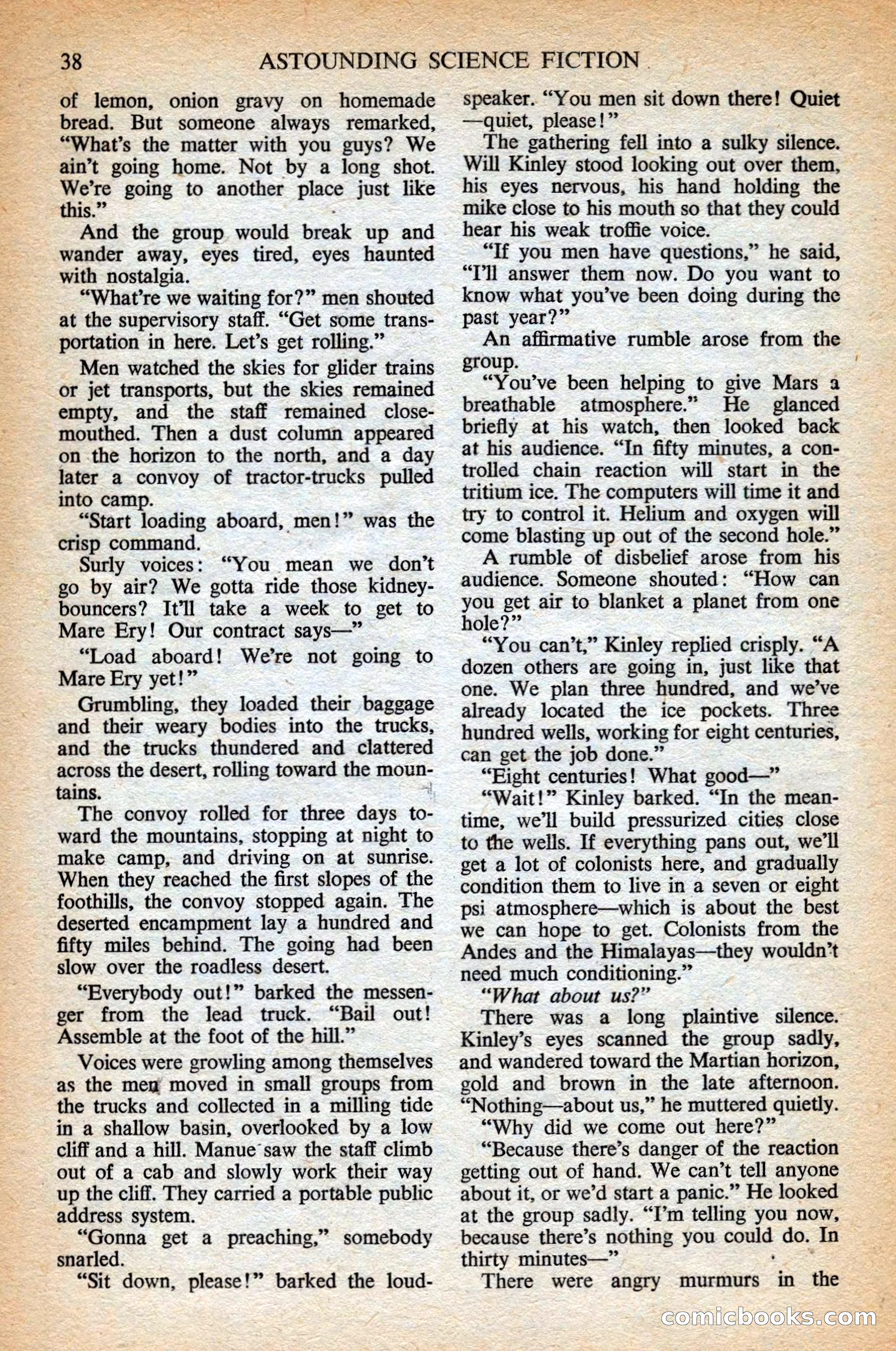
A restored page from Pulp Fiction, 1953. Page through the whole issue in the reader above.
📄 Transcribed text from this page (OCR, searchable)
Machine-transcribed from the original scan — historical spelling and the odd misread are preserved.
of lemon, onion gravy on homemade bread. But someone always remarked, “What’s the matter with you guys? We ain’t going home. Not by a long shot. aoe going to another place just like The : And the group would break up and wander away, eyes tired, eyes haunted with nostalgia. “What're we waiting for?” men shouted at the supervisory staff. “Get some trans- portation in here. Let’s get rolling.” Men watched the skies for glider trains or jet transports, but the skies remained empty, and the staff remained close- mouthed. Then a dust column appeared on the horizon to the north, and a day later a convoy of tractor-trucks pulled into camp. “Start loading aboard, men!” was the crisp command. Surly voices: “You mean we don’t go by air? We gotta ride those kidney- bouncers? It'll take a week to get to Mare Ery! Our contract says— “Load aboard! We're not going to Mare Ery yet!” Grumbling, they loaded their baggage and their weary bodies into the trucks, and the trucks thundered and clattered across the desert, rolling toward the moun- tains. The convoy rolled for three days to- ward the mountains, stopping at night to make camp, and driving on at sunrise. When they reached the first slopes of the foothills, the convoy stopped again. The deserted encampment lay a hundred and fifty miles behind. The going had been slow over the roadless desert. “Everybody out!” barked the messen- ger from the lead truck. “Bail out! Assemble at the foot of the hill.” Voices were growling among themselves as the meg moved in small groups from the trucks and collected in a milling tide in a shallow basin, overlooked by a low cliff and a hill. Manue’saw the staff climb out of a cab and slowly work their way up the cliff. They carried a portable public address system. “Gonna get a preaching,” snarled. “Sit down, please!” barked the loud- somebody er tee See Ng oh i Pik Cie Tce a Nem OR ee “es es= = pe SN hee ee gC ae - . : or = “a2 ~ a ie em 3 YF Se oS <= Ine ASTOUNDING SCIENCE FICTION : 2 speaker. “You men sit down there! Quiet See ed —quiet, please! The gathering fell into a sulky silence. Will Kinley stood looking out over them, his eyes nervous, his hand holding the mike close to his mouth so that they could hear his weak troffie voice. “If you men have questions,” he said, “Tl answer them now. Do you want to know what you’ve been doing during the past year?” An affirmative rumble arose from the group. “You've been helping to give Mars a breathable atmosphere.” He _ glanced briefly at his watch, then looked back at his audience. “In fifty minutes, a con- trolled chain reaction will start in the tritium ice. The computers will time it and try to control it. Helium and oxygen will come blasting up out of the second hole.” A rumble of disbelief arose from his audience. Someone shouted: “How can you get air to blanket a planet from one hole?” “You can’t,” Kinley replied crisply. “A dozen others are going in, just like that one. We plan three hundred, and we’ve already located the ice pockets. Three hundred wells, working for eight centuries, can get the job done.” “Right centuries! What good—” “Wait!” Kinley barked. “In the mean- time, we'll build pressurized cities close to the wells. If everything pans out, we'll get a lot of colonists here, and gradually condition them to live in a seven or eight psi atmosphere—which is about the best we can hope to get. Colonists from the Andes and the Himalayas—they wouldn't need much conditioning.” “What about us?” There was a long plaintive silence. Kinley’s eyes scanned the group sadly, and wandered toward the Martian horizon, gold and brown in the late afternoon. “Nothing—about us,” he muttered quietly. “Why did we come out here?” “Because there’s danger of the reaction getting out of hand. We can t tell anyone about it, or we’d start a panic.” He looked at the group sadly. “I’m telling you now, because there’s nothing you coun do. In thirty minutes—” There were angry murmurs in the EOmMmichbooks cc LAA