
Pulp Fiction, 1953 · page 38 of 68
Astounding British Edition, Vol. 9, No. 7 — page 38: what you’re looking at
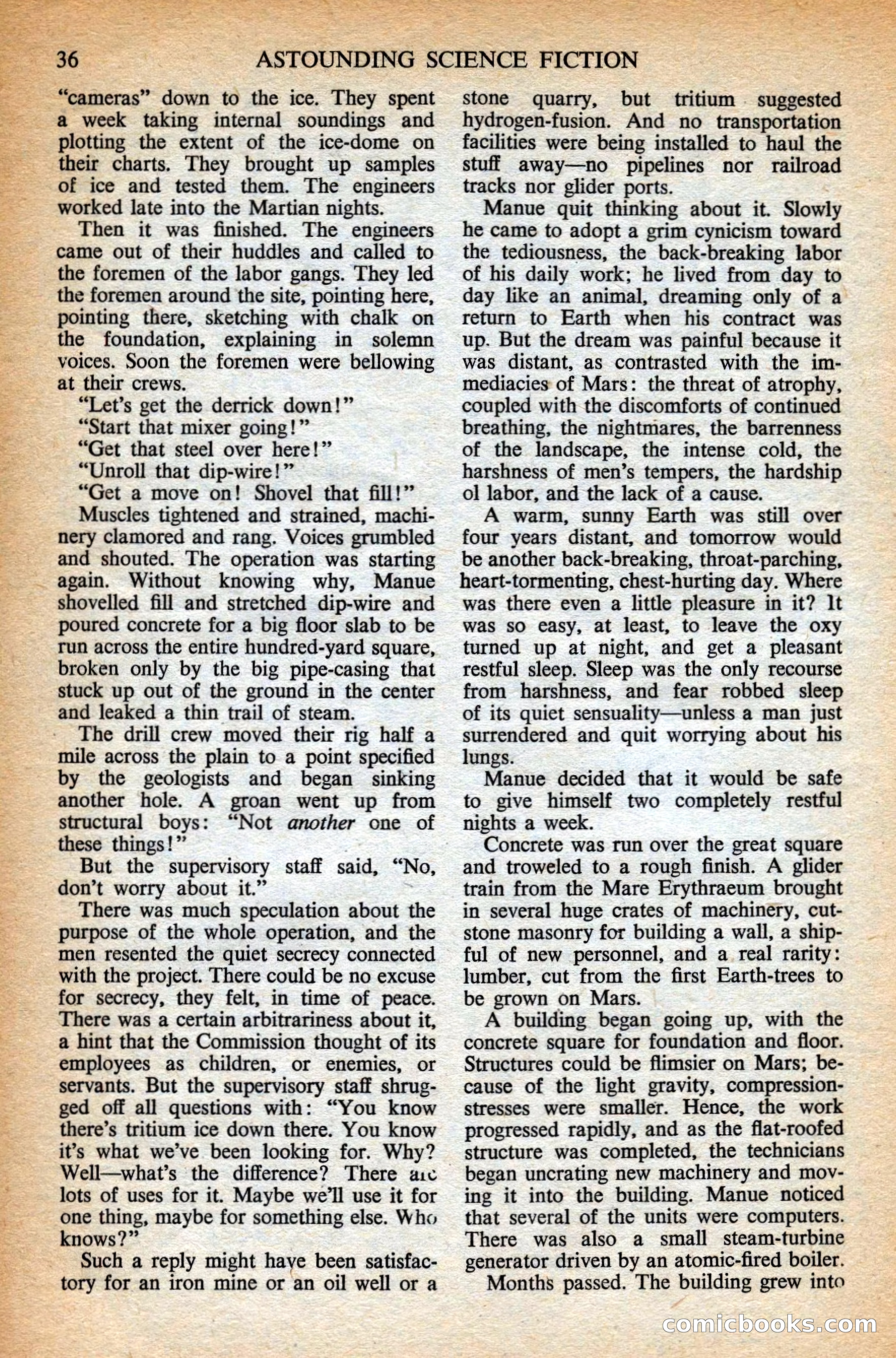
A restored page from Pulp Fiction, 1953. Page through the whole issue in the reader above.
📄 Transcribed text from this page (OCR, searchable)
Machine-transcribed from the original scan — historical spelling and the odd misread are preserved.
| “eaheras” down to the ice. They spent _ a week taking internal soundings and _ plotting the extent of the ice-dome on _ their charts. They brought up samples Of ice and tested them. The engineers worked late into the Martian nights. Then it was finished. The engineers came out of their huddles and called to the foremen of the labor gangs. They led __ the foremen around the site, pointing here, __-pointing there, sketching with chalk on the foundation, explaining in solemn voices. Soon the foremen were bellowing at their crews. “Let’s get the derrick down!” “Start that mixer going!” “Get that steel over here!” “Unroll that dip-wire!” “Get a move on! Shovel that fill!” Muscles tightened and strained, machi- nery clamored and rang. Voices grumbled and shouted. The operation was starting again. Without knowing why, Manue shovelled fill and stretched dip-wire and poured concrete for a big floor slab to be run across the entire hundred-yard square, broken only by the big pipe-casing that stuck up out of the ground in the center and leaked a thin trail of steam. The drill crew moved their rig half a mile across the plain to a point specified by the geologists and began sinking another hole. A groan went up from structural boys: “Not another one of these things!” But the supervisory staff said, don’t worry about it.” There was much speculation about the purpose of the whole operation, and the ‘ yy 4 ’ : ; 7 « . iw i , 1 bss i tea sete iian een tw y Peete Pe - py ¥ tend , are With “N re) * eA nt eat . ‘ . " ___ men resented the quiet secrecy connected ___with the project. There could be no excuse ___ for secrecy, they felt, in time of peace. There was a certain arbitrariness about it, a hint that the Commission thought of its = employees as children, or enemies, or ___ servants. But the supervisory staff shrug- ged off all questions with: “You know = there’s tritium ice down there. You know = it’s what we’ve been looking for. Why? lots of uses for it. Maybe we'll use it for One thing, maybe for something else. Who knows?” Such a reply might have been satisfac- - tory for an iron mine or an oil well or a cx \ > > . , " ") + é mv) at, ; my Sih okt : ff? Vs a ah , ee t\ ’ rid iJ weet . r\ ae ———.. * a - —eS ~ = —= “+= Ae * oe de et == a s “ Well—what’s the difference? There aic - > 7” ye a — et pe! Tere = 7 * - _ ss S a a a ware ~ ASTOUNDING SCIENCE | FICTI ION stone quarry, but tritium » suggested hydrogen-fusion. And no transportation facilities were being installed to haul the stuff away—no pipelines nor railroad tracks nor glider ports. Manue quit thinking about it. Slowly he came to adopt a grim cynicism toward the tediousness, the back-breaking labor of his daily work; he lived from day to day like an animal, dreaming only of a return to Earth when his contract was up. But the dream was painful because it was distant, as contrasted with the im- mediacies of Mars: the threat of atrophy, coupled with the discomforts of continued breathing, the nightmares, the barrenness of the landscape, the intense cold, the harshness of men’s tempers, the hardship ol labor, and the lack of a cause. A warm, sunny Earth was still over four years distant, and tomorrow would be another back-breaking, throat-parching, heart-tormenting, chest-hurting day. Where was there even a little pleasure in it? It was so easy, at least, to leave the oxy turned up at night, and get a pleasant restful sleep. Sleep was the only recourse from harshness, and fear robbed sleep of its quiet sensuality—unless a man just surrendered and quit worrying about his lungs. Manue decided that it would be safe to give himself two completely restful nights a week. Concrete was run over the great square and troweled to a rough finish. A glider train from the Mare Erythraeum brought in several huge crates of machinery, cut- stone masonry for building a wall, a ship- ful of new personnel, and a real rarity: lumber, cut from the first Earth-trees to be grown on Mars. A building began going up, with the concrete square for foundation and floor. Structures could be flimsier on Mars; be- cause of the light gravity, compression- stresses were smaller. Hence, the work progressed rapidly, and as the flat-roofed structure was completed, the technicians began uncrating new machinery and mov- ing it into the building. Manue noticed that several of the units were computers. There was also a small steam-turbine generator driven by an atomic-fired boiler. Months passed. The building grew into GEOMIGdoOO (©) <S) ae