
Pulp Fiction, 1953 · page 33 of 68
Astounding British Edition, Vol. 9, No. 7 — page 33: what you’re looking at
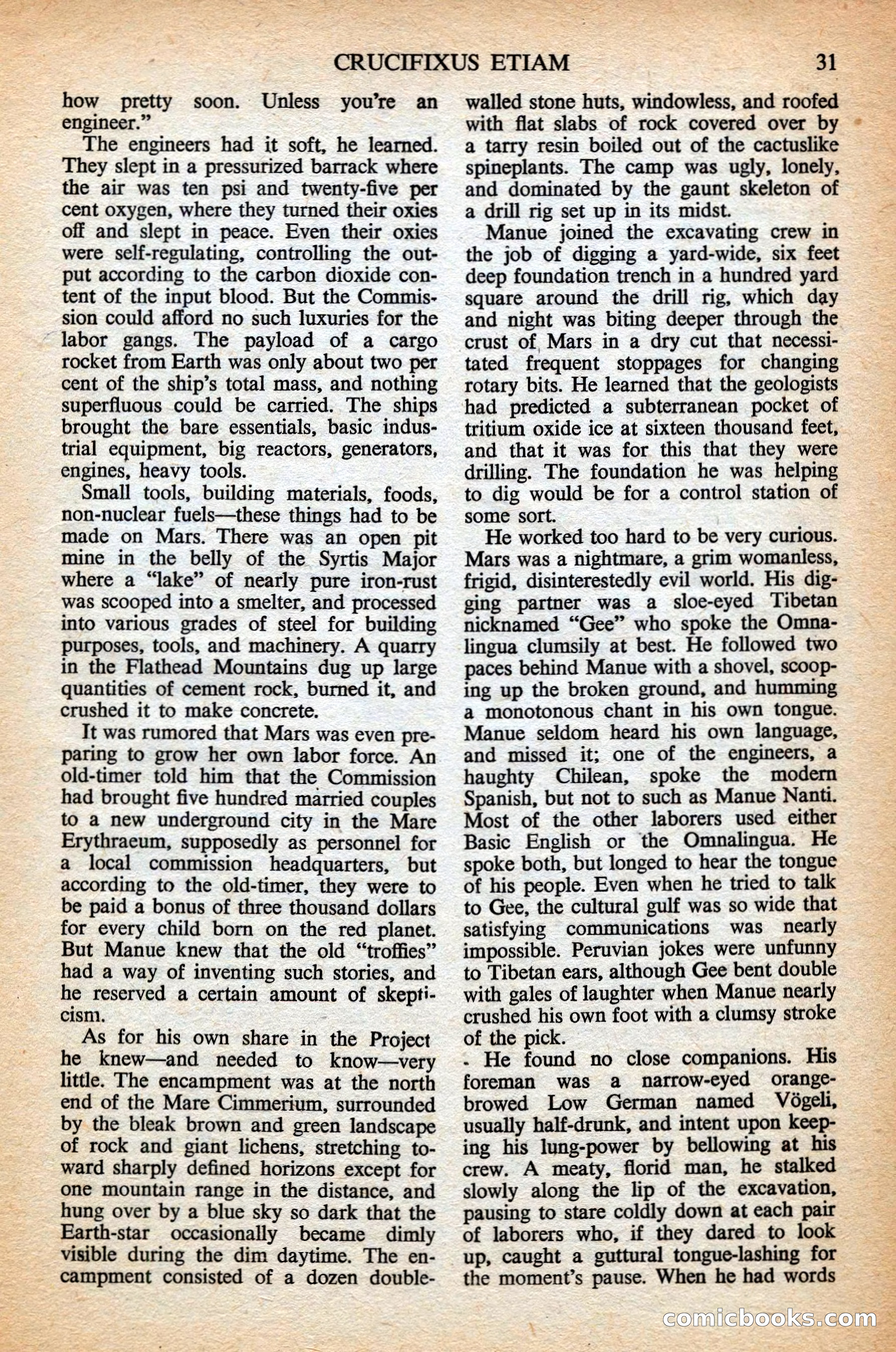
A restored page from Pulp Fiction, 1953. Page through the whole issue in the reader above.
📄 Transcribed text from this page (OCR, searchable)
Machine-transcribed from the original scan — historical spelling and the odd misread are preserved.
CRUCIFIXUS ETIAM how pretty soon. Unless you’re an engineer.” The engineers had it soft, he learned. They slept in a pressurized barrack where the air was ten psi and twenty-five per cent oxygen, where they turned their oxies off and slept in peace. Even their oxies were self-regulating, controlling the out- put according to the carbon dioxide con- tent of the input blood. But the Commis- sion could afford no such luxuries for the labor gangs. The payload of a cargo rocket from Earth was only about two per cent of the ship’s total mass, and nothing superfluous could be carried. The ships brought the bare essentials, basic indus- trial equipment, big reactors, generators, engines, heavy tools. Small tools, building materials, foods, non-nuclear fuels—these things had to be made on Mars. There was an open pit mine in the belly of the Syrtis Major where a “lake” of nearly pure iron-rust was scooped into a smelter, and processed into various grades of steel for building purposes, tools, and machinery. A quarry in the Flathead Mountains dug up large quantities of cement rock, burned it, and crushed it to make concrete. It was rumored that Mars was even pre- paring to grow her own labor force. An old-timer told him that the Commission had brought five hundred married couples to a new underground city in the Mare Erythraeum, supposedly as personnel for a local commission headquarters, but according to the old-timer, they were to be paid a bonus of three thousand dollars for every child born on the red planet. But Manue knew that the old “troffies” had a way of inventing such stories, and he reserved a certain amount of skepti- cism. As for his own share in the Project he knew—and needed to know—very little. The encampment was at the north end of the Mare Cimmerium, surrounded by the bleak brown and green landscape of rock and giant lichens, stretching to- ward sharply defined horizons except for one mountain range in the distance, and hung over by a blue sky so dark that the Earth-star occasionally became dimly visible during the dim daytime. The en- _ Campment consisted of a dozen double- 31 walled stone huts, windowless, and roofed with flat slabs of rock covered over by a tarry resin boiled out of the cactuslike spineplants. The camp was ugly, lonely, and dominated by the gaunt skeleton of a drill rig set up in its midst. Manue joined the excavating crew in the job of digging a yard-wide, six feet deep foundation trench in a hundred yard square around the drill rig, which day and night was biting deeper through the crust of Mars in a dry cut that necessi- tated frequent stoppages for changing rotary bits. He learned that the geologists had predicted a subterranean pocket of tritium oxide ice at sixteen thousand feet, and that it was for this that they were drilling. The foundation he was helping to dig would be for a control station of some sort. He worked too hard to be very curious. Mars was a nightmare, a grim womanless, frigid, disinterestedly evil world. His dig- ging partner was a sloe-eyed ‘Tibetan nicknamed “Gee” who spoke the Omna- lingua clumsily at best. He followed two paces behind Manue with a shovel, scoop- ing up the broken ground, and humming a monotonous chant in his own tongue. Manue seldom heard his own language, and missed it; one of the engineers, a haughty Chilean, spoke the moder Spanish, but not to such as Manue Nanti. Most of the other laborers used either Basic English or the Omnalingua. He spoke both, but longed to hear the tongue of his people. Even when he tried to talk to Gee, the cultural gulf was so wide that satisfying communications was nearly impossible. Peruvian jokes were unfunny to Tibetan ears, although Gee bent double with gales of laughter when Manue nearly crushed his own foot with a clumsy stroke of the pick. . He found no close companions. His foreman was a _ nafrow-eyed orange- browed Low German named Vo6Ogeli, usually half-drunk, and intent upon keep- ing his lung-power by bellowing at his crew. A meaty, florid man, he stalked slowly along the lip of the excavation, pausing to stare coldly down at each pair of laborers who, if they dared to look up, caught a guttural tongue-lashing for the moment’s pause. When he had words Gomichbooks ‘ ¥ if ] : | i pic ’ x BLY, Pe WENA, ex ¥ tt) né da ee Nin Pye ie