
Pulp Fiction, 1953 · page 30 of 68
Astounding British Edition, Vol. 9, No. 7 — page 30: what you’re looking at
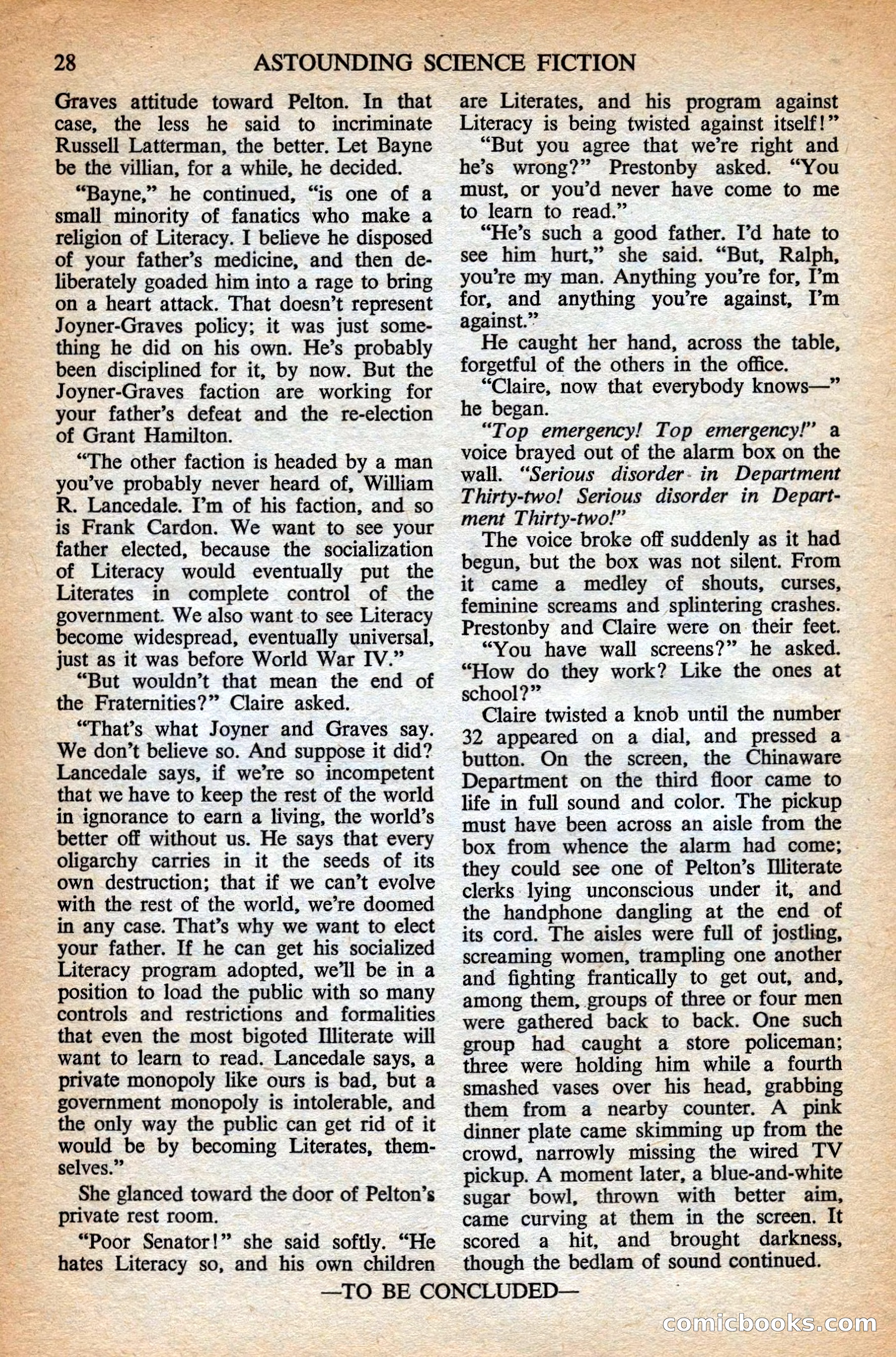
A restored page from Pulp Fiction, 1953. Page through the whole issue in the reader above.
📄 Transcribed text from this page (OCR, searchable)
Machine-transcribed from the original scan — historical spelling and the odd misread are preserved.
=a Keke t 2h Sa —- ~ Graves attitude toward Pelton. In that case, the less he said to incriminate Russell Latterman, the better. Let Bayne be the villian, for a while, he decided. “Bayne,” he continued, “is one of a ~small minority of fanatics who make a religion of Literacy. I believe he disposed of your father’s medicine, and then de- liberately goaded him into a rage to bring on a heart attack. That doesn’t represent Joyner-Graves policy; it was just some- thing he did on his own. He’s probably been disciplined for it, by now. But the Joyner-Graves faction are working for your father’s defeat and the re-election of Grant Hamilton. “The other faction is headed by a man you’ve probably never heard of, William R. Lancedale. ’m of his faction, and so is Frank Cardon. We want to see your father elected, because the socialization of Literacy would eventually put the Literates in complete control of the government. We also want -to see Literacy become widespread, eventually universal, just as it was before World War IV.” “But wouldn’t that mean the end of the Fraternities?” Claire asked. “That’s what Joyner and Graves say. We don’t believe so. And suppose it did? Lancedale says, if we’re so incompetent that we have to keep the rest of the world in ignorance to earn a living, the world’s better off without us. He says that every oligarchy carries in it the seeds of its - own destruction; that if we can’t evolve with the rest of the world, we’re doomed in any case. That’s why we want to elect your father. If he can get his socialized Literacy program adopted, we'll be in a position to load the public with so many controls and restrictions and formalities that even the most bigoted Illiterate will want to learn to read. Lancedale says, a private monopoly like ours is bad, but a government monopoly is intolerable, and the only way the public can get rid of it would be by becoming Literates, them- selves.” She glanced toward the door of Pelton’s private rest room. “Poor Senator!” she said softly. “He hates Literacy so, and his own children ASTOUNDING SCIENCE FICTION a are Literates, and his program against Literacy is being twisted against itself!” “But you agree that we’re right and he’s wrong?” Prestonby asked. “You must, or you'd never have come to me to learn to read.” “He’s such a good father. I’d hate to see him hurt,” she said. “But, Ralph, you're my man. Anything you’re for, I’m for, and anything you’re against, I’m against.” He caught her hand, across the table, forgetful of the others in the office. “Claire, now that everybody knows—” he began. “Top emergency! Top emergency!” a voice brayed out of the alarm box on the wall. “Serious disorder- in Department Thirty-two! Serious disorder in Depart- ment Thirty-two!” The voice broke off suddenly as it had begun, but the box was not silent. From it came a medley of shouts, curses, feminine screams and splintering crashes. Prestonby and Claire were on their feet. “You have wall screens?” he asked. “How do they work? Like the ones at school?” Claire twisted a knob until the number 32 appeared on a dial, and pressed a button. On the screen, the Chinaware Department on the third floor came to life in full sound and color. The pickup must have been across an aisle from the box from whence the alarm had come; . they could see one of Pelton’s Illiterate clerks lying unconscious under it, and the handphone dangling at the end of its cord. The aisles were full of jostling, screaming women, trampling one another and fighting frantically to get out, and, among them, groups of three or four men were gathered back to back. One such group had caught a store policeman: three were holding him while a fourth smashed vases over his head, grabbing them from a nearby counter. A pink dinner plate came skimming up from the crowd, narrowly missing the wired TV pickup. A moment later, a blue-and-white sugar bowl, thrown with better aim, came curving at them in the screen. It scored a hit, and brought darkness, though the bedlam of sound continued. —TO BE CONCLUDED— GoOmicbooks com.