
Pulp Fiction, 1953 · page 22 of 68
Astounding British Edition, Vol. 9, No. 7 — page 22: what you’re looking at
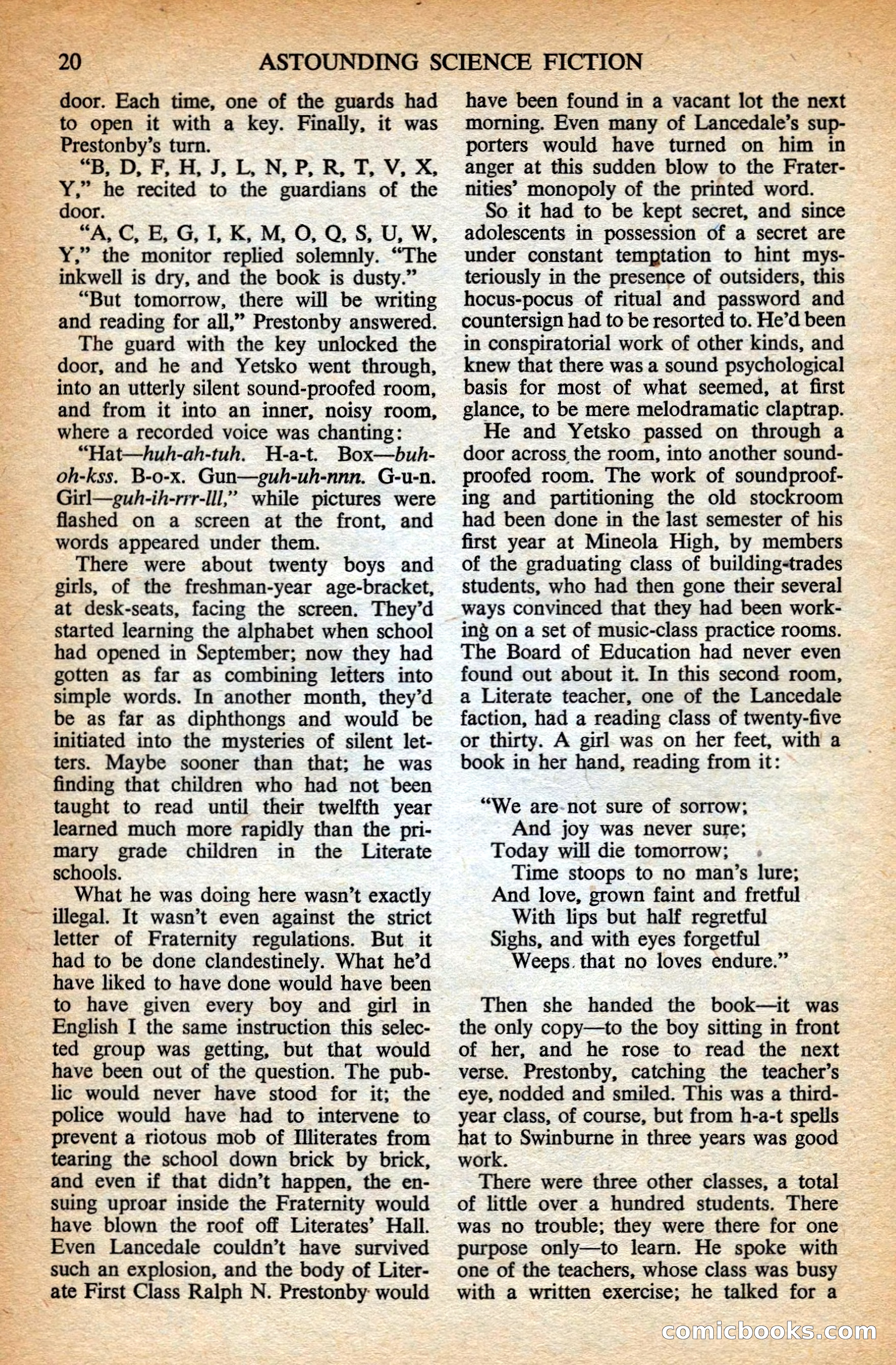
A restored page from Pulp Fiction, 1953. Page through the whole issue in the reader above.
📄 Transcribed text from this page (OCR, searchable)
Machine-transcribed from the original scan — historical spelling and the odd misread are preserved.
WAT A SS AR od ke Pe, rn WeRy LC hat earcat La SPA iv 9 sa mvs Pee Zl ean wae oe Tv tottnd ee Peskin teu RGER UA RAI AL iF AD Dg a 7 door. Each time, one of the guards had to open it with a key. Finally, it was __ Prestonby’s turn. “B, D, F, H, J, L, N, P, R, T, V, X, Y,” he recited to the guardians of the door. “A, C, E, G, I, K, M, O, Q, S, U, W, Y,” the monitor replied solemnly. “The inkwell is dry, and the book is dusty.” “But tomorrow, there will be writing and reading for all,” Prestonby answered. The guard with the key unlocked the door, and he and Yetsko went through, - into an utterly silent sound-proofed room, and from it into an inner, noisy room, where a recorded voice was chanting: “Hat—huh-ah-tuh. H-a-t. Box—buh- oh-kss. B-o-x. Gun—guh-uh-nnn. G-u-n. Girl—guh-ih-rrr-ill,’” while pictures were flashed on a screen at the front, and words appeared under them. There were about twenty boys and girls, of the freshman-year age-bracket, at desk-seats, facing the screen. They’d started learning the alphabet when school had opened in September; now they had gotten as far as combining letters into simple words. In another month, they’d be as far as diphthongs and would be initiated into the mysteries of silent let- ters. Maybe sooner than that; he was finding that children who had not been taught to read until their twelfth year learned much more rapidly than the pri- mary grade children in the Literate schools. What he was doing here wasn’t exactly - illegal. It wasn’t even against the strict letter of Fraternity regulations. But it had to be done clandestinely. What he’d have liked to have done would have been to have given every boy and girl in English I the same instruction this selec- ted group was getting, but that would have been out of the question. The pub- lic would never have stood for it; the police would have had to intervene to prevent a riotous mob of Illiterates from tearing the school down brick by brick, and even if that didn’t happen, the en- suing uproar inside the Fraternity would have blown the roof off Literates’ Hall. Even Lancedale couldn’t have survived such an explosion, and the body of Liter- _ ate First Class Ralph N. Prestonby: would ASTOUNDING SCIENCE FICTION have been found in a vacant lot the next morning. Even many of Lancedale’s sup- porters would have turned on him in anger at this sudden blow to the Frater- nities’ monopoly of the printed word. So it had to be kept secret, and since adolescents in possession of a secret are under constant temptation to hint mys- teriously in the presence of outsiders, this hocus-pocus of ritual and password and countersign had to be resorted to. He’d been in conspiratorial work of other kinds, and knew that there was a sound psychological basis for most of what seemed, at first glance, to be mere melodramatic claptrap. He and Yetsko passed on through a door across the room, into another sound- proofed room. The work of soundproof- ing and partitioning the old stockroom had been done in the last semester of his first year at Mineola High, by members of the graduating class of building-trades students, who had then gone their several ways convinced that they had been work- ing on a set of music-class practice rooms. The Board of Education had never even found out about it. In this second room, a Literate teacher, one of the Lancedale faction, had a reading class of twenty-five or thirty. A girl was on her feet, with a book in her hand, reading from it: “We are-not sure of sorrow; And joy was never sure; Today will die tomorrow; Time stoops to no man’s lure; And love, grown faint and fretful With lips but half regretful Sighs, and with eyes forgetful Weeps. that no loves endure.” Then she handed the book—it was the only copy—to the boy sitting in front of her, and he rose to read the next verse. Prestonby, catching the teacher’s ~ eye, nodded and smiled. This was a third- year class, of course, but from h-a-t spells hat to Swinburne in three years was good work. There were three other classes, a total of little over a hundred students. There was no trouble; they were there for one purpose onl i one of the teachers, whose class was busy with a written exercise; he talked for a cComicbooksseom —