
Pulp Fiction, 1953 · page 13 of 68
Astounding British Edition, Vol. 9, No. 7 — page 13: what you’re looking at
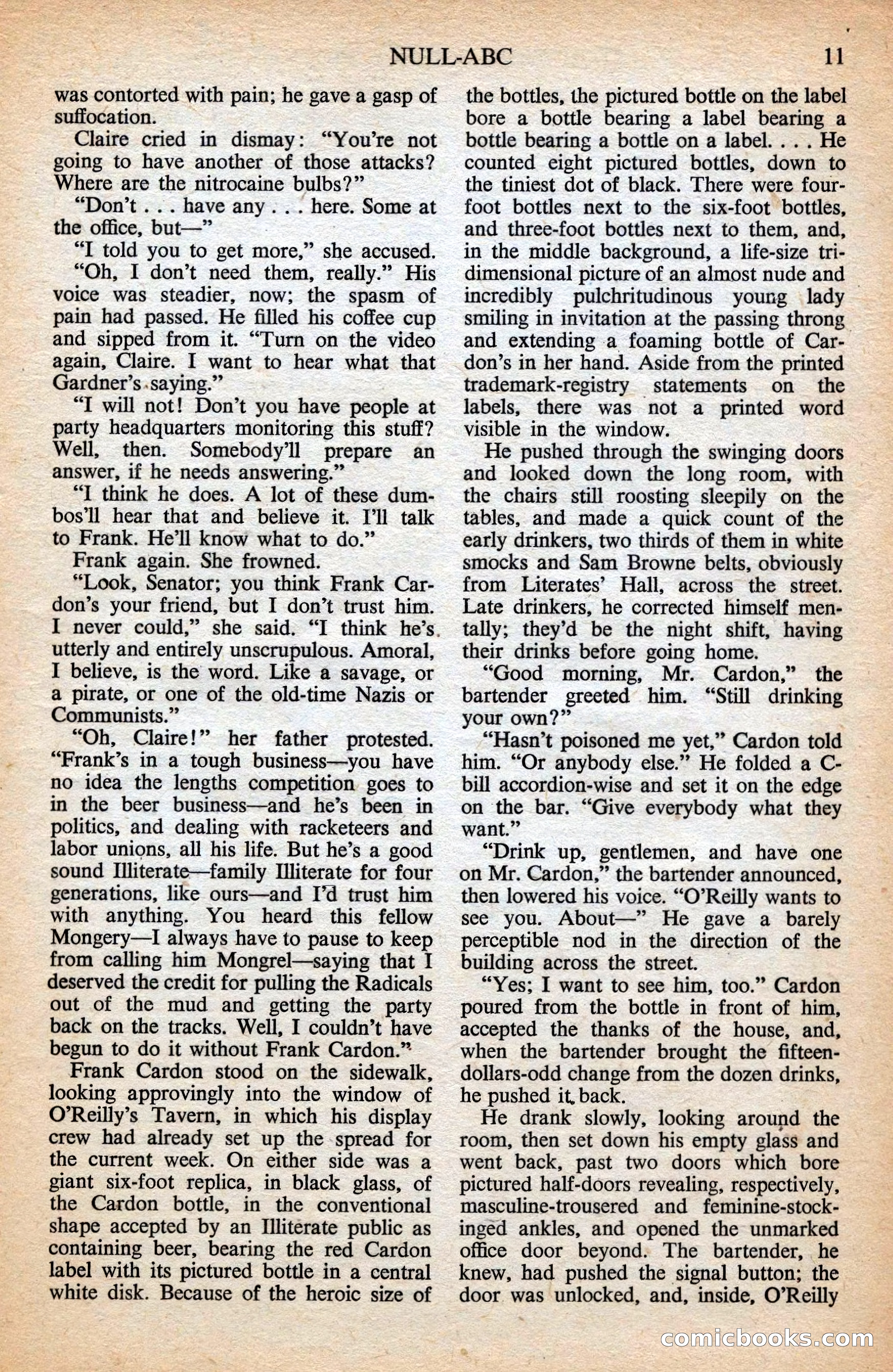
A restored page from Pulp Fiction, 1953. Page through the whole issue in the reader above.
📄 Transcribed text from this page (OCR, searchable)
Machine-transcribed from the original scan — historical spelling and the odd misread are preserved.
NULL-ABC was contorted with pain; he gave a gasp of suffocation. Claire cried in dismay: “You're not _ going to have another of those attacks? Where are the nitrocaine bulbs?” “Don’t ... have any... here. Some at the office, but—” . “I told you to get more,” she accused. “Oh, I don’t need them, really.” His voice was steadier, now; the spasm of pain had passed. He filled his coffee cup and sipped from it. “Turn on the video again, Claire. I want to hear what that Gardner’s .saying.” “I will not! Don’t you have people at party headquarters monitoring this stuff? Well, then. Somebody’ll prepare an answer, if he needs answering.” “I think he does. A lot of these dum- bos’ll hear that and believe it. I'll talk to Frank. He’ll know what to do.” Frank again. She frowned. “Look, Senator; you think Frank Car- don’s your friend, but I don’t trust him. I never could,” she said. “I think he’s. utterly and entirely unscrupulous. Amoral, I believe, is the word. Like a savage, or a pirate, or one of the old-time Nazis or Communists.” “Oh, Claire!” her father protested. “Frank’s in a tough business—you have no idea the lengths competition goes to in the beer business—and he’s been in politics, and dealing with racketeers and labor unions, all his life. But he’s a good sound Illiterate—family Illiterate for four generations, like ours—and I’d trust him with anything. You heard this fellow Mongery—lI always have to pause to keep from calling him Mongrel—saying that I deserved the credit for pulling the Radicals out of the mud and getting the party back on the tracks. Well, I couldn’t have begun to do it without Frank Cardon.” Frank Cardon stood on the sidewalk, looking approvingly into the window of O’Reilly’s Tavern, in which his display crew had already set up the-spread for the current week. On either side was a giant six-foot replica, in black glass, of the Cardon bottle, in the conventional shape accepted by an Illiterate public as containing beer, bearing the red Cardon label with its pictured bottle in a central white disk. Because of the heroic size of 1] the bottles, the pictured bottle on the label bore a bottle bearing a label bearing a bottle bearing a bottle on a label. . . . He counted eight pictured bottles, down to the tiniest dot of black. There were four- foot bottles next to the six-foot bottles, and three-foot bottles next to them, and, in the middle background, a life-size tri- dimensional picture of an almost nude and — incredibly pulchritudinous young lady smiling in invitation at the passing throng and extending a foaming bottle of Car- don’s in her hand. Aside from the printed trademark-registry statements on _ the labels, there was not a printed word visible in the window. He pushed through the swinging doors and looked down the long room, with the chairs still roosting sleepily on the tables, and made a quick count of the early drinkers, two thirds of them in white smocks and Sam Browne belts, obviously from Literates’ Hall, across the street. Late drinkers, he corrected himself men- tally; they’d be the night shift, having their drinks before going home. “Good morning, Mr. Cardon,” the bartender greeted him. “Still drinking your own?” ““Hasn’t poisoned me yet,” Cardon told him. “Or anybody else.” He folded a C- bill accordion-wise and set it on the edge on the bar. “Give everybody what they want.” “Drink up, gentlemen, and have one on Mr. Cardon,” the bartender announced, then lowered his voice. “O’Reilly wants to see you. About—” He gave a barely perceptible nod in the direction of the building across the street. “Yes; I want to see him, too.” Cardon poured from the bottle in front of him, accepted the thanks of the house, and, when the bartender brought the fifteen- dollars-odd change from the dozen drinks, he pushed it, back. He drank slowly, looking around the room, then set down his empty glass and went back, past two doors which bore pictured half-doors revealing, respectively, masculine-trousered and feminine-stock- inged ankles, and opened the unmarked office door beyond. The bartender, he knew, had pushed the signal button; the door was unlocked, and, inside, O’Reilly Eomichbooks.co m