
Pulp Fiction, 1953 · page 23 of 68
Astounding British Edition, May 1953 — page 23: what you’re looking at
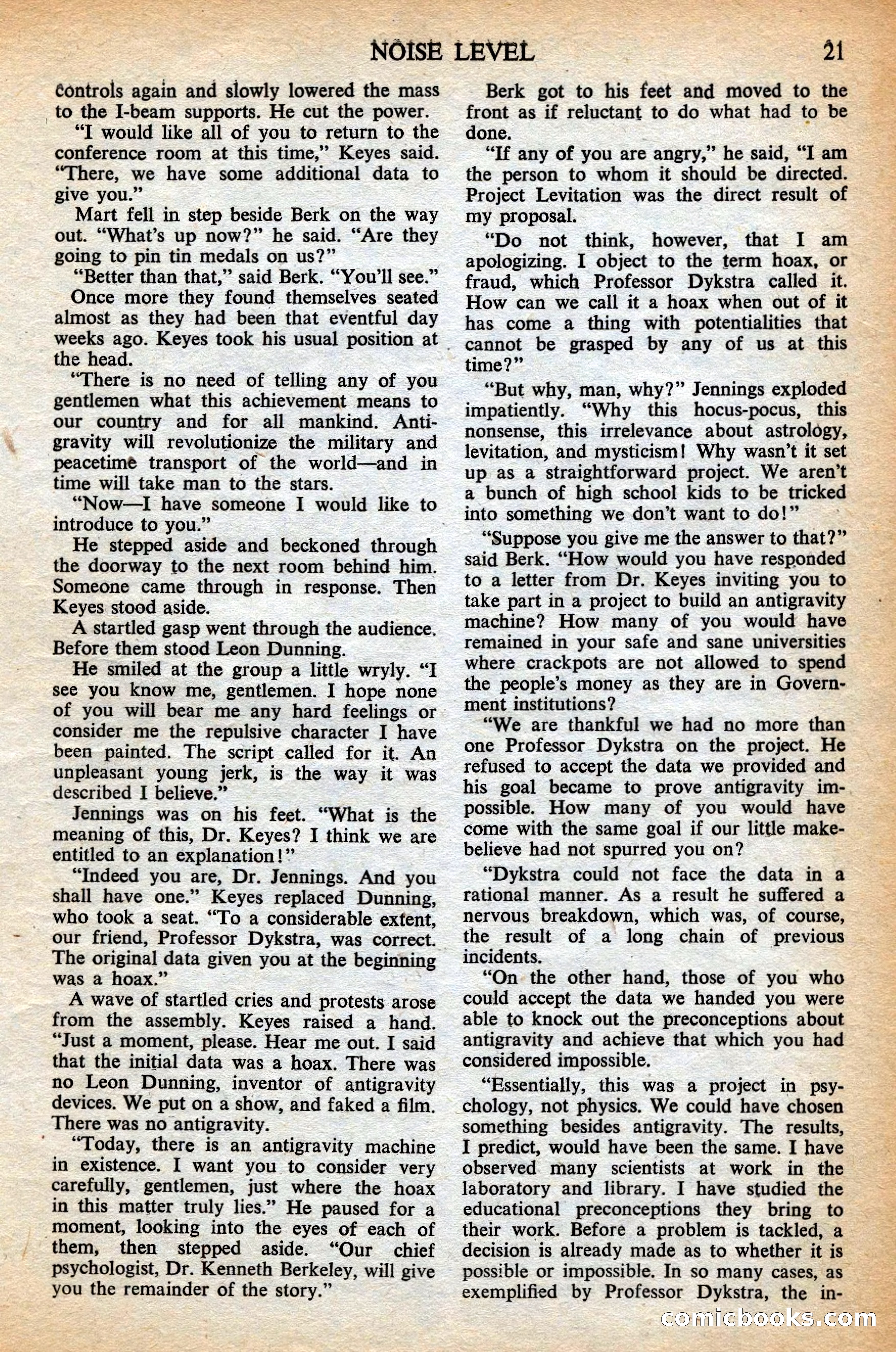
A restored page from Pulp Fiction, 1953. Page through the whole issue in the reader above.
📄 Transcribed text from this page (OCR, searchable)
Machine-transcribed from the original scan — historical spelling and the odd misread are preserved.
€ontrols again and slowly lowered the mass _to the I-beam supports. He cut the power. “I would like all of you to return to the conference room at this time,’’ Keyes said. “There, we have some additional data to give you.” Mart fell in step beside Berk on the way out. “What’s up now?” he said. “Are they going to pin tin medals on us?” “Better than that,” said Berk. “You'll see.” Once more they found themselves seated almost as they had been that eventful day weeks ago. Keyes took his usual position at — the head. “There is no need of telling any of you gentlemen what this achievement means to our country and for all mankind. Anti- gravity will revolutionize the military and peacetimé transport of the world—and in time will take man to the stars. ““"Now—I have someone I would like to introduce to you.” He stepped aside and beckoned through the doorway to the next room behind him. Someone came through in response. Then Keyes stood aside. A startled gasp went through the audience. Before them stood Leon Dunning. He smiled at the group a little wryly. “I see you know me, gentlemen. I hope none of you will bear me any hard feelings or consider me the repulsive character I have been painted. The script called for it. An unpleasant young jerk, is the way it was described I believe.” Jennings was on his feet. “What is the meaning of this, Dr. Keyes? I think we are entitled to an explanation!”’ “Indeed you are, Dr. Jennings. And you shall have one.” Keyes replaced Dunning, who took a seat. “To a considerable extent, our friend, Professor Dykstra, was correct. The original data given you at the beginning was a hoax.” A wave of startled cries and protests arose from the assembly. Keyes raised a hand. “Just a moment, please. Hear me out. I said that the initial data was a hoax. There was no Leon Dunning, inventor of antigravity devices. We put on a show, and faked a film. There was no antigravity. “Today, there is an antigravity machine in existence. I want you to consider very carefully, gentlemen, just where the hoax in this matter truly lies.’ He paused for a moment, looking into the eyes of each of them, then stepped aside. “Our chief psychologist, Dr. Kenneth Berkeley, will give you the remainder of the story.” NOISE LEVEL - 21 Berk got to his feet and moved to the front as if reluctant to do what had to be done. “If any of you are angry,” he said, “I am the person to whom it should be directed. Project Levitation was the direct result of my proposal. “Do not think, however, that I am apologizing. I object to the term hoax, or fraud, which Professor Dykstra called it. How can we call it a hoax when out of it has come a thing with potentialities that cannot be grasped by any of us at this time?” “But why, man, why?” Jennings exploded impatiently. “Why this hocus-pocus, this nonsense, this irrelevance about astrology, levitation, and mysticism! Why wasn’t it set up as a straightforward project. We aren’t a bunch of high school kids to be tricked into something we don’t want to do!” “Suppose you give me the answer to that?” said Berk. “‘How would you have responded to a letter from Dr. Keyes inviting you to take part in a project to build an antigravity machine? How many of you would have remained in your safe and sane universities where crackpots are not allowed to spend the people’s money as they are in Govern- ment institutions? “We are thankful we had no more than one Professor Dykstra on the project. He refused to accept the data we provided and his goal became to prove antigravity im- possible. How many of you would have come with the same goal if our little make- believe had not spurred you on? “Dykstra could not face the data in a rational manner. As a result he suffered a nervous breakdown, which was, of course, the result of a long chain of previous incidents. “On the other hand, those of you who could accept the data we handed you were able to knock out the preconceptions about antigravity and achieve that which you had considered impossible. “Essentially, this was a project in psy- chology, not physics. We could have chosen something besides antigravity. The results, I predict, would have been the same. I have observed. many scientists at work in the laboratory and library. I have studied the educational preconceptions they bring to their work. Before a problem is tackled, a decision is already made as to whether it is possible or impossible. In so many cases, as exemplified by Professor Dykstra, the in- Eomicbooks: co ee a ae ae 4 Aw Ys. ~~ 7 a te ont & ran Bh Pa) Ca? ES