
Pulp Fiction, 1953 · page 12 of 68
Astounding British Edition, May 1953 — page 12: what you’re looking at
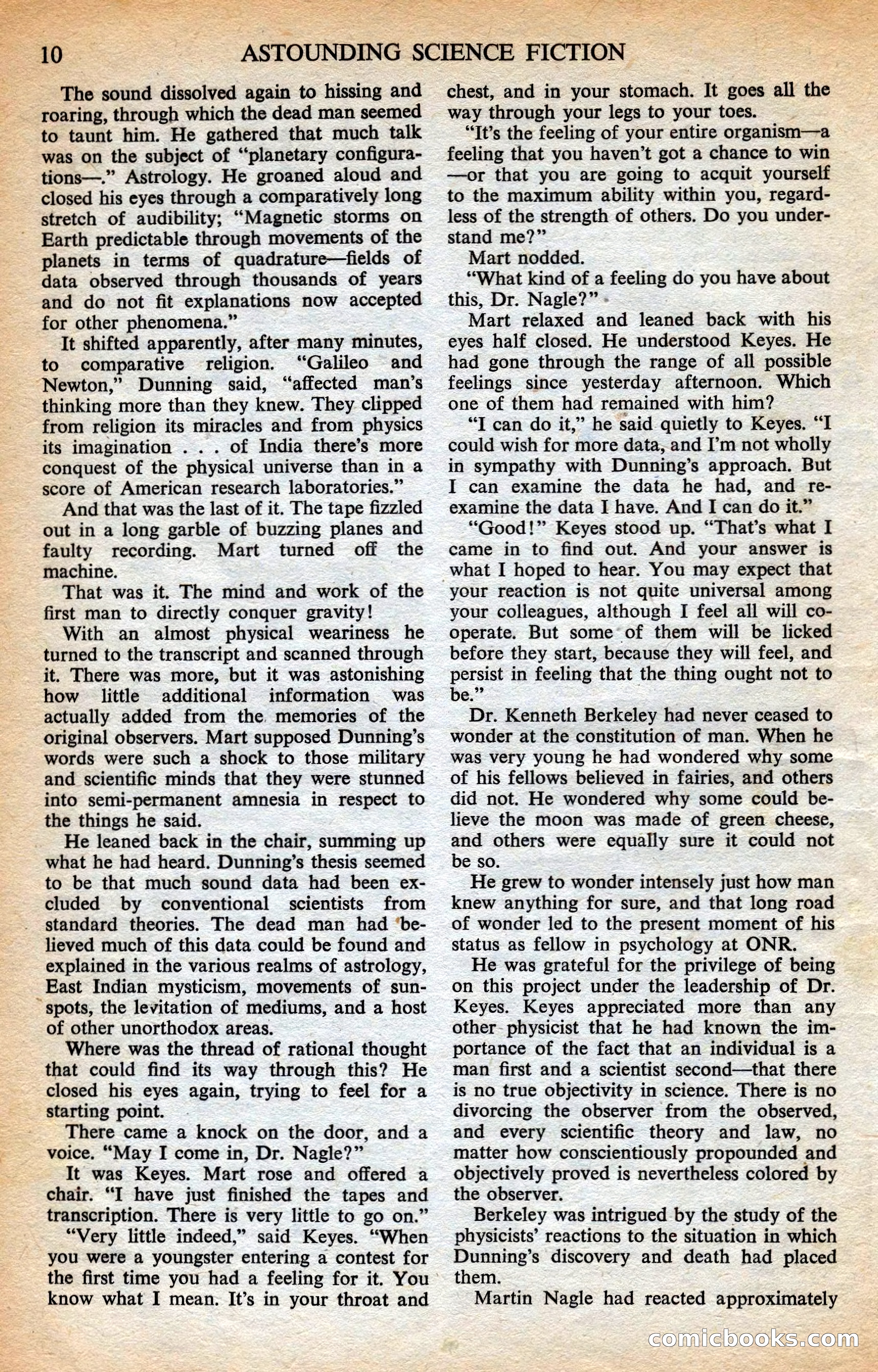
A restored page from Pulp Fiction, 1953. Page through the whole issue in the reader above.
📄 Transcribed text from this page (OCR, searchable)
Machine-transcribed from the original scan — historical spelling and the odd misread are preserved.
ew ea, Pir The sound dissolved again to hissing and roaring, through which the dead man seemed to taunt him. He gathered that much talk was on the subject of “planetary configura- tions—.” Astrology. He groaned aloud and closed his eyes through a comparatively long stretch of audibility; ‘““Magnetic storms on Earth predictable through movements of the planets in terms of quadrature—fields of data observed through thousands of years and do not fit explanations now accepted for other phenomena.” It shifted apparently, after many minutes, to comparative religion. “Galileo and Newton,” Dunning said, “affected man’s thinking more than they knew. They clipped from religion its miracles and from physics its imagination . . . of India there’s more conquest of the physical universe than in a score of American research laboratories.” And that was the last of it. The tape fizzled out in a long garble of buzzing planes and faulty recording. Mart turned off the machine. That was it. The mind and work of the first man to directly conquer gravity! With an almost physical weariness he turned to the transcript and scanned through it. There was more, but it was astonishing how little additional information was actually added from the. memories of the original observers. Mart supposed Dunning’s words were such a shock to those military and scientific minds that they were stunned into semi-permanent amnesia in respect to the things he said. He leaned back in the chair, summing up what he had heard. Dunning’s thesis seemed to be that much sound data had been ex- cluded by conventional scientists from standard theories. The dead man had ‘be- lieved much of this data could be found and explained in the various realms of astrology, East Indian mysticism, movements of sun- spots, the levitation of mediums, and a host of other unorthodox areas. : Where was the thread of rational thought that could find its way through this? He closed his eyes again, trying to feel for a starting point. There came a knock on the door, and a voice. “May I come in, Dr. Nagle?” It was Keyes. Mart rose and offered a chair. “I have just finished the tapes and transcription. There is very little to go on.” “Very little indeed,” said Keyes. “When you were a youngster entering a contest for the first time you had a feeling for it. You’ know what I mean. It’s in your throat and soar ree ea tye! oF chest, and in your stomach. It goes all the way through your legs to your toes. “It’s the feeling of your entire organism—a feeling that you haven’t got a chance to win —or that you are going to acquit yourself to the maximum ability within you, regard- less of the strength of others. Do you under- stand me?” Mart nodded. “What kind of a feeling do you have about this, Dr. Nagle?” » Mart relaxed and leaned back with his eyes half closed. He understood Keyes. He had gone through the range of all possible feelings since yesterday afternoon. Which one of them had remained with him? “T can do it,” he said quietly to Keyes. “I could wish for more data, and I’m not wholly in sympathy with Dunning’s approach. But I can examine the data he had, and re- examine the data I have. And I can do it.” “Good!” Keyes stood up. “That’s what I came in to find out. And your answer is what I hoped to hear. You may expect that your reaction is not quite universal among your colleagues, although I feel all will co- operate. But some of them will be licked before they start, because they will feel, and persist in feeling that the thing ought not to be.” Dr. Kenneth Berkeley had never ceased to wonder at the constitution of man. When he was very young he had wondered why some of his fellows believed in fairies, and others did not. He wondered why some could be- lieve the moon was made of green cheese, and others were equally sure it could not be so. He grew to wonder intensely just how man knew anything for sure, and that long road of wonder led to the present moment of his status as fellow in psychology at ONR. He was grateful for the privilege of being on this project under the leadership of Dr. Keyes. Keyes appreciated more than any other- physicist that he had known the im- portance of the fact that an individual is a man first and a scientist second—that there is no true objectivity in science. There is no divorcing the observer from the observed, and every scientific theory and law, no matter how conscientiously propounded and objectively proved is nevertheless colored by the observer. Berkeley was intrigued by the study of the physicists’ reactions to the situation in which Dunning’s discovery and death had placed them. Martin Nagle had reacted approximately Gomicboo PIGS et en Pe tag Ge a et” Se EY te SP i Ne, a ASTOUNDING SCIENCE FICTION <SriGOm