
Pulp Fiction, 1952 · page 61 of 68
Astounding Science Fiction, February 1952 (British Edition) — page 61: what you’re looking at
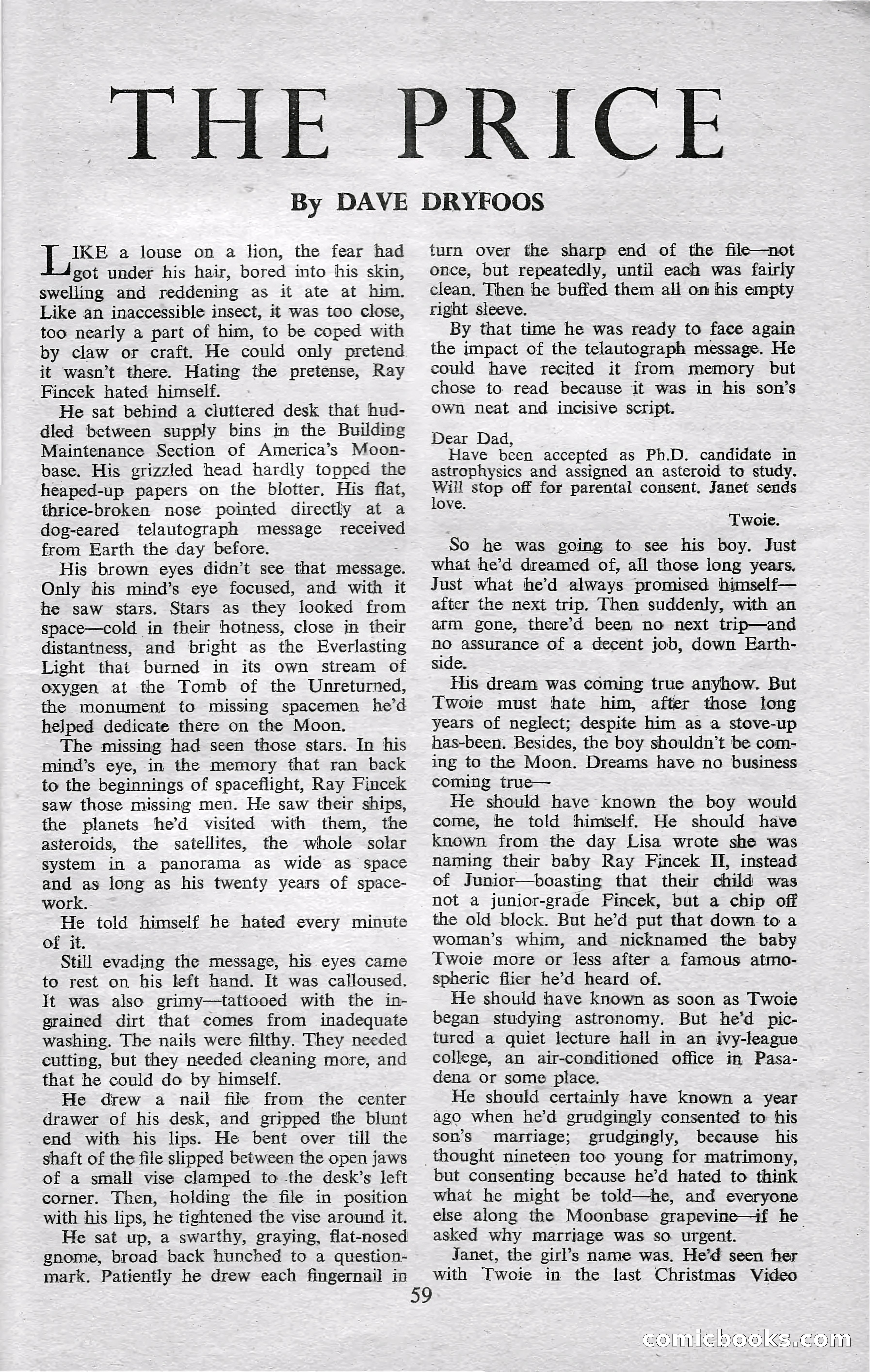
A restored page from Pulp Fiction, 1952. Page through the whole issue in the reader above.
📄 Transcribed text from this page (OCR, searchable)
Machine-transcribed from the original scan — historical spelling and the odd misread are preserved.
THE PRICE By DAVE IKE a louse on a lion, the fear had got under his hair, bored into his skin, swelling and reddening as it ate at him. Like an inaccessible insect, it was too close, too nearly a part of him, to be coped with by claw or craft. He could only pretend it wasn’t there. Hating the pretense, Ray Fincek hated himself. He sat behind a cluttered desk that hud- dled between supply bins in the Building Maintenance Section of America’s Moon- base. His grizzled head hardly topped the heaped-up papers on the blotter. His flat, thrice-broken nose pointed directly at a dog-eared telautograph message received from Earth the day before. His brown eyes didn’t see that message. Only his mind’s eye focused, and with it he saw stars. Stars as they looked from space—cold in their hotness, close in their distantness, and bright as the Everlasting Light that burned in its own stream of oxygen at the Tomb of the Unreturned, the monument to missing spacemen he’d helped dedicate there on the Moon. The missing had seen those stars. In his mind’s eye, in the memory that ran back to the beginnings of spaceflight, Ray Fincek saw those missing men. He saw their ships, the planets he’d visited with them, the asteroids, the satellites, the whole solar system in a panorama as wide as space and as long as his twenty years of space- work. He told himself he hated every minute of it. Still evading the message, his eyes came to rest on his left hand. It was calloused. It was also grimy—tattooed with the in- grained dirt that comes from inadequate washing. The nails were filthy. They needed cutting, but they needed cleaning more, and that he could do by himself. He drew a nail file from the center drawer of his desk, and gripped the blunt end with his lips. He bent over till the shaft of the file slipped between the open jaws of a small vise clamped to the desk’s left corner. Then, holding the file in position with his lips, he tightened the vise around it. He sat up, a swarthy, graying, flat-nosed gnome, broad back hunched to a question- mark. Patiently he drew each fingernail in DRYFOOS turn over the sharp end of the file—not once, but repeatedly, until each was fairly clean, Then he buffed them all on his empty right sleeve. By that time he was ready to face again the impact of the telautograph message. He could have recited it from memory but chose to read because it was in his son’s own neat and incisive script. Dear Dad, Have been accepted as Ph.D. candidate in astrophysics and assigned an asteroid to study. beet stop off for parental consent. Janet sends ove Twote. So he was going to see his boy. Just what he'd dreamed of, all those long years. Just what he'd always promised himself— after the next trip. Then suddenly, with an arm gone, there'd been no next trip—and no assurance of a decent job, down Earth- side. His dream was coming true anyhow. But Twoie must hate him, after those long years of neglect; despite him as a stove-up has-been. Besides, the boy shouldn’t be com- ing to the Moon. Dreams have no business coming true— He should have known the boy would come, he told himself. He should have known from the day Lisa wrote she was naming their baby Ray Fincek II, instead of Junior—boasting that their child was not a junior-grade Fincek, but a chip off the old block. But he’d put that down to a woman’s whim, and nicknamed the baby Twoie more or less after a famous atmo- spheric flier he’d heard of. He should have known as soon as Twoie began studying astronomy. But he’d pic- tured a quiet lecture hall m an ivy-league college, an air-conditioned office in Pasa- dena or some place. He should certainly have known a year ago when he'd grudgingly consented to his son’S marriage; grudgingly, because his thought nineteen too young for matrimony, 59 but consenting because he’d hated to think what he might be told—he, and everyone else along the Moonbase grapevine—if he asked why marriage was so. urgent. Janet, the girl’s name was. He’d seen her with Twoie in the last Christmas Video GOmMmicsdoo <S (S@)