
Pulp Fiction, 1952 · page 54 of 68
Astounding Science Fiction, February 1952 (British Edition) — page 54: what you’re looking at
A restored page from Pulp Fiction, 1952. Page through the whole issue in the reader above.
📄 Transcribed text from this page (OCR, searchable)
Machine-transcribed from the original scan — historical spelling and the odd misread are preserved.
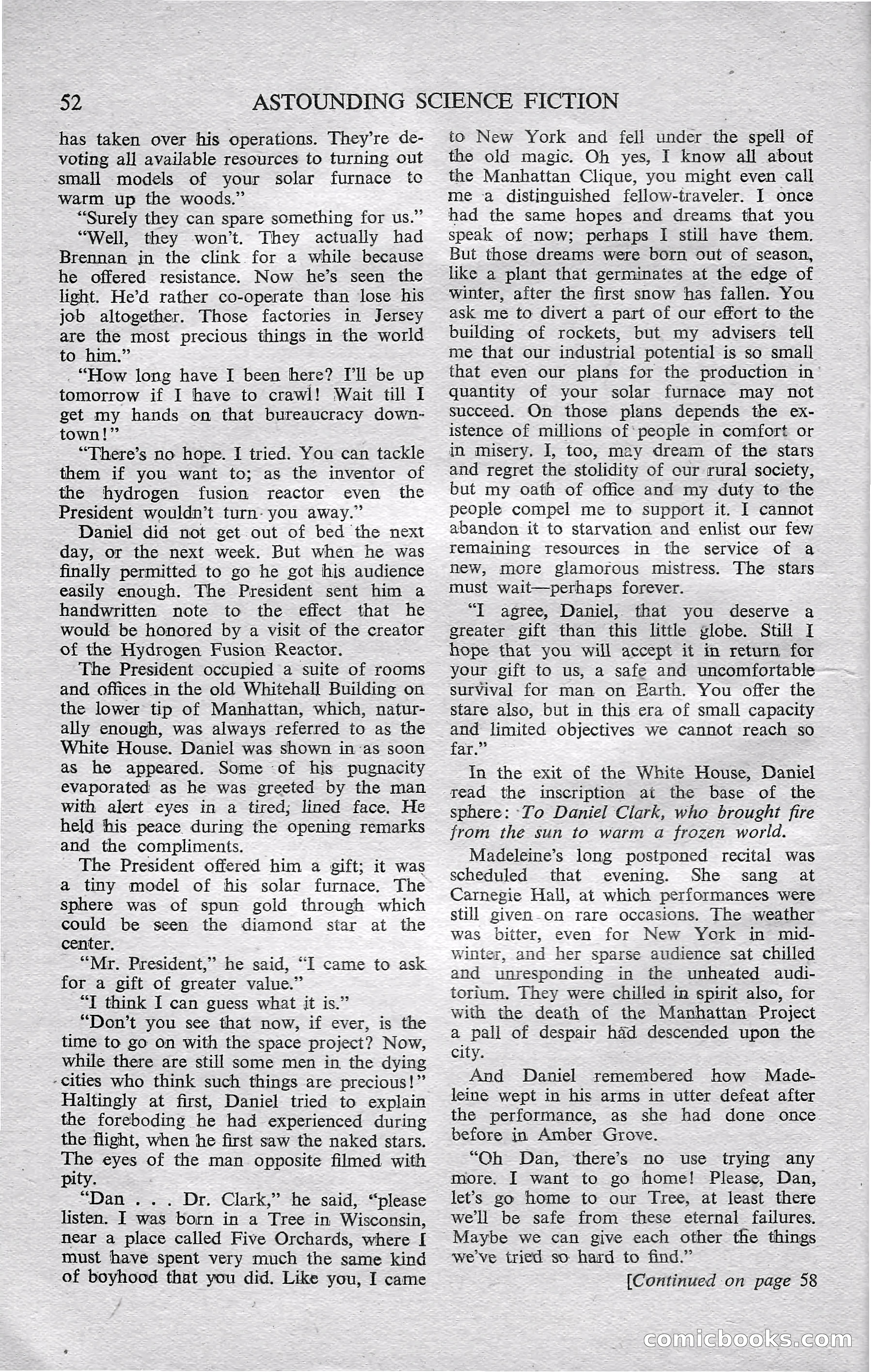
32 has taken over his operations. They’re de- voting all available resources to turning out small models of your solar furnace to warm up the woods.” “Surely they can spare something for us.” “Well, they won't. They actually had Brennan in the clink for a while because he offered resistance. Now he’s seen the light. He’d rather co-operate than lose his job altogether. Those factories in Jersey are the most precious things in the world to him.” _ “How long have I been here? Pi be up tomorrow if I have to crawl! Wait till I get my hands on that bureaucracy down- town!” “There’s no hope. I tried. You can tackle them if you want to; as the inventor of the hydrogen fusion reactor even the President wouldn’t turn- you away.” Daniel did not get out of bed the next day, or the next week. But when he was finally permitted to go he got his audience easily enough. The President sent him a handwritten note to the effect that he would be honored by a visit of the creator of the Hydrogen Fusion Reactor. The President occupied a suite of rooms and offices in the old Whitehall Building on the lower tip of Manhattan, which, natur- ally enough, was always referred to as the White House. Daniel was shown in-as soon as he appeared. Some of his pugnacity evaporated as he was greeted by the man with alert eyes in a tired; lined face. He held his peace during the opening remarks and the compliments. The President offered him a gift; it was a tiny model of his solar furnace. The sphere was of spun gold through which could be seen the diamond star at the center. “Mr. President,” he said, “I came to ask for a gift of greater value.” “I think I can guess what it is.” “Don’t you see that now, if ever, is the time to go on with the space project? Now, while there are still some men in the dying -cities who think such things are precious!” Haltingly at first, Daniel tried to explain the foreboding he had experienced during the flight, when he first saw the naked stars. The eyes of the man opposite filmed with pity. “Dan ... Dr. Clark,” he said, “please listen. I was born in a Tree in Wisconsin, near a place called Five Orchards, where I must have spent very much the same kind of boyhood that you did. Like you, I came ASTOUNDING SCIENCE FICTION to New York and fell under the spell of the old magic. Oh yes, I know all about the Manhattan Clique, you might even call me a distinguished fellow-traveler. I once had the same hopes and dreams that you speak of now; perhaps I still have them. But those dreams were born out of season, like a plant that germinates at the edge of Winter, after the first snow thas fallen. You ask me to divert a part of our effort to the building of rockets, but my advisers tell me that our industrial potential is so small that even our plans for the production in’ quantity of your solar furnace may not succeed. On those plans depends the ex- istence of millions of’ people in comfort or in misery. I, too, may dream of the stars and regret the stolidity of our rural society, but my oath of office and my duty to the people compel me to support it. I cannot abandon it to starvation and enlist our few remaining resources in the service of a new, more glamorous mistress. The stars must wait—perhaps forever. “I agree, Daniel, that you deserve a greater gift than this little globe. Stili I hope that you will accept it in return for your gift to us, a safe and uncomfortable survival for man on Harth. You offer the stare also, but in this era of small capacity and limited objectives we cannot reach so far.” in the exit of the White House, Daniel read the inscription at the base of the sphere: ‘To Daniel Clark, who broughi fire from the sun to warm a frozen world. Madeleine’s long postponed recital was scheduled that evening. She sang at Carnegie Hall, at which performances were still given-on rare occasions. The weather was bitter, even for New York in mid- Winter, and her sparse audience sat chilled and unresponding in the unheated audi- torium. They were chilled in spirit also, for with the death of the Manhattan Project a pall of despair had descended upon the city. | 3 And Daniel remembered how Made- leine wept in his arms in utter defeat after the performance, as she had done once before in Amber Grove. “Qh Dan, there’s no use trying any more. I want to go home! Please, Dan, let’s go home to our Tree, at least there well be safe from these eternal failures. Maybe we can give each other the things we've tried so hard to find.” [Continued on page 58 O EOmMmicsoo S (S@)