
Pulp Fiction, 1950 · page 33 of 68
Astounding Science Fiction, October 1950 — page 33: what you’re looking at
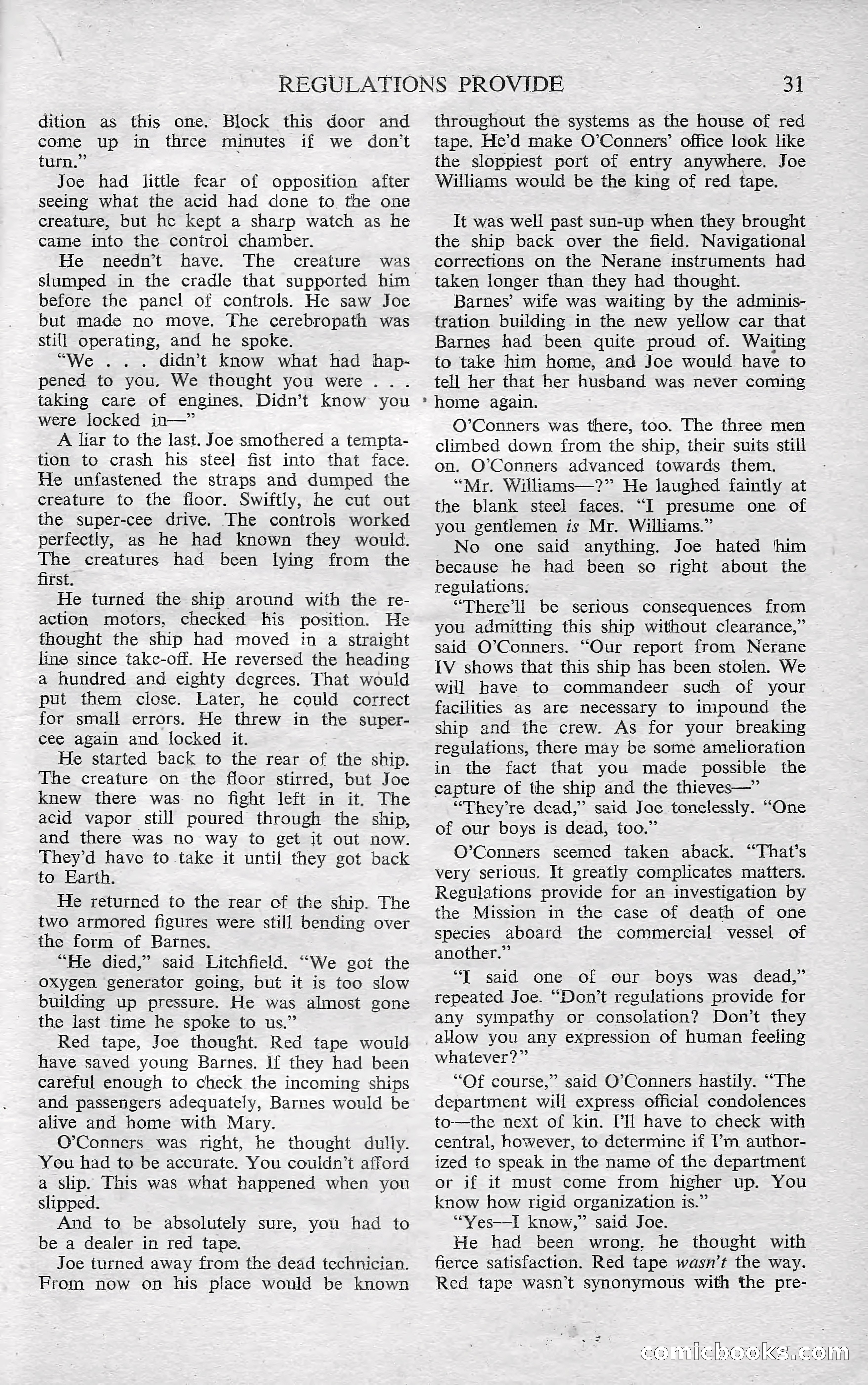
A restored page from Pulp Fiction, 1950. Page through the whole issue in the reader above.
📄 Transcribed text from this page (OCR, searchable)
Machine-transcribed from the original scan — historical spelling and the odd misread are preserved.
REGULATIONS PROVIDE dition as this one. Block this door and come up in three minutes if we don't turn.” Joe had little fear of opposition after seeing what the acid had done to the one creature, but he kept a sharp watch as he came into the contro] chamber. He needn’t have. The creature was slumped in the cradle that supported him before the panel of controls. He saw Joe but made no move. The cerebropath was still operating, and he spoke. “We .. . didn’t know what had hap- pened to you. We thought you were... taking care of engines. Didn’t know you were locked in—” A liar to the last. Joe smothered a tempta- tion to crash his steel fist into that face. He unfastened the straps and dumped the creature to the floor. Swiftly, he cut out the super-cee drive. The controls worked perfectly, as he had known they would. The creatures had been lying from the first. He turned the ship around with the re- action motors, checked his position. He thought the ship had moved in a straight line since take-off. He reversed the heading a hundred and eighty degrees. That would put them close. Later, he could correct for small errors. He threw in the super- cee again and locked it. He started back to the rear of the ship. The creature on the floor stirred, but Joe knew there was no fight left in it. The acid vapor still poured through the ship, and there was no way to get it out now. They’d have to take it until they got back to Earth. He returned to the rear of the ship. The two armored figures were still bending over the form of Barnes. “He died,” said Litchfield. “We got the - oxygen generator going, but it is too slow building up pressure. He was almost gone the last time he spoke to us.” Red tape, Joe thought. Red tape would have saved young Barnes. If they had been careful enough to check the incoming ships and passengers adequately, Barnes would be alive and home with Mary. O’Conners was right, he thought dully. You had to be accurate. You couldn’t afford a slip. This was what happened when you slipped. And to be absolutely sure, you had to be a dealer in red tape. Joe turned away from the dead technician. From now on his place would be known 3] throughout the systems as the house of red tape. He’d make O’Conners’ office look like the sloppiest port of entry anywhere. Joe Williams would be the king of red tape. It was well past sun-up when they brought the ship back over the field. Navigational corrections on the Nerane instruments had taken longer than they had thought. Barnes’ wife was waiting by the adminis- tration building in the new yellow car that Barnes had been quite proud of. Waiting to take him home, and Joe would have to tell her that her husband was never coming home again. O’Conners was there, too. The three men climbed down from the ship, their suits still on. O’Conners advanced towards them. “Mr. Williams—?” He laughed faintly at the blank steel faces. “I presume one of you gentlemen is Mr. Williams.” No one said anything. Joe hated him because he had been so right about the regulations: “There ll be serious consequences from you admitting this ship without clearance,” said O’Conners. “Our report from Nerane IV shows that this ship has been stolen. We will have to commandeer such of your facilities as are necessary to impound the ship and the crew. As for your breaking regulations, there may be some amelioration in the fact that you made possible the capture of the ship and the thieves—” “They're dead,” said Joe tonelessly. “One of our boys is dead, too.” O’Conners seemed taken aback. “That’s very serious. It greatly complicates matters. Regulations provide for an investigation by the Mission in the case of death of one species aboard the commercial vessel of another.” “T said one of our boys was dead,” repeated Joe. “Don’t regulations provide for any sympathy or consolation? Don’t they allow you any expression of human feeling whatever?” “Of course,” said O’Conners hastily. “The department will express official condolences to—the next of kin. I'll have to check with central, however, to determine if I’m author- ized to speak in the name of the department or if it must come from higher up. You know how rigid organization is.” “Yes-—!I know,” said Joe. He had been wrong. he thought with fierce satisfaction. Red tape wasn’t the way. Red tape wasn’t synonymous with the pre- GOmichoo “S' (CO)