
Pulp Fiction, 1950 · page 28 of 68
Astounding Science Fiction, October 1950 — page 28: what you’re looking at
A restored page from Pulp Fiction, 1950. Page through the whole issue in the reader above.
📄 Transcribed text from this page (OCR, searchable)
Machine-transcribed from the original scan — historical spelling and the odd misread are preserved.
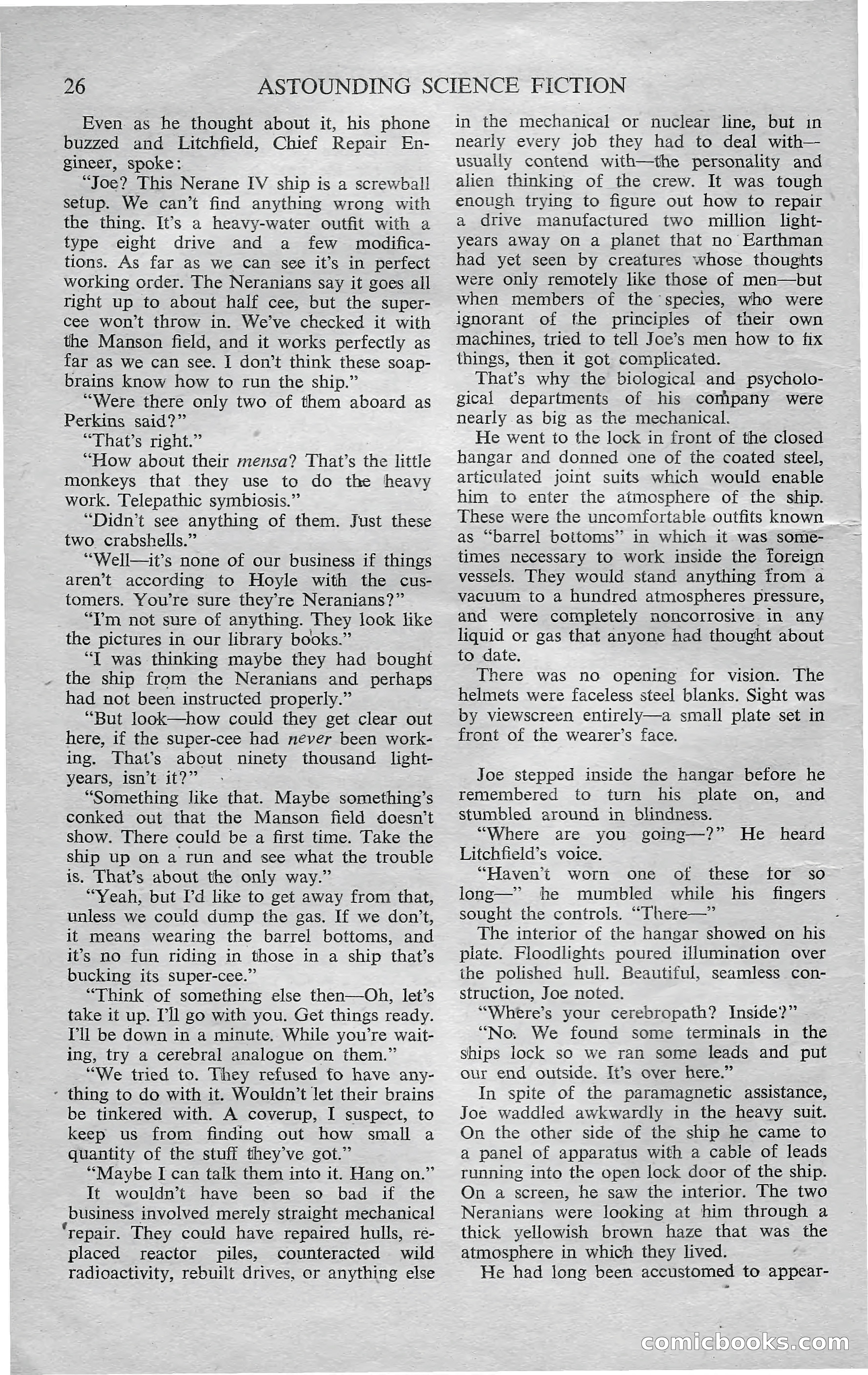
26 ASTOUNDING SCIENCE FICTION Even as he thought about it, his phone buzzed and Litchfield, Chief Repair En- gineer, spoke: “Joe? This Nerane IV ship is a screwball setup. We can’t find anything wrong with the thing. It’s a heavy-water outfit with a type eight drive and a few modifica- tions. As far as we can see it’s in perfect working order. The Neranians say it goes ail right up to about half cee, but the super- cee won't throw in. We’ve checked it with the Manson field, and it works perfectly as far as we can see. I don’t think these soap- brains know how to run the ship.” “Were there only two of them aboard as Perkins said?” “That’s right.” “How about their mensa? That’s the little monkeys that they use to do the heavy work. Telepathic symbiosis.” “Didn't see anything of them. Just these two. crabshells.” “Well—it’s none of our business if things aren’t according to Hoyle with the cus- tomers. You’re sure they’re Neranians?” “Tm not sure of anything. They look like the pictures in our library books.” “I was thinking maybe they had bought the ship from the Neranians and perhaps had not been instructed properly.” “But look—how could they get clear out here, if the super-cee had never been work- ing. That’s about ninety thousand light- years, isn’t it?” - “Something like that. Maybe something’s conked out that the Manson field doesn’t show. There could be a first time. Take the ship up on a run and see what the trouble is. That’s about the only way.” “Yeah, but I’d like to get away from that, unless we could dump the gas. If we don’t, it means wearing the barrel bottoms, and its no fun riding in those in a ship that’s bucking its super-cee.” “Think of something else then—Oh, let’s take it up. Pl go with you. Get things ready. [ll be down in a minute. While you’re wait- ing, try a cerebral analogue on them.” “We tried to. They refused fo have any- - thing to do with it. Wouldn’t let their brains be tinkered with. A coverup, I suspect, to keep us from finding out how small a quantity of the stuff they’ve got.” “Maybe I can talk them into it. Hang on.” It wouldn’t have been so bad if the business involved merely straight mechanical ‘repair. They could have repaired hulls, re- placed reactor piles, counteracted wild radioactivity, rebuilt drives, or anything else in the mechanical or nuclear line, but in nearly every job they had to deal with— usually contend with—the personality and alien thinking of the crew. It was tough enough trying to figure out how to repair a drive manufactured two million light- years away on a planet that no Earthman had yet seen by creatures whose thoughts were Only remotely like those of men—but when members of the species, who were ignorant of the principles of their own machines, tried to tell Joe’s men how to fix things, then it got complicated. That’s why the biological and psycholo- gical departments of his company were nearly as big as the mechanical. He went to the lock in front of the closed bangar and donned one of the coated steel, articulated joint suits which would enable him to enter the atmosphere of the ship. These were the uncomfortable outfits known — ~ as “barrel bottoms’ in which it was some- times necessary to work inside the foreign vessels. They would stand anything from a vacuum to a hundred atmospheres pressure, and were completely noncorrosive in any liquid or gas that anyone had thought about to date. There was no opening for vision. The helmets were faceless steel blanks. Sight was by viewscreen entirely—a small plate set in front of the wearer’s face. Joe stepped inside the hangar before he remembered to turn his plate on, and stumbled around in blindness. “Where are you going—?” He heard Litchfield’s voice. “Haven't worn one of these for so long—” he mumbled while his fingers sought the controls. “There—” The interior of the hangar showed on his plate. Floodlights poured illumination over ihe polished hull. Beautiful, seamless con- struction, Joe noted. “Where’s your cerebropath? Inside?” “No. We found some terminals in the ships lock so we ran some leads and put our end outside. It’s over here.” In spite of the paramagnetic assistance, Joe waddled awkwardly in the heavy suit. On the other side of the ship he came to a panel of apparatus with a cable of leads running into the open lock door of the ship. On a screen, he saw the interior. The two Neranians were looking at him through a thick yellowish brown haze that was the atmosphere in which they lived. He had long been accustomed to appear- booksscom com (a)