
Pulp Fiction, 1950 · page 26 of 68
Astounding Science Fiction, October 1950 — page 26: what you’re looking at
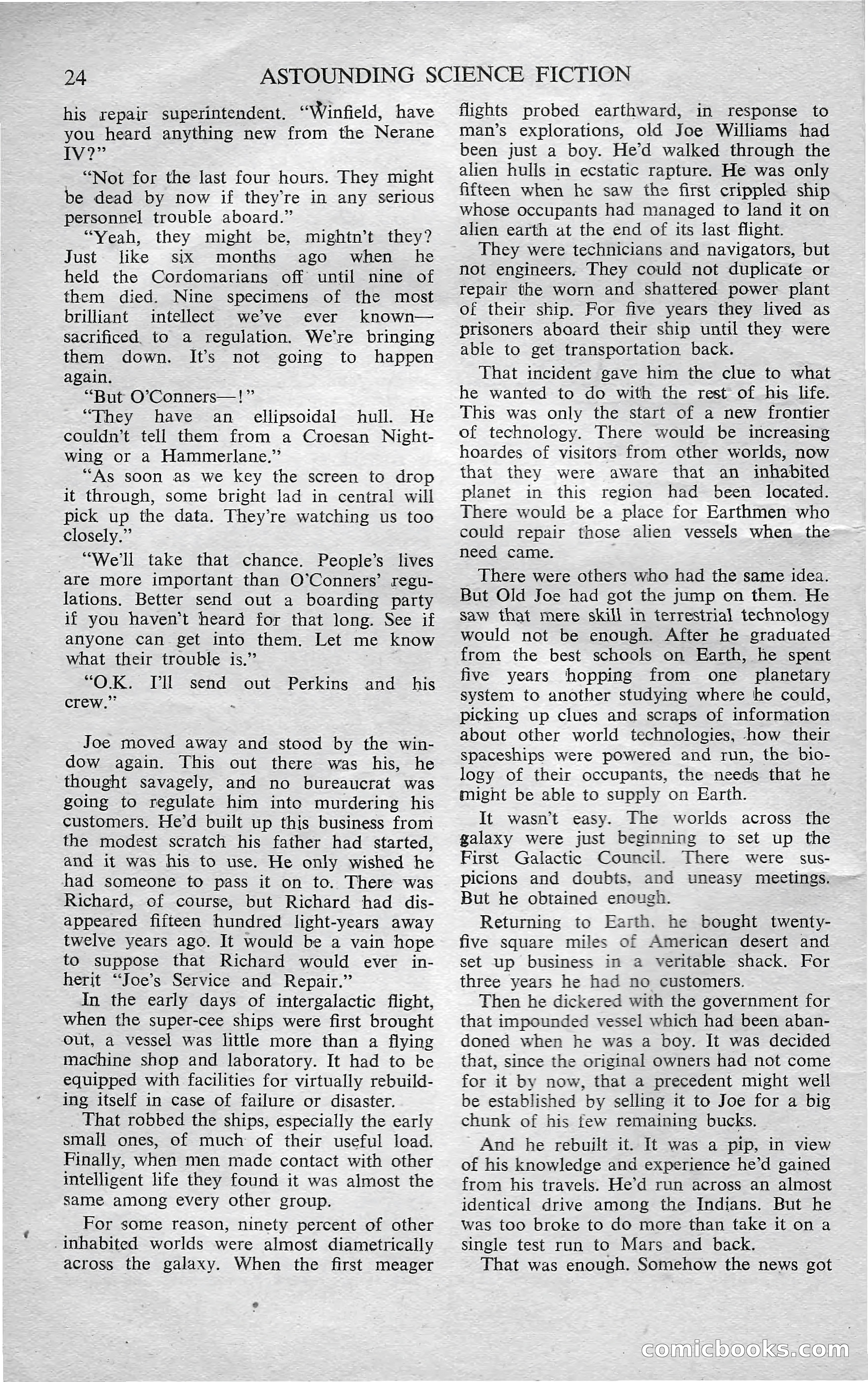
A restored page from Pulp Fiction, 1950. Page through the whole issue in the reader above.
📄 Transcribed text from this page (OCR, searchable)
Machine-transcribed from the original scan — historical spelling and the odd misread are preserved.
24 | ASTOUNDING SCIENCE FICTION his repair superintendent. “Winfield, have you heard anything new from the Nerane Iv?” _ “Not for the last four hours. They might be dead by now if theyre in any serious personnel trouble aboard.” “Yeah, they might be, mightn’t they? Just like six months ago when he held the Cordomarians off until nine of them died. Nine specimens of the most brilliant intellect we've ever known— sacrificed. to a regulation. We're bringing them down. It’s not going to happen again. “But O’Conners—!” “They have an ellipsoidal hull. He couldn’t tell them from a Croesan Night- wing or a Hammerlane.” “As soon as we key the screen to drop it through, some bright lad in central will pick up the data. Puy re watching us too closely.” “We'll take that chance. People’s lives are more important than O’Conners’ regu- lations. Better send out a boarding party if you haven't heard for that long. See if anyone can get into them, Let me know what their trouble is.’ “O.K. [ll send out Perkins and his crew.” . Joe moved away and stood by the win- dow again. This out there was his, he thought savagely, and no bureaucrat was going to regulate him into murdering his customers. He’d built up this business from the modest scratch his father had started, and it was his to use. He only wished he had someone to pass it on to. There was Richard, of course, but Richard had dis- appeared fifteen hundred light-years away twelve years ago. It would be a vain hope to suppose that Richard would ever in- herit “Joe’s Service and Repair.” In the early days of intergalactic flight, when the super-cee ships were first brought out, a vessel was little more than a flying machine shop and laboratory. It had to be equipped with facilities for virtually rebuild- ing itself in case of failure or disaster. That robbed the ships, especially the early small ones, of much of their useful load. Finally, when men made contact with other intelligent life they found it was almost the Same among every other group. _ For some reason, ninety percent of other -inhabited worlds were almost diametrically across the galaxy. When the first meager e flights probed earthward, in response to man’s explorations, old Joe Williams had been just a boy. He’d walked through the alien hulls in ecstatic rapture. He was only fifteen when he saw the first crippled ship whose occupants had managed to land it on alien earth at the end of its last flight. They were technicians and navigators, but not engineers. They could not duplicate or repair the worn and shattered power plant of their ship. For five years they lived as prisoners aboard their ship until they were able to get transportation back. That incident gave him the clue to what he wanted to do with the rest of his life. This was only the start of a new frontier of technology. There would be increasing hoardes of visitors from other worlds, now that they were aware that an inhabited planet in this region had been located. There would be a place for Earthmen who could repair those alien vessels when. the need came. There were others who had the same idea. But Old Joe had got the jump on them. He saw that mere skill in terrestrial technology would not be enough. After he graduated from the best schools on Earth, he spent five years hopping from one planetary system to another studying where he could, picking up clues and scraps of information about other world technologies, how their spaceships were powered and run, the bio- logy of their occupants, the needs that he might be able to supply on Earth. It wasn’t easy. The worlds across the galaxy were just beginning to set up the First Galactic Council. There were sus- picions and doubts, and uneasy meetings. But he obtained enough. Returning to Earth. he bought twenty- five square miles of American desert and set up business in a veritable shack. For three years he had no customers. Then he dickered with the government for that impounded vessel which had been aban- doned when he was a boy. Jt was decided that, since the original owners had not come for it by now, that a precedent might well be established by selling it to Joe for a big chunk of his few remaining bucks. And he rebuilt it. It was a pip, in view of his knowledge and experience he’d gained from his travels. He’d run across an almost identical drive among the Indians. But he was too broke to do more than take it on a single test run to Mars and back. That was enough. Somehow the news got Gomichooksacom