
Pulp Fiction, 1949 · page 61 of 68
Astounding British Edition, Vol. 6, No. 8 — page 61: what you’re looking at
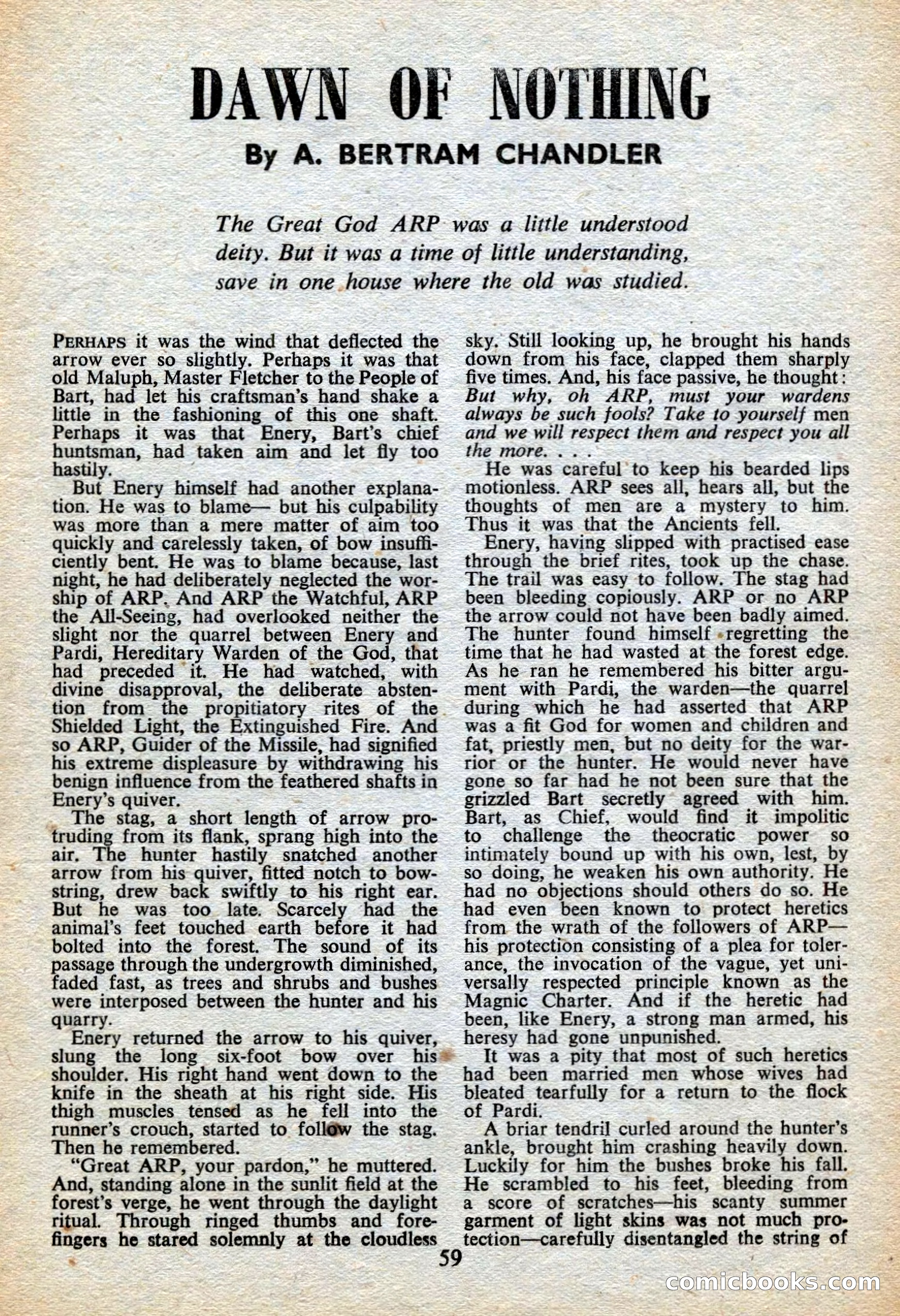
A restored page from Pulp Fiction, 1949. Page through the whole issue in the reader above.
📄 Transcribed text from this page (OCR, searchable)
Machine-transcribed from the original scan — historical spelling and the odd misread are preserved.
DAWN OF NOTHING By A. BERTRAM CHANDLER The Great God ARP. was a little understood deity. But it was a time of little understanding, save in one house where the old was studied. PERHAPS it was the wind that deflected the arrow ever so slightly. Perhaps it was that old Maluph, Master Fletcher to the People of Bart, had let his craftsman’s hand shake a little in the fashioning of this one shaft. Perhaps it was that Enery, Bart’s chief rad Sag had taken aim and let fly too y. But Enery himself had another explana- tion. He was to blame— but his culpability was more than a mere matter of aim too quickly and carelessly taken, of bow insufli- ciently bent. He was to blame because, last night, he had deliberately neglected the wor- ship of ARP. And ARP the Watchful, ARP the All-Seeing, had overlooked neither the slight nor the quarrel between Enery and Pardi, Hereditary Warden of the God, that had preceded it. He had watched, with divine disapproval, the deliberate absten- tion from the propitiatory rites of the. Shielded Light, the Extinguished Fire. And so ARP, Guider of the Missile, had signified his extreme displeasure by withdrawing his benign influence from the feathered shafts in Enery’s quiver. .. The stag, a short length of arrow pro- truding from its flank, sprang high into the air, e hunter hastily snatched another arrow from his quiver, fitted notch to bow- string, drew back swiftly to his right ear. But he was too late. Scarcely had the animal’s feet touched earth before it had bolted into the forest. The sound of its passage through the undergrowth diminished, faded fast, as trees and shrubs and bushes were interposed between the hunter and his quarry. Enery returned the arrow to his quiver, slung the long six-foot bow over shoulder. His right hand went down to the knife in the sheath at his right side. His thigh muscles tensed as he fell into the runner’s crouch, started to foll@w the stag. Then he remembered. “Great ARP, your pardon,” he muttered. And, standing alone in the sunlit field at the forest’s verge, he went through the daylight ritual. Through ringed thumbs and fore- » his * fingers he stared solemnly at the ae sky. Still looking up, he brought his hands down from his face, clapped them sharply five times. And, his face passive, he thought: But why, oh ARP, must your wardens always be such fools? Take to yourself men and we will respect them and respect you all the more. ... He was careful'to keep his bearded lips motionless. ARP sees all, hears all, but the thoughts of men are a mystery to him. Thus it was that the Ancients fell. Enery, having slipped with practised ease through the brief rites, took up the chase. The trail was easy to follow. The stag had been bleeding copiously. ARP or no ARP the arrow could not have been badly aimed. The hunter found himself «regretting the time that he had wasted at the forest edge. As he ran he remembered his bitter argu- ment with Pardi, the warden—the quarrel during which he had asserted that ARP was a fit God for women and children and fat, priestly men, but no deity for the war- rior or the hunter. He would never have gone so far had he not been sure that the grizzled Bart secretly agreed with him. Bart, as Chief, would find it impolitic to challenge the theocratic power so intimately bound up with his own, lest, by so doing, he weaken his own authority. He had no objections should others do so. He had even been known to protect heretics from the wrath of the followers of ARP— his protection consisting of a plea for toler- ance, the invocation of the vague, yet uni- versally respected principle known as the Magnic Charter. And if the heretic had been, like Enery, a strong man armed, his heresy had gone unpunished. It was a pity that most of such heretics had been married men whose wives had bleated tearfully for a return to the flock of Pardi. A briar tendril curled around the hunter’s ankle, brought him crashing heavily down. Luckily for him the bushes broke his fall. He scrambled to his feet, bleeding from a score of scratches—his scanty summer garment of light skins was not much pro- tection—carefully disentangled the string of Eomicbooks (E@)