
Pulp Fiction, 1949 · page 6 of 68
Astounding British Edition, Vol. 6, No. 8 — page 6: what you’re looking at
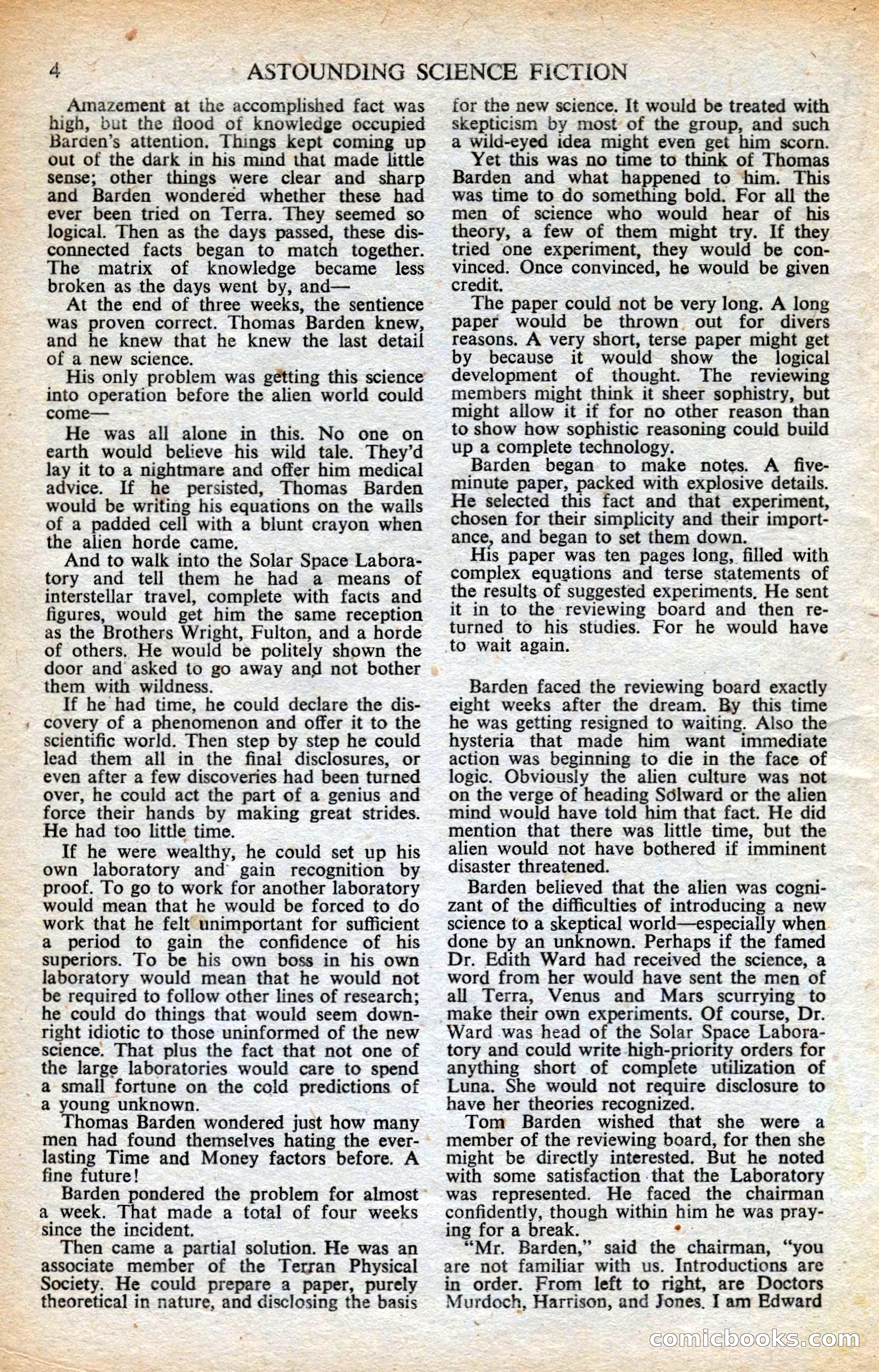
A restored page from Pulp Fiction, 1949. Page through the whole issue in the reader above.
📄 Transcribed text from this page (OCR, searchable)
Machine-transcribed from the original scan — historical spelling and the odd misread are preserved.
Amazement at the accomplished fact was high, but the flood of knowledge occupied Barden’s attention, Things kept coming up out of the dark in his mind that made little sense; other things were clear and sharp and Barden wondered whether these had ever been tried on Terra. They seemed so logical. Then as the days passed, these dis- connected facts began to match together. The matrix of knowledge became less broken as the days went by, and— At the end of three weeks, the sentience was proven correct. Thomas Barden knew, and he knew that he knew the last detail of a new science. His only problem was getting this science into operation before the alien world could come— He was all alone in this. No one on earth would believe his wild tale. They’d lay it to a nightmare and offer him medical advice. If he persisted, Thomas Barden would be writing his equations on the wails of a padded cell with a blunt crayon when the alien horde came, And to walk into the Solar Space Labora- tory and tell them he had a means of interstellar travel, complete with facts and figures, would get him the same reception as the Brothers Wright, Fulton, and a horde of others. He would be politely shown the door and asked to go away and not bother them with wildness. If he had time, he could declare the dis- covery of a phenomenon and offer it to the scientific world. Then step by step he could lead them all in the final disclosures, or even after a few discoveries had been turned over, he could act the part of a genius and force their hands by making great strides. He had too little time. If he were wealthy, he could set up his own laboratory and gain recognition by proof. To go to work for another laboratory would mean that he would be forced to do work that he felt unimportant for sufficient a period to gain the confidence of his superiors. To be his own boss in his own laboratory would mean that he would not be required to follow other lines of research; he could do things that would seem down- right idiotic to those uninformed of the new science. That plus the fact that not one of the large laboratories would care to spend a small fortune on the cold predictions of a young unknown. Thomas Barden wondered just how many men had found themselves hating the ever- lasting Time and Money factors before. A fine future! Barden pondered the problem for almost’ a week. That made a total of four weeks since the incident. Then came a partial solution. He was an associate member of the Terran Physical Society. He could prepare a paper, purely theoretical in nature, and disclosing the basis I i OI er he eT, ely » ASTOUNDING SCIENCE FICTION for the new science. It would be treated with skepticism by most of the group, and such a wild-eyed idea might even get him scorn. Yet this was no time to think of Thomas Barden and what happened to him. This was time to do something bold. For all the men of science who would hear of his theory, a few of them might try. If they tried one experiment, they would be con- vinced. Once convinced, he would be given credit. The paper could not be very long. A long paper would be thrown out for divers reasons. A very short, terse paper might get by because it would show the logical development of thought. The reviewing members might think it sheer sophistry, but might allow it if for no other reason than to show how sophistic reasoning could build up a complete technology. Barden began to make notes. A five- minute paper, packed with explosive details. He selected this fact and that experiment, chosen for their simplicity and their import- ance, and began to set them down. His paper was ten pages long, filled with complex equations and terse statements of the results of suggested experiments, He sent it in to the reviewing board and then re- turned to his studies. For he would have to wait again. Barden faced the reviewing board exactly eight weeks after the dream. By this time he was getting resigned to waiting. Also the hysteria that made him want immediate action was beginning to die in the face of logic. Obviously the alien culture was not on the verge of heading Sdlward or the alien mind would have told him that fact. He did mention that there was little time, but the alien would not have bothered if imminent disaster threatened. Barden believed that the alien was cogni- zant of the difficulties of introducing a new science to a skeptical world—especially when done by an unknown. Perhaps if the famed Dr. Edith Ward had received the science, a word from her would have sent the men of all Terra, Venus and Mars scurrying to make their own experiments. Of course, Dr. Ward was head of the Solar Space Labora- tory and could write high-priority orders for anything short of complete utilization of Luna. She would not require disclosure to have her theories recognized. Tom Barden wished that she were a member of the reviewing board, for then she might be directly interested. But he noted with some satisfaction that the Laboratory was represented. He faced the chairman confidently, though within him he was pray- ing for a break. “Mr. Barden,” said the chairman, “you are not familiar with us. Introductions are in order. From left to right, are Doctors Murdoch, Harrison, and Jones. I am Edward Oo COMMcoooks (CO)