
Pulp Fiction, 1949 · page 4 of 68
Astounding British Edition, Vol. 6, No. 8 — page 4: what you’re looking at
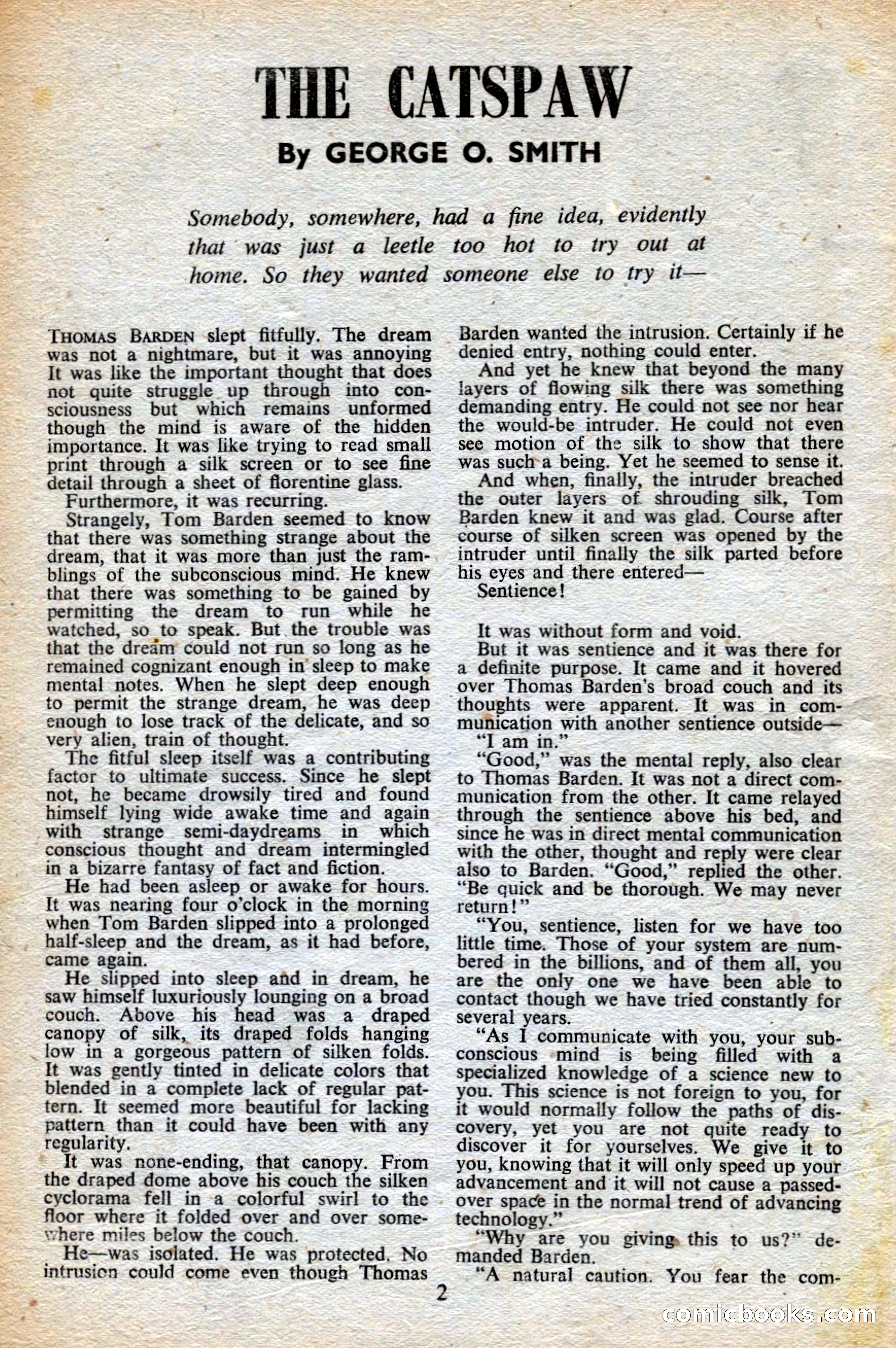
A restored page from Pulp Fiction, 1949. Page through the whole issue in the reader above.
📄 Transcribed text from this page (OCR, searchable)
Machine-transcribed from the original scan — historical spelling and the odd misread are preserved.
ws THE CATSPAW By GEORGE O. SMITH : Somebody, somewhere, had a fine idea, evidently : that was just a leetle too hot to try out at home. So they wanted someone else to try it— THOMAS BARDEN ‘slept fitfully. The dream was not a nightmare, but it was annoying It was like the important thought that does not quite struggle up through into con- sciousness but which remains unformed though the mind is aware of the hidden importance. It was like trying to read small print through a silk screen or to see fine detail through a sheet of florentine glass. Furthermore, it was recurring. Strangely, Tom Barden seemed to know that there was something strange about the dream, that it was more than just the ram- blings of the subconscious mind. He knew that there was something to be gained by permitting the dream to run while he watched, so to speak. But the trouble was that the dream could not run so long as he remained cognizant enough in’ sleep to make mental notes. When he slept deep enough to permit the strange dream, he was deep enough to lose track of the delicate, and so very alien, train of thought. The fitful sleep itself was a contributing factor to ultimate success. Since he slept not, he became drowsily tired and found himself lying wide awake time and again with strange semi-daydreams in which conscious thought and dream intermingled in a bizarre fantasy of fact and fiction. He had been asleep or awake for hours. It was nearing four o’clock in the morning when Tom Barden slipped into a prolonged half-sleep and the dream, as it had before, came again. He slipped into sleep afd in dream, he saw himself luxuriously lounging on a broad couch. Above his head was a draped canopy of silk, its draped folds hanging _low in a gorgeous pattern of silken folds. z It was gently tinted in delicate colors that blended in a complete lack of regular pat- tern. It seemed more beautiful for lacking pattern than it could have been with any regularity. It was none-ending, that canopy. From the draped dome above his couch the silken cyclorama fell in -a colorful swirl to the . floor where it folded over and over some- where miles below the couch. He—was isolated. He was protected. No intrusion could come even though Thomas Barden wanted the intrusion. Certainly if he denied entry, nothing could enter. And yet he knew that beyond the many layers of flowing silk there was something demanding entry. He could not see nor hear the would-be intruder. He could not even see motion of the silk to show that there was sucha being. Yet he seemed to sense it. And when, finally, the intruder breached the outer layers of shrouding silk, Tom Barden knew it and was glad. Course after course of silken screen was opened by the intruder until finally the silk parted before his eyes and there entered— Sentience! It was without form and void. But it was sentience and it was there for a definite purpose. It came and it hovered -over Thomas Barden’s broad couch and its thoughts were apparent. It was in com- munication with another sentience outside— “] am in.” “Good,” was the mental reply, also clear to Thomas Barden. It was not a direct com- munication from the other. It came relayed through the sentience above his bed, and since he was in direct mental communication with the other, thought and reply were clear also to Barden. “Good,” replied the other. “Be quick and be thorough. We may never return!” “You, sentience, listen for we have too little time. Those of your system are num- bered in the billions, and of them all, you are the only one we have been able to contact though we have tried constantly for several years. “As I communicate with you, your sub- conscious mind is being with a specialized knowledge of a science new to you. This science is not foreign to you, for it would normally follow the paths of dis- covery, yet you are not quite ready to discover it for yourselves. We give it to you, knowing that it will only speed up your advancement and it will not cause a passed- over space in the normal trend of advancing technology.” 3 “Why are you giving this to us?’ de- manded Barden. “A natural caution. You fear the com- EOMIGSOO S (Go)