
Pulp Fiction, 1949 · page 33 of 68
Astounding British Edition, Vol. 6, No. 8 — page 33: what you’re looking at
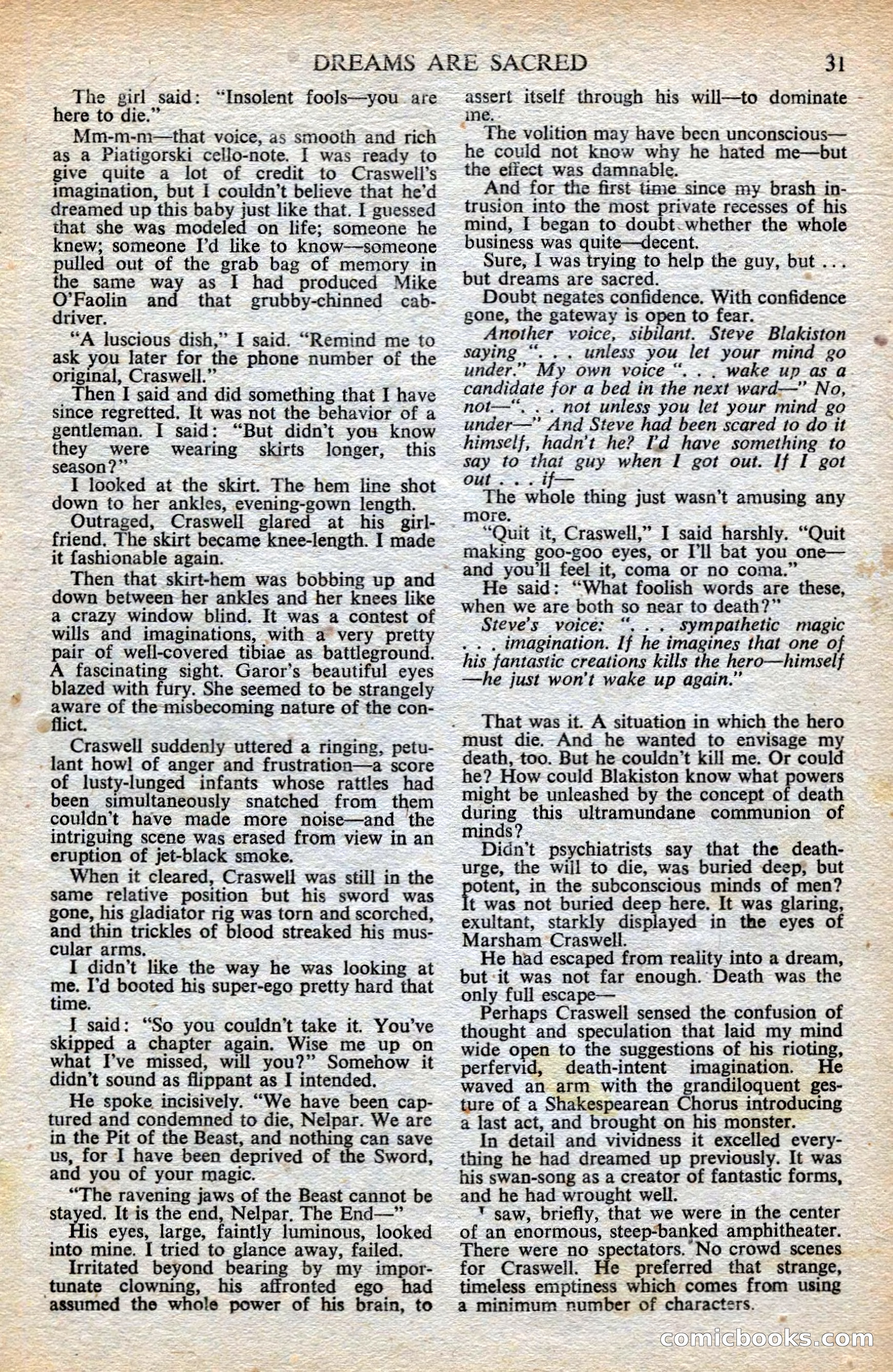
A restored page from Pulp Fiction, 1949. Page through the whole issue in the reader above.
📄 Transcribed text from this page (OCR, searchable)
Machine-transcribed from the original scan — historical spelling and the odd misread are preserved.
DREAMS ARE SACRED The girl said: “Insolent fools—you are here to die.” Mm-m-m—that voice, as smooth and rich as a Piatigorski cello-note. I was ready to give quite a lot of credit to Craswell’s imagination, but I couldn’t believe that he’d dreamed up this baby just like that. I guessed that she was modeled on life; someone he knew; someone I’d like to know—someone pulled out of the grab bag of memory in the same way as I had produced Mike O’Faolin and that grubby-chinned cab- driver. “A luscious dish,” I said. “Remind me to ask you later for the phone number of the original, Craswell.” Then I said and did something that I have since regretted. It was not the behavior of a gentleman. I said: “But didn’t you know they -were wearing skirts longer, this season?” I looked at the skirt. The hem line shot down to her ankles, evening-gown length. Outraged, Craswell glared at his girl- friend, The skirt became knee-length. I made it fashionable again. Then that skirt-hem was bobbing up and down between her ankles and her knees like a crazy window blind. It was a contest of wills and imaginations, with a very pret pair of well-covered tibiae as battleground. A fascinating sight. Garor’s beautiful eyes blazed with fury. She seemed to be strangely aware of the-misbecoming nature of the con- flict. Craswell suddenly uttered a ringing, petu- -lant howl of anger and frustration—a score of lusty-lunged infants whose rattles had been simultaneously snatched from them couldn’t have made more noise—and the intriguing scene was erased from view in an eruption of jet-black smoke. When it cleared, Craswell was still in the same relative position but his sword was gone, his gladiator rig was torn and scorched, and thin trickles of blood streaked his mus- cular arms. I didn’t like the way he was looking at me. I'd booted his super-ego pretty hard that time. - I said: “So you couldn’t take it. You’ve skipped a chapter again. Wise me up on what I’ve missed, will you?” Somehow it didn’t sound as flippant as I intended. He spoke incisively. “We have been cap- tured and condemned to die, Nelpar. We are in the Pit of the Beast, and nothing can save us, for I have been deprived of the Sword, and you of your magic. “The ravening jaws of the Beast cannot be stayed. It is the end, Nelpar. The End—” is eyes, large, faintly luminous, looked into mine. I tried to glance away, failed. Irritated beyond bearing by my impor- tunate clowning, his affronted ego had ‘assumed the whole power of his brain, to _he? How could Blakiston know what 31 assert itself through his will—to dominate ine. . < The volition may have been unconscious— he could not know why he hated me—but the efiect was damnable. And for the first. time since my brash in- trusion into the most private recesses of his mind, I began to doubt.whether the whole business was quite—decent. Sure, I was trying to help the guy, but ... but dreams are sacred. ; Doubt negates confidence. With confidence gone, the gateway is open to fear. Another voice, sibilant. Steve Blakiston saying “. .. unless you let your mind go under.” My own voice“. . . wake up as a candidate for a bed in the next ward—’ No, not—“, . . not unless you let your mind go under—"’ And Steve had been scared to do it himself, hadn't he? Fd have something to say to that guy when I got out. If I got Ob «Af The whole thing just wasn’t amusing any _ more. “Quit it, Craswell,” I said harshly. “Quit making goo-goo eyes, or I'll bat you one— — “and you'll feel it, coma or no coma.” He said: “What foolish words are these, | when we are both so near to death?” Steve’s voice: . sympathetic magic . . , imagination. If he imagines that one of his fantastic creations kills the hero—himself —he just won't wake up again.” That was it. A situation in which the hero “must die. And he wanted to envisage my death, too. But he couldn’t kill me. Or could owers might be unleashed by the concept of death during this ultramundane communion of minds? Didn’t psychiatrists say that the death- urge, the will to die, was buried deep; but tent, in the subconscious minds of men? t was not buried deep here. It was glaring, exultant, starkly displayed in the eyes of Marsham Craswell. He had escaped from reality into a dream, but ‘it was not far enough. Death was the only full esca : Perhaps Craswell sensed the confusion of thought and speculation that laid my mind wide open to the suggestions of his rioting, perfervid, death-intent imagination. He waved an arm with the grandiloquent ges- ture of a Shakespearean Chorus introducing a last act, and brought on his monster. In detail and vividness it excelled every- thing he had dreamed up previously. It was his swan-song as a creator of fantastic forms, and he had wrought well. Bs saw, briefly, that we were in the center of an enormous, steep-banked amphitheater. There were no spectators. No crowd scenes for Craswell. He preferred that strange, timeless emptiness which comes from using a minimum number of characters. Gom icboo S (E@) Im