
Pulp Fiction, 1949 · page 25 of 68
Astounding British Edition, Vol. 6, No. 8 — page 25: what you’re looking at
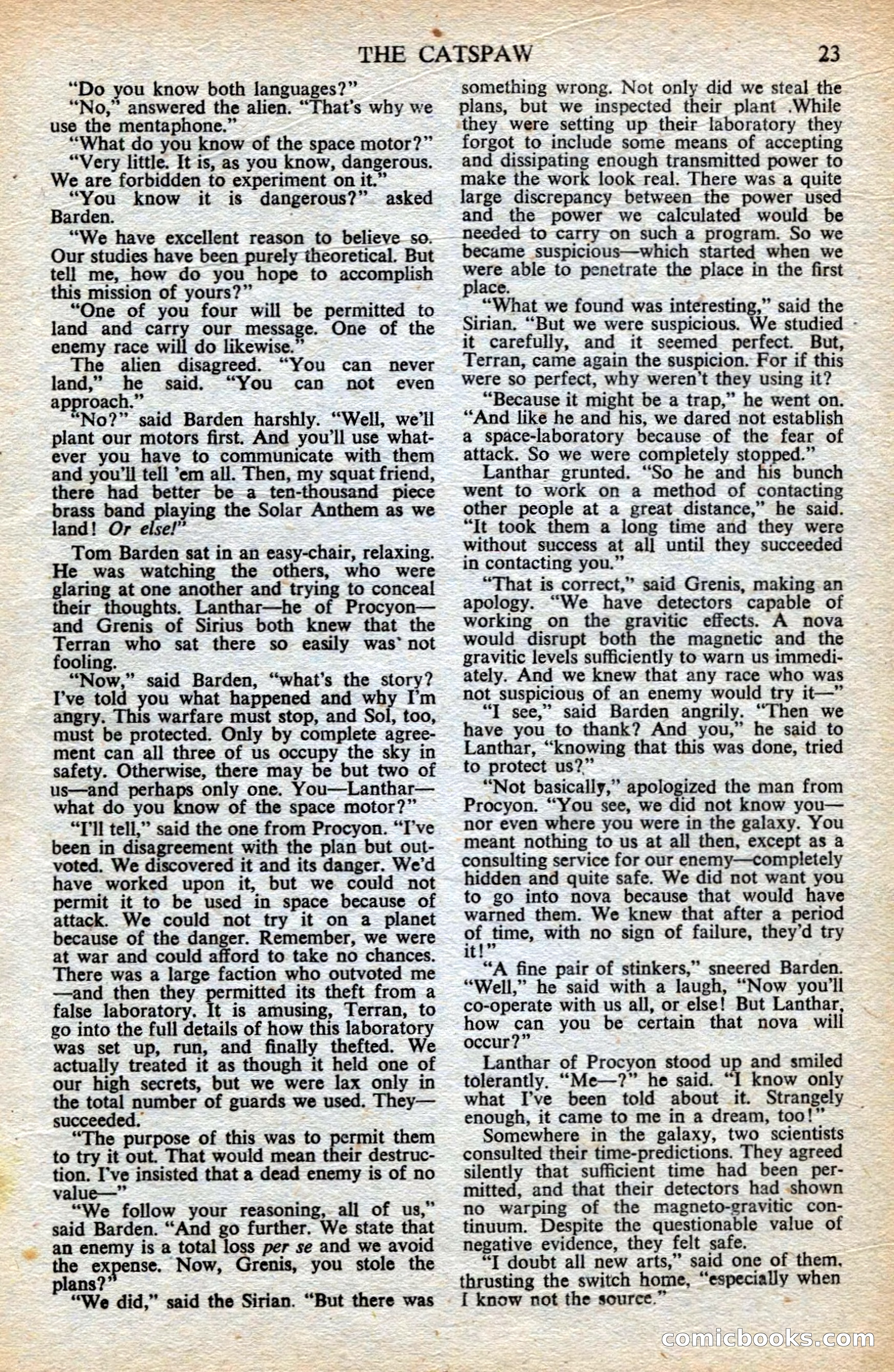
A restored page from Pulp Fiction, 1949. Page through the whole issue in the reader above.
📄 Transcribed text from this page (OCR, searchable)
Machine-transcribed from the original scan — historical spelling and the odd misread are preserved.
+ THE CATSPAW “Do you know both languages?” “No,” answered the alien. “That’s why we use the mentaphone.” “What do you know of the space motor?” “Very little. It is, as you know, dangerous. We are forbidden to experiment on it.” “You know it is dangerous?” asked Barden. “We have excellent reason to believe so. Our studies have been purely theoretical. But tell me, how do you hope to accomplish this mission of yours?” ; “One of you four will be permitted to land and carry our message. One of the enemy race will do likewise.” The alien disagreed. “You can never land,” he said. “You can not even approach.” ‘No?” said Barden harshly. “Well, we'll plant our motors first. And you'll use what- ever you have to communicate with them and you'll tell °em all. Then, my squat friend, there had better be a ten-thousand piece brass band playing the Solar Anthem as we land! Or else!” Tom Barden sat in an easy-chair, relaxing. He was watchi the others, who were glaring at one another and trying to conceal their thoughts. Lanthar—he of Procyon— and Grenis of Sirius both knew that the Terran who sat there so easily was* not fooling. “Now,” said Barden, “what’s the story? I’ve told you what happened and why I’m angry. This warfare must stop, and Sol, too, must be protected. Only by complete agree- ment can all three of us occupy the sky in safety. Otherwise, there may be but two of us—and perhaps only one. You—Lanthar— what do you know of the space motor?” “T'll tell,” said the one from Procyon. “I’ve been in disagreement with the plan but out- voted. We discovered it and its danger. We'd have worked upon it, but we could not permit it to be used in space because of attack. We could not try it on a planet because of the danger. Remember, we were at war and could afford to take no chances. There was a large faction who outvoted me —and then they permitted its theft from a false laboratory. It is amusing, Terran, to go into the full details of how this laboratory was set up, run, and finally thefted. We actually treated it as though it held one of our high secrets, but we were lax only in the total number of guards we used. They— succeeded, “The purpose of this was to permit them to try it out. That would mean their destruc- tion. I've insisted that a dead enemy is of no value—” ; “We follow your reasoning, all of us,” said Barden. “And go further. We state that an enemy is a total loss per se and we avoid the expense, Now, Grenis, you stole the plans? “We did,” said the Sirian. “But there was 23 something wrong. Not only did we steal the plans, but we inspected their plant .While they were setting up their laboratory they forgot to include some means of accepting and dissipating enough transmitted power to make the work look real. There was a quite large discrepancy between the power used and the power we calculated would be needed to carry on such a program. So we became suspicious—which started when we adr able to penetrate the place in the first place. _“What we found was interesting,” said the Sirian. “But we were suspicious. it carefully, and it seemed perfect. But, Terran, came again the suspicion. For if this were so perfect, why weren't they using it? “Because it might be a trap,” he went on. ““And like he and his, we dared not establish a space-laboratory because of the fear of attack. So we were completely stopped.” Lanthar grunted. “So he and his bunch went to work on a method of contacting other people at a great distance,” he said. “It took them a long time and they were without success at all until they succeeded in contacting you.” “That is correct,” said Grenis, making an apology. “We have detectors capable of working on the gravitic effects. A nova would disrupt both the magnetic and the gravitic levels sufficiently to warn us immedi- ately. And we knew that any race who was not suspicious of an enemy would try it—” “T see,” said Barden angrily. “Then we have you to thank? And you,” he said to Lanthar, “knowing that this was done, tried to protect us?” “Not basically,” apologized the man from Procyon. “You see, we did not know you— nor even where you were in the galaxy. You meant nothing to us at all then, except as a consulting service for our enemy—completely hidden and quite safe. We did not want you to go into nova because that would have warned them. We knew that after a period of time, with no sign of failure, they'd try i “A fine pair of stinkers,” sneered Barden. “Well,” he said with a laugh, “Now you'll co-operate with us all, or else! But Lanthar, how can you be certain that nova will occur?” Lanthar of Procyon stood up and smiled tolerantly. ““Me—?” he said. “I know only what I’ve been told about it. Strangely enough, it came to me in a dream, too!” Somewhere in the galaxy, two scientists consulted their time-predictions. They agreed silently that sufficient time had been per- mitted, and that their detectors had shown no warping of the magneto-gravitic con- tinuum. Despite the questionable value of negative evidence, they felt safe. “I doubt all new arts,” said one of them, thrusting the switch home, “especially when [ know not the source.” = EOmMmIGdoOo <SiiGO e studied - ~