
Pulp Fiction, 1949 · page 23 of 68
Astounding British Edition, Vol. 6, No. 8 — page 23: what you’re looking at
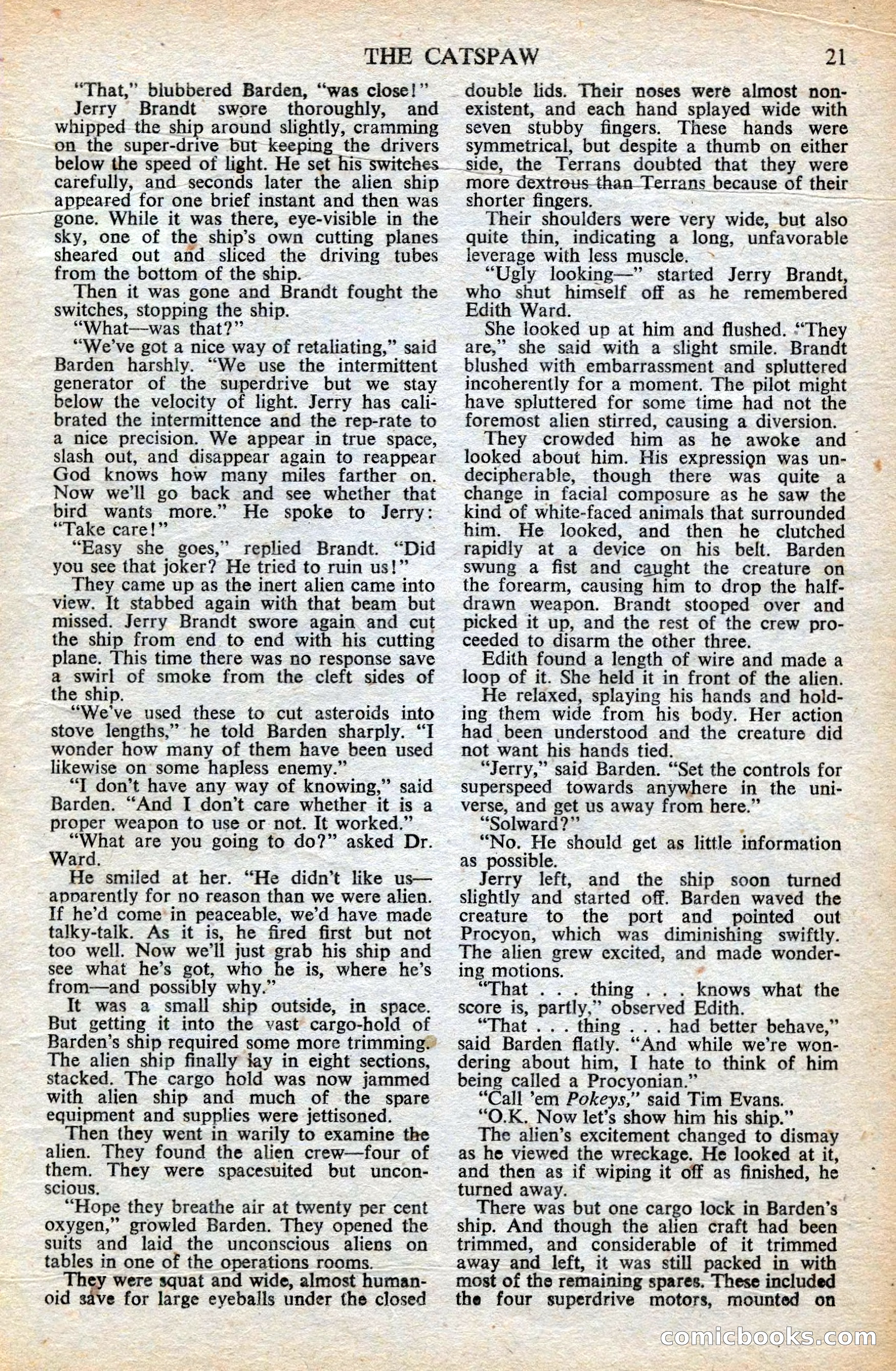
A restored page from Pulp Fiction, 1949. Page through the whole issue in the reader above.
📄 Transcribed text from this page (OCR, searchable)
Machine-transcribed from the original scan — historical spelling and the odd misread are preserved.
THE CATSPAW 21 “That,” blubbered Barden, “was close!” Jerry Brandt swore thoroughly, and whipped the ship around slightly, cramming on the super-drive but keeping the drivers below the speed of light. He set his switches. carefully, and seconds later the alien ship appeared for one brief instant and then was ~ gone. While it was there, eye-visible in the sky, one of the ship’s own cutting planes sheared out and sliced the driving tubes from the bottom of the ship. Then it was gone and Brandt fought the switches, stopping the ship. “What—was that?” “We've got a nice way of retaliating,” said Barden harshly. “We use the intermittent generator of the superdrive but we stay below the velocity of light. Jerry has cali- brated the intermittence and the rep-rate to a nice precision. We appear in true space, slash out, and disappear again to reappear God knows how many miles farther on. Now we'll go back and see whether that bird wants more.” He spoke to Jerry: “Take care!” 3 “Kasy she goes,” replied Brandt. “Did you see that joker? He tried to ruin us!” They came up as the inert alien came into view. It stabbed again with that beam but missed. Jerry Brandt swore again and cut the ship from end to end with his cutting plane. This time there was no response save a swirl of smoke from the cleft sides of the ship. “We've used these to cut asteroids into stove lengths,” he told Barden sharply. “I wonder how many of them have been used likewise on some hapless enemy.” “IT don’t have any way of knowing,” said Barden. “And I don’t care whether it is a proper weapon to use or not. It worked.” “What are you going to do?” asked Dr. Ward. He smiled at her. “He didn’t like us— apparently for no reason than we were alien. If he’d come’ in peaceable, we’d have made talky-talk. As it is, he fired first but not too well. Now we'll just grab his ship and see what he’s got, who he is, where he’s from—and possibly why.” It was a small ship outside, in space. But getting it into the vast cargo-hold of Barden’s ship required some more trimming?’ The alien ship finally lay in eight sections, stacked. The cargo hold was now jammed with alien ship and much of the spare equipment and supplies were jettisoned. Then they went in warily to examine the alien. They found the alien crew—four of them. They were spacesuited but uncon- scious. “Hope they breathe air at twenty per cent oxygen,” growled Barden. They opened the suits and laid the unconscious aliens on tables in one of the operations rooms. thy were squat and wide, almost human- oid save for large eyeballs under the closed double lids. Their noses were almost non- existent, and each hand splayed wide with seven stubby fingers. These hands were symmetrical, but despite a thumb on either side, the Terrans doubted that they were more dextrous-than Terrans because of their shorter fingers. . = Their shoulders were very wide, but also quite thin, indicating a long, unfavorable leverage with less muscle. “Ugly looking—” started Jerry Brandt, who shut himself off as he remembered Edith Ward. She looked up at him and flushed. “They are,’ she said with a slight smile. Brandt blushed with embarrassment and spluttered incoherently for a moment. The pilot might have spluttered for some time had not the foremost alien stirred, causing a diversion. | They crowded him as he awoke and looked about him. His expressign was un- decipherable, though there was quite a change in facial composure as he saw the kind of white-faced animals that surrounded him. He looked, and then he clutched rapidly at a device on his belt. Barden swung a fist and caught the creature on the forearm, causing him to drop the half- drawn weapon. Brandt stooped over and picked it up, and the rest of the crew pro- ceeded to disarm the other three. Edith found a length of wire and made a loop of it. She held it in front of the alien. He relaxed, splaying his hands and hold- ing them wide from his body. Her action had been understood and the creature did not want his hands tied. “Jerry,” said Barden. “Set the controls for superspeed towards anywhere in the uni- verse, and get us away from here.” “Solward?”’ : “No. He should get as little information as possible. Jerry left, and the ship soon turned slightly and started off. Barden waved the creature to the port and pointed out Procyon, which was diminishing swiftly. The alien grew excited, and made wonder- ing motions. 4 “That ... thing . . . knows what the score is, partly,” observed Edith. “That ... thing ... had better behave,” said Barden flatly. “And while we’re won- dering about him, I hate to think of him being called a Procyonian.” “Call ’em Pokeys,” said Tim Evans. “O.K. Now let’s show him his ship.” The alien’s excitement changed to dismay as he viewed the wreckage. He looked at it, and then as if wiping it off as finished, he turned away. 3 There was but one cargo lock in Barden’s ship. And though the alien craft had been trimmed, and considerable of it trimmed away and left, it was still packed in with most of the remaining spares. These included the four superdrive motors, mounted on (EO) Gomichooks