
Pulp Fiction, 1948 · page 62 of 68
Astounding British Edition, Vol. 6, No. 2 — page 62: what you’re looking at
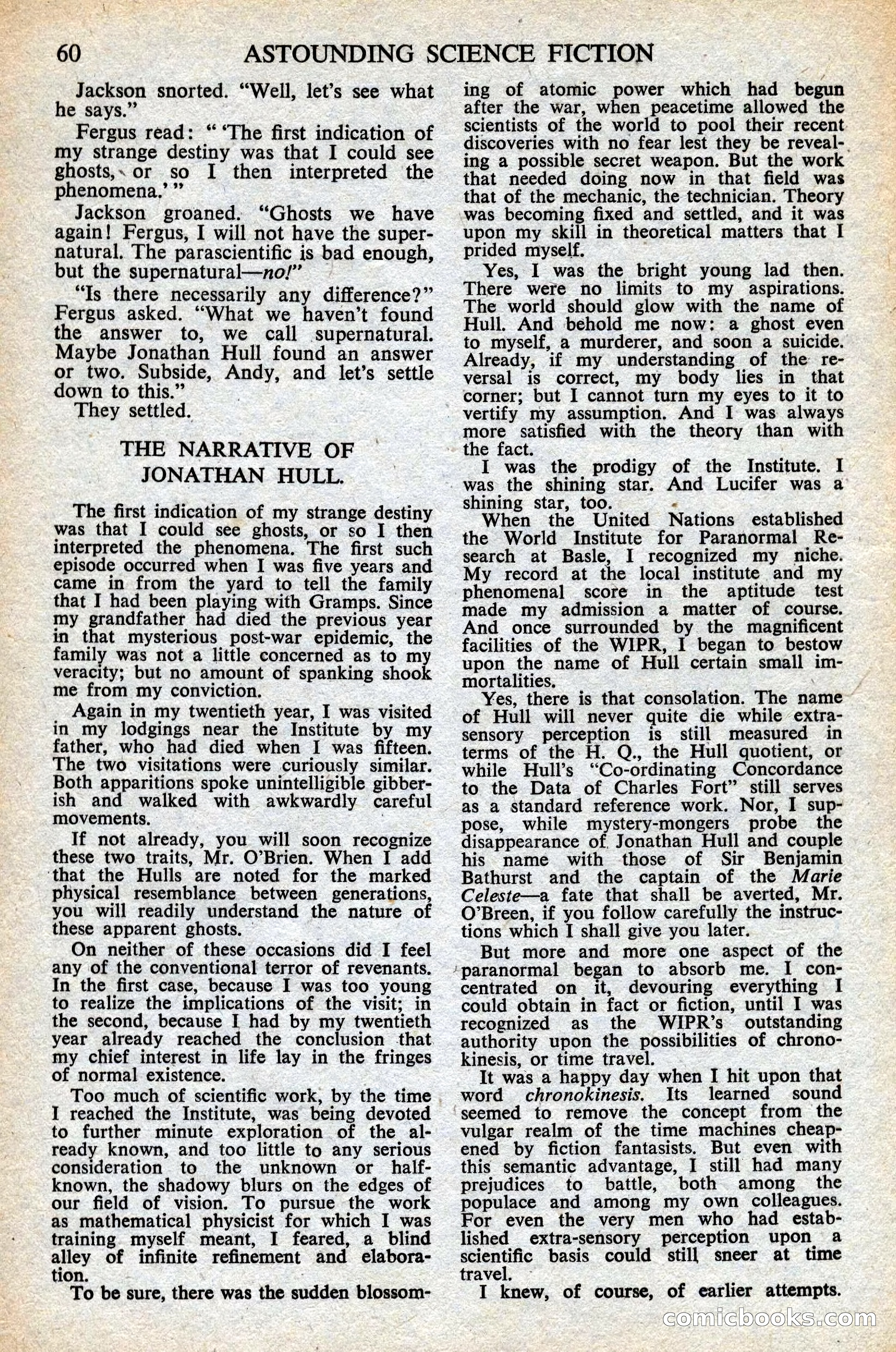
A restored page from Pulp Fiction, 1948. Page through the whole issue in the reader above.
📄 Transcribed text from this page (OCR, searchable)
Machine-transcribed from the original scan — historical spelling and the odd misread are preserved.
60 Jackson snorted. “Well, let’s see what he says.” Fergus read: “ ‘The first indication of my strange destiny was that I could see ghosts,. or so I then interpreted the phenomena,’ ” Jackson groaned. “Ghosts we have again! Fergus, I will not have the super- natural. The parascientific is bad enough, but the supernatural—no/” _ “Is there necessarily any difference?” Fergus asked. “What we haven’t found the answer to, we call supernatural. Maybe Jonathan Hull found an answer or two. Subside, Andy, and let’s settle down to this.” | They settled. THE NARRATIVE OF JONATHAN HULL. The first indication of my strange destiny was that I could see ghosts, or so I then interpreted the phenomena. The first such episode occurred when I was five years and came in from the yard to tell the family that I had been playing with Gramps. Since my grandfather had died the previous year in that mysterious post-war epidemic, the family was not a little concerned as to my veracity; but no amount of spanking shook me from my conviction. _ Again in my twentieth year, I was visited in my lodgings near the Institute by my father, who had died when I was fifteen. The two visitations were curiously similar. Both apparitions spoke unintelligible gibber- ish and walked with awkwardly careful movements. If not already, you will soon recognize these two traits, Mr. O’Brien. When I add ‘that the Hulls are noted for the marked physical resemblance between generations, you will readily understand the nature of these apparent ghosts. © On neither of these occasions did I feel any of the conventional terror of revenants. In the first case, because I was too young to realize the implications of the visit; in the second, because I had by my twentieth year already reached the conclusion that my chief interest in life lay in the fringes of normal existence. Too much of scientific work, by the time | I reached the Institute, was being devoted to further minute exploration of the al- ready known, and too little to any serious consideration to the unknown or half- known, the shadowy blurs on the edges of our field of vision. To pursue the work as mathematical physicist for which I was training myself meant, I feared, a blind alley of infinite refinement and elabora- tion. To be sure, there was the sudden blossom- ASTOUNDING SCIENCE FICTION ing of atomic power which had begun after the war, when peacetime allowed the scientists of the world to pool their recent discoveries with no fear lest they be reveal-. ing a possible secret weapon. But the work that needed doing now in that field was that of the mechanic, the technician. Theory was becoming fixed and settled, and it was upon my skill in theoretical matters that I prided myself. | | Yes, I was the bright young lad then. There were no limits to my aspirations. The world should glow with the name of Hull. And behold me now: a ghost even to myself, a murderer, and soon a suicide. Already, if my understanding of the re- versal is correct, my body lies in that corner; but I cannot turn my eyes to it to _ vertify my assumption. And I was always more satisfied with the theory than with ~ the fact. I was the prodigy of the Institute. I was the shining star. And Lucifer was a shining star, too. « When the United Nations established the World Institute for Paranormal Re- search at Basle, I recognized my _ niche. My record at the local institute and my phenomenal score in the aptitude test made my admission a matter of course. And once surrounded by the magnificent facilities of the WIPR, I began to bestow upon the name of Hull certain small im- mortalities. . Yes, there is that consolation. The name of Hull will never quite die while extra- sensory perception is still measured in terms of the H. Q., the Hull quotient, or while Hull’s “Co-ordinating Concordance to the Data of Charles Fort” still serves as a standard reference work. Nor, I sup- pose, while mystery-mongers probe the disappearance of. Jonathan Hull and couple his name with those of Sir Benjamin Bathurst and the captain of the Marie Celeste—a fate that shall be averted, Mr. O’Breen, if you follow carefully the instruc- tions which I shall give you later. But more and more one aspect of the ‘paranormal began to absorb me. I con- centrated on it, devouring everything I could obtain in fact or fiction, until I was recognized as the WIPR’s outstanding authority upon the possibilities of chrono- kinesis, or time travel. It was a happy day when I hit upon that word chronokinesis. Its learned sound seemed to remove the concept from the vulgar realm of the time machines cheap- ened by fiction fantasists. But even with this semantic advantage, I still had many prejudices to battle, both among the populace and among my own colleagues. For even the very men who had estab- lished extra-sensory perception upon a scientific basis could still sneer at time travel. I knew, of course, of earlier attempts. CoOnmlcloooks CO©