
Pulp Fiction, 1922 · page 80 of 187
Argosy All-Story Weekly — page 80: what you’re looking at
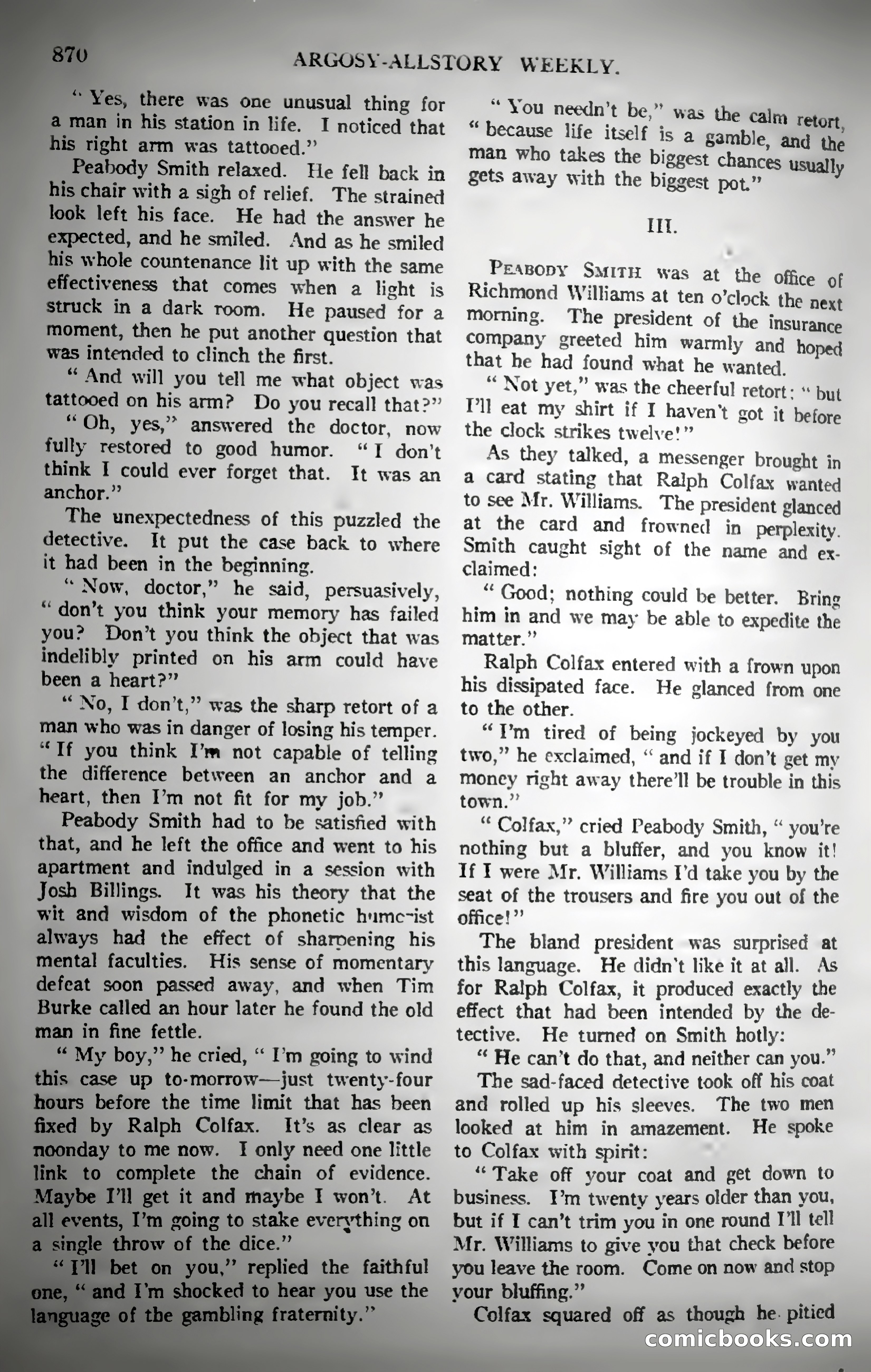
A restored page from Pulp Fiction, 1922. Page through the whole issue in the reader above.
📄 Transcribed text from this page (OCR, searchable)
Machine-transcribed from the original scan — historical spelling and the odd misread are preserved.
es, there was one unusual thing for in his station in life. I noticed that ht arm was tattooed.” Peabody Smith relaxed. He fell back in his chair with a sigh of relief. The strained _ look left his face. He had the answer he _ expected, and he smiled. And as he smiled his whole countenance lit up with the same effectiveness that comes when a light is Struck in a dark room. He paused for a moment, then he put another question that was intended to clinch the first. “ And will you tell me what object was tattooed on his arm? Do you recall that?” © Oh, yes,” answered the doctor, now fully restored to good humor. “I don't think I could ever forget that. It was an anchor.” The unexpectedness of this puzzled the detective. It put the case back to where it had been in the beginning. ~ Now, doctor,” he said, persuasively, “don’t you think your memory has failed you? Don’t you think the object that was indelibly printed on his arm could have been a heart?” “ No, I don’t,” was the sharp retort of a man who was in danger of losing his temper. “If you think I’m not capable of telling the difference between an anchor and a heart, then I’m not fit for my job.” Peabody Smith had to be satisfied with that, and he left the office and went to his apartment and indulged in a session with Josh Billings. It was his theory that the wit and wisdom of the phonetic humc-ist always had the effect of sharnening his mental faculties. His sense of momentary defeat soon passed away, and when Tim Burke called an hour later he found the old man in fine fettle. “ My boy,” he cried, “ I’m going to wind this case up to-morrow—just twenty-four hours before the time limit that has been xed by Ralph Colfax. It’s as clear as day to me now. I only need one little » complete the chain of evidence. get it and maybe I won’t. At | going to stake everything on dice.” replied the faithful lear you use the aia E a q ARGOSY-ALLSTORY WEEKLY. —_ “ You needn’t be,” was the calm retort “because life itself is a gamble, and the man who takes the biggest chances usually gets away with the biggest pot.” 1588 Peasopy SMITH was at the Office of Richmond Williams at ten o'clock the next Morning. The president of the insurance company greeted him warmly and hoped that he had found what he wanted. “ Not yet,” was the cheerful] retort: “ but Pll eat my shirt if I haven't got it before the clock strikes twelve!” As they talked, a messenger brought in a card stating that Ralph Colfax wanted to see Mr. Williams. The president glanced at the card and frowned in perplexity. Smith caught sight of the name and ex- claimed: “Good; nothing could be better. Bring him in and we may be able to expedite the matter.” Ralph Colfax entered with a frown upon his dissipated face. He glanced from one to the other. “Pm tired of being jockeyed by you two,” he exclaimed, “ and if I don’t get my money right away there’ll be trouble in this town.” “ Colfax,” cried Peabody Smith, “ you’re nothing but a bluffer, and you know it! If ¥ were Mr. Williams I'd take you by the seat of the trousers and fire you out of the office!’ The bland president was surprised at this language. He didn't like it at all. As for Ralph Colfax, it produced exactly the effect that had been intended by the de- tective. He turned on Smith hotly: “‘ He can’t do that, and neither can you.” The sad-faced detective took off his coat and rolled up his sleeves. The two men looked at him in amazement. He spoke to Colfax with spirit: “Take off your coat and get down to business. I’m twenty years older than you, but if I can’t trim you in one round I'll tell Mr. Williams to give you that check before you leave the room. Come on now and stop your bluffing.” ~~ Colfax squared off as though he. pitied com cbooks.com —