
Pulp Fiction, 1922 · page 75 of 187
Argosy All-Story Weekly — page 75: what you’re looking at
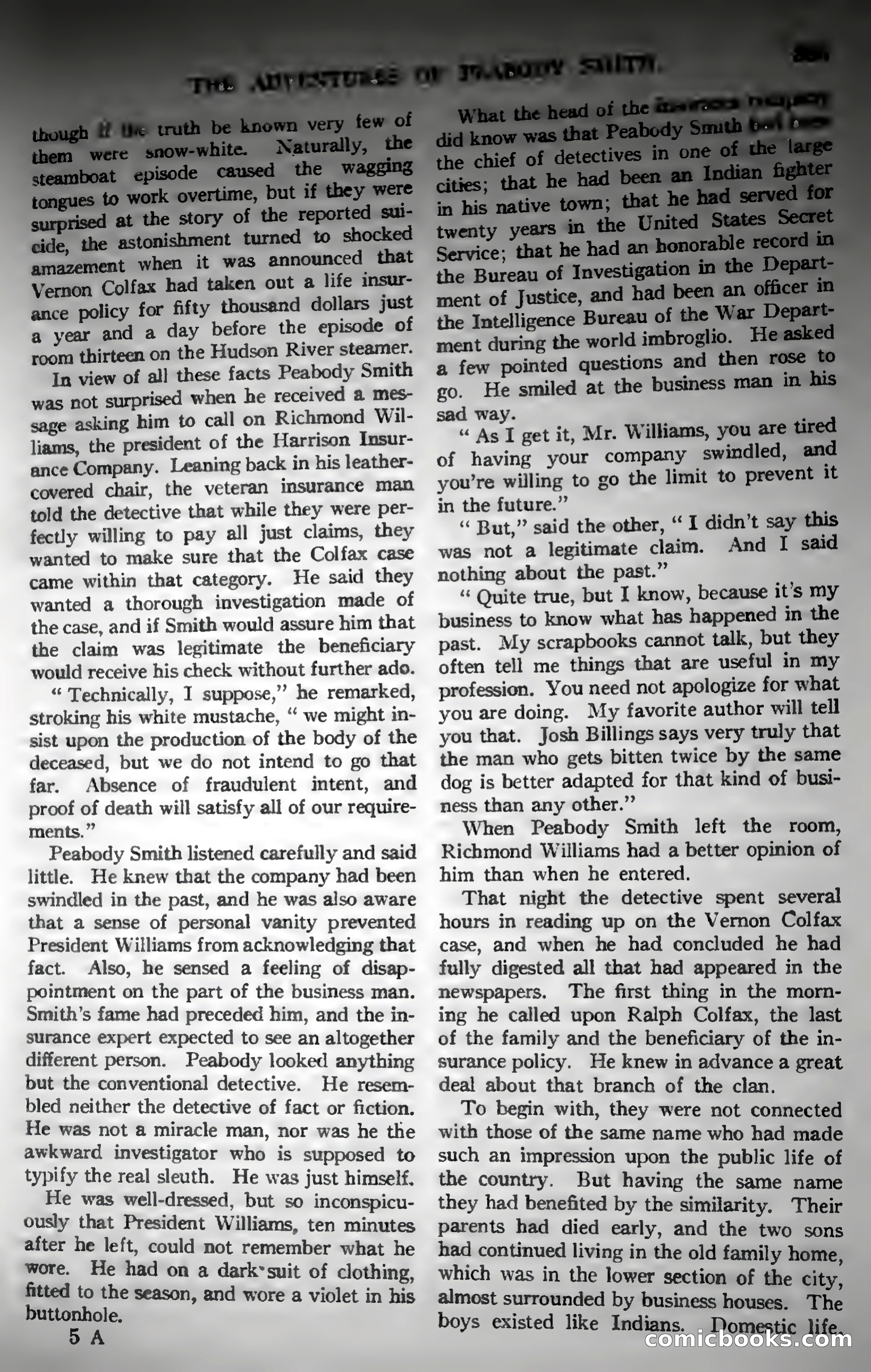
A restored page from Pulp Fiction, 1922. Page through the whole issue in the reader above.
📄 Transcribed text from this page (OCR, searchable)
Machine-transcribed from the original scan — historical spelling and the odd misread are preserved.
: nt turned to — when it was announced that Vernon Colfax had taken out a life insur- ance policy for fifty thousand dollars just a year and a day before the episode of room thirteen on the Hudson River steamer. In view of all these facts Peabody Smith was not surprised when he received a mes- sage asking him to call on Richmond Wil- liams, the president of the Harrison Insur- ance Company. Leaning back in his leather- covered chair, the veteran insurance man told the detective that while they were per- fectly willing to pay all just claims, they wanted to make sure that the Colfax case came within that category. He said they wanted a thorough investigation made of the case, and if Smith would assure him that the claim was legitimate the beneficiary would receive his check without further ado. “‘ Technically, I suppose,” he remarked, stroking his white mustache, “ we might in- sist upon the production of the body of the deceased, but we do not intend to go that far. Absence of fraudulent intent, and proof of death will satisfy all of our require- ments.” Peabody Smith listened carefully and said little. He knew that the company had been swindled in the past, and he was also aware that a sense of personal vanity prevented President Williams from acknowledging that fact. Also, he sensed a feeling of disap- pointment on the part of the business man. Smith’s fame had preceded him, and the in- surance expert expected to see an altogether different person. Peabody looked anything but the conventional detective. He resem- bled neither the detective of fact or fiction. He was not a miracle man, nor was he the awkward investigator who is supposed to typify the real sleuth. He was just himself. He was well-dressed, but so inconspicu- ously that President Williams, ten minutes after he left, could not remember what he wore. He had on a dark~suit of clothing, fitted to the season, and wore a violet in his buttonhole. 5A 10% g ‘ , . 7: Service; that he ha the Bureau of Investigation ment of Justice, and h a the Intelligence Bureau of the War 4 ment during the world imbroglio. Heasmet a few pointed questions and then rose to go. He smiled at the business man MiSs” sad way. ‘ . 2 yn get it, Mr. Wilhams, you are tired of having your company swindled, and you’re willing to go the limit to prevent it in the future.” “ But,” said the other, “I didn’t say this was not a legitimate claim. And I said nothing about the past.” “‘ Quite true, but I know, because it’s my business to know what has happened in the past. My scrapbooks cannot talk, but they often tell me things that are useful in my profession. You need not apologize for what you are doing. My favorite author will tell you that. Josh Billings says very truly that the man who gets bitten twice by the same dog is better adapted for that kind of busi- ness than any other.” When Peabody Smith left the room, Richmond Williams had a better opinion of him than when he entered. That night the detective spent several hours in reading up on the Vernon Colfax case, and when he had concluded he had fully digested all that had appeared in the newspapers. The first thing in the morn- ing he called upon Ralph Colfax, the last of the family and the beneficiary of the in- surance policy. He knew in advance a great deal about that branch of the clan. To begin with, they were not connected with those of the same name who had made such an impression upon the public life of the country. But having the same name they had benefited by the similarity. Their parents had died early, and the two sons had continued living in the old family home, which was in the lower section of the city, almost surrounded by business houses. The boys existed like Indians ic li eGunlebookeeconn