
Pulp Fiction, 1922 · page 63 of 187
Argosy All-Story Weekly — page 63: what you’re looking at
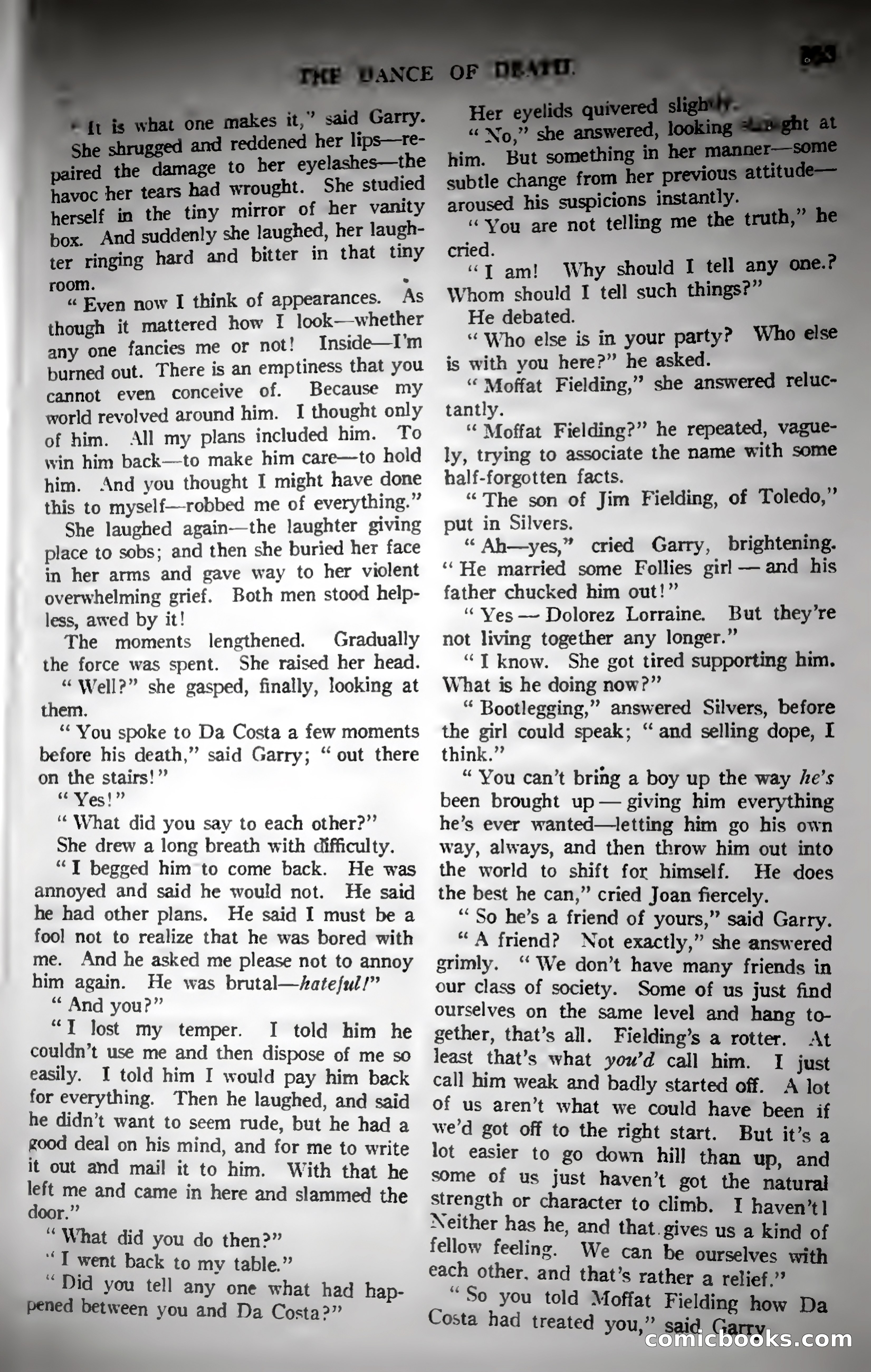
A restored page from Pulp Fiction, 1922. Page through the whole issue in the reader above.
📄 Transcribed text from this page (OCR, searchable)
Machine-transcribed from the original scan — historical spelling and the odd misread are preserved.
a 1. chrvooed and reddened her lips—re- pa! og ‘the da age to her eyelashes—the havoc her tears had wrought. She studied herself in the tiny mirror of her vanity box. And suddenly she laughed, her laugh- ter ringing hard and bitter in that tiny wu Even now I think of appearances. As though it mattered how I look—whether any one fancies me or not! Inside—I’m burned out. There is an emptiness that you cannot even conceive of. Because my world revolved around him. I thought only of him. All my plans included him. To win him back—to make him care—to hold him. And you thought I might have done this to myself—robbed me of everything.” She laughed again—the laughter giving place to sobs; and then she buried her face in her arms and gave way to her violent overwhelming grief. Both men stood help- less, awed by it! The moments lengthened. Gradually the force was spent. She raised her head. “Well?” she gasped, finally, looking at them. “You spoke to Da Costa a few moments before his death,” said Garry; “ out there on the stairs!” imyes!”’ ‘What did you say to each other?”’ She drew a long breath with difficulty. “I begged him to come back. He was armoyed and said he would not. He said he had other plans. He said I must be a fool not to realize that he was bored with me. And he asked me please not to annoy him again. He was brutal—sateful!” “T lost my temper. I told him he couldn’t use me and then dispose of me so easily. I told him I would pay him back for everything. Then he laughed, and said he didn’t want to seem rude, but he had a good deal on his mind, and for me to write it out and mail it to him. With that he left me and came in here and slammed the door.” “What did you do then?” “TI went back to my table.” “Did you tell any one what had hap- pened between you and Da Costa?” — subtle change from her p WU aroused his suspicions 15 “You are not telling me the tr a ” cried. —. ‘“T am! Why should I tell any one. Whom should I tell such things?” He debated. “Who else is in your party? Who else is with you here?” he asked. “ Moffat Fielding,” she answered reluc- tantly. “ Moffat Fielding?” he repeated, vague- ly, trying to associate the name with some half-forgotten facts. “The son of Jim Fielding, of Toledo,” put in Silvers. . “ Ah—yes,” cried Garry, brightening. ‘“‘ He married some Follies girl — and his father chucked him out!” “ Ves — Dolorez Lorraine. But they’re not living together any longer.” “IT know. She got tired supporting him. What is he doing now?” “ Bootlegging,” answered Silvers, before the girl could speak; “ and selling dope, I think.” “ You can’t bring a boy up the way he’s been brought up — giving him everything he’s ever wanted—letting him go his own way, always, and then throw him out into the world to shift for himself. He does the best he can,” cried Joan fiercely. ‘So he’s a friend of yours,” said Garry. “A friend? Not exactly,” she answered grimly. “We don’t have many friends in our Class of society. Some of us just find ourselves on the same level and hang to- gether, that’s all. Fielding’s a rotter. At least that’s what you’d call him. I just call him weak and badly started off. A lot of us aren’t what we could have been if we'd got off to the right start. But it’s a lot easier to go down hill than up, and some of us just haven’t got the natural Strength or character to climb. I haven't] Neither has he, and that. gives us a kind of fellow feeling. We can be ourselves with each other, and that’s rather a relief ,’? “So you told Moffat Fielding how Da Costa had treated you.” sai | | = "comic 500 oks.cc 4 re