
Pulp Fiction, 1922 · page 36 of 187
Argosy All-Story Weekly — page 36: what you’re looking at
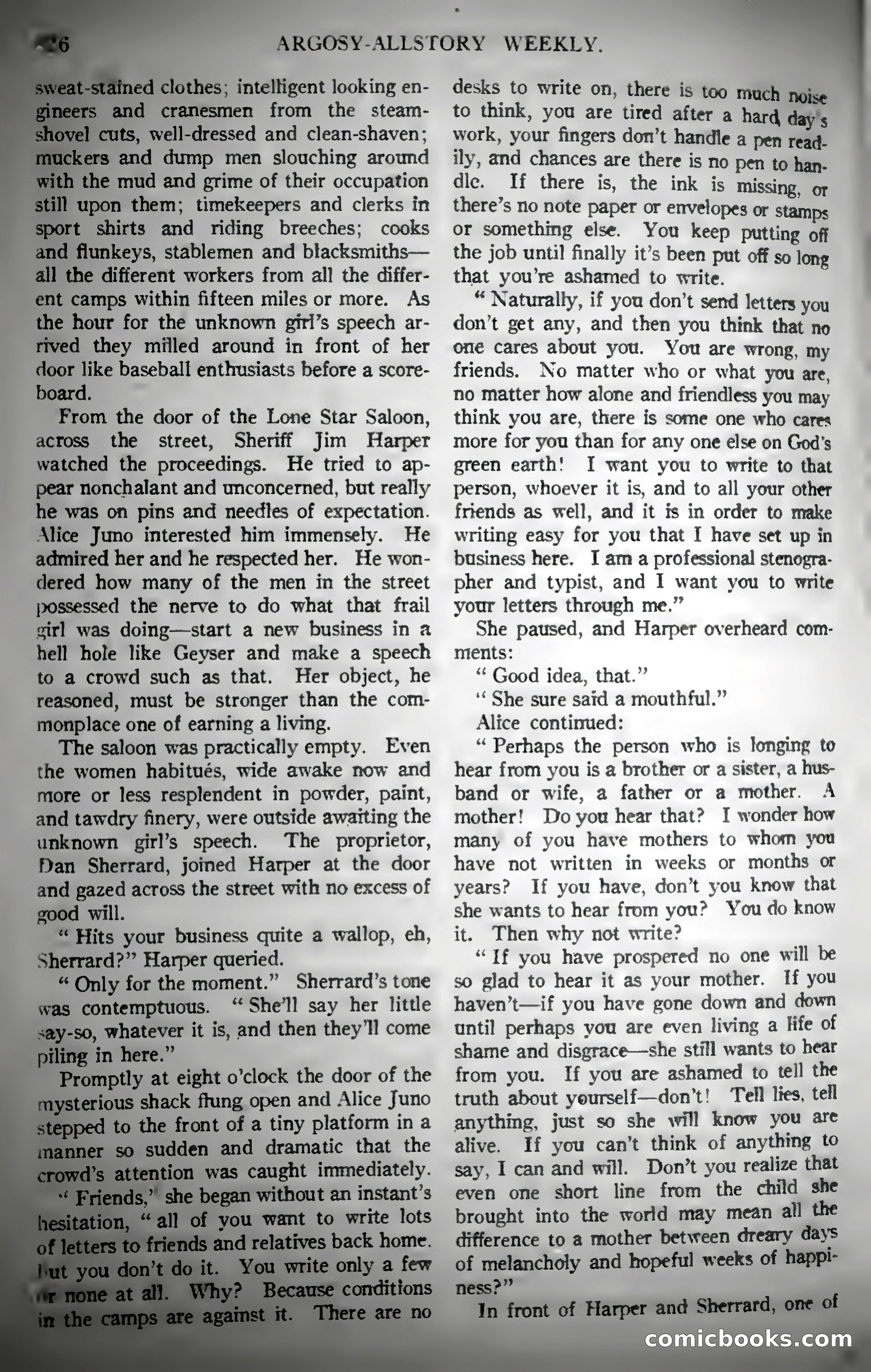
A restored page from Pulp Fiction, 1922. Page through the whole issue in the reader above.
📄 Transcribed text from this page (OCR, searchable)
Machine-transcribed from the original scan — historical spelling and the odd misread are preserved.
4ined clothes; intelligent looking en- and cranesmen from the steam- cuts, well-dressed and clean-shaven; ers and dump men slouching around 1 the mud and grime of their occupation ! upon them; timekeepers and clerks in sport shirts and riding breeches; cooks and flunkeys, stablemen and blacksmiths— all the different workers from all the differ- ent camps within fifteen miles or more. As the hour for the unknown girl’s speech ar- _ rived they milled around in front of her door like baseball enthusiasts before a score- board. From the door of the Lone Star Saloon, _ across the street, Sheriff Jim Harper _ watched the proceedings. He tried to ap- pear nonchalant and unconcerned, but really he was on pins and needles of expectation. Alice Juno interested him immensely. He admired her and he respected her. He won- dered how many of the men in the street possessed the nerve to do what that frail girl was doing—start a new business in a hell hole like Geyser and make a speech to a crowd such as that. Her object, he reasoned, must be stronger than the com- monplace one of earning a living. The saloon was practically empty. Even the women habitués, wide awake now and more or less resplendent in powder, paint, and tawdry finery, were outside awaiting the unknown girl’s speech. The proprietor, Pan Sherrard, joined Harper at the door and gazed across the street with no excess of good will. “Hits your business quite a wallop, eh, Sherrard?”’ Harper queried. “ Only for the moment.” Sherrard’s tone ‘was contemptuous. “She'll say her little ay-so, whatever it is, and then they'll come ing in here.” Promptly at eight o’clock the door of the ‘terious shack fhing open and Alice Juno ed to the front of a tiny platform ina r so sudden and dramatic that the tention was caught immediately. " she began without an instant’s of you want to write lots ind relatives back home. oe ARGOSY-ALLSTORY WEEKLY. desks to write on, there is too much noise to think, you are tired after a hard day's work, your fingers don’t handle a pen read- ily, and chances are there is no pen to han- dle. If there is, the ink is missing, of there’s no note paper or envelopes or stamps or something else. You keep putting off the job until finally it’s been put off so long that you’re ashamed to write. “ Naturally, if you don’t send letters you don’t get any, and then you think that no one cares about you. You are wrong, my friends. No matter who or what you are, no matter how alone and friendless you may think you are, there is some one who cares more for you than for any one else on God's green earth! I want you to write to that person, whoever it is, and to all your other friends as well, and it is in order to make writing easy for you that I have set up in business here. I am a professional stenogra- pher and typist, and I want you to write your letters through me.” She paused, and Harper overheard com- mients: “* Good idea, that.” ‘She sure said a mouthful.” Alice continued: “Perhaps the person who is longing to hear from you is a brother or a sister, a hus- band or wife, a father or a mother. A mother! Do you hear that? I wonder how many of you have mothers to whom you have not written in weeks or months or years? If you have, don’t you know that she wants to hear from you? You do know it. Then why not write? “If you have prospered no one will be so glad to hear it as your mother. [f you haven’t—if you have gone down and down until perhaps you are even living a life of shame and disgrace—she still wants to hear from you. If you are ashamed to tell the truth about yourself—don’t! Tell lies, tell anything, just so she will know you are alive. If you can’t think of anything to say, I can and will. Don’t you realize that even one short line from the child she brought into the world may mean all the difference to a mother between dreary days of melancholy and hopeful weeks of happl- ness?” In front of He AS