
Pulp Fiction, 1922 · page 142 of 187
Argosy All-Story Weekly — page 142: what you’re looking at
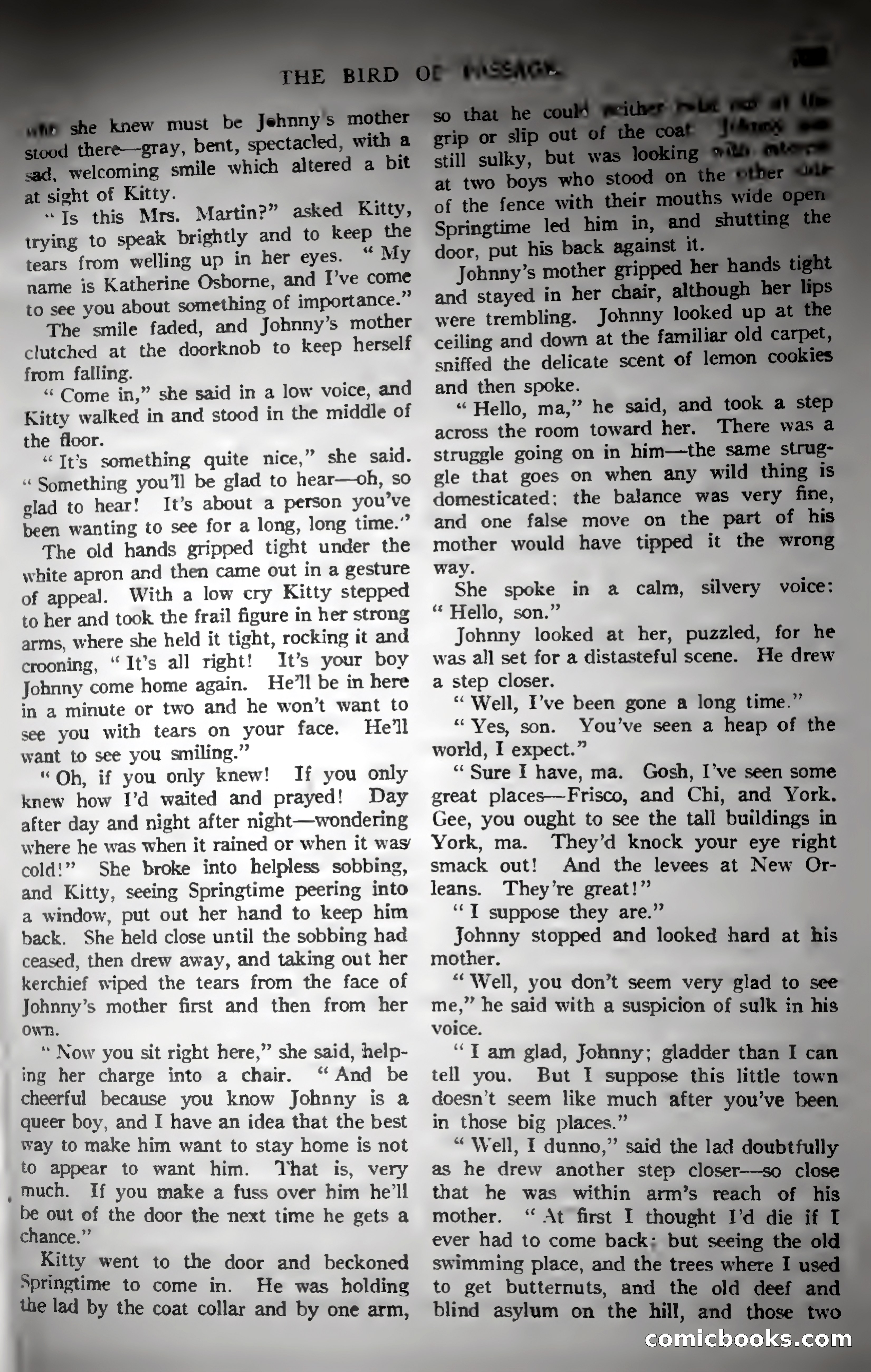
A restored page from Pulp Fiction, 1922. Page through the whole issue in the reader above.
📄 Transcribed text from this page (OCR, searchable)
Machine-transcribed from the original scan — historical spelling and the odd misread are preserved.
here—eray, bent, spectacled, ' sad, welcoming smile which altered a bit at sight of Kitty. “Is this Mrs. Martin?” asked Kitty, trying to speak brightly and to keep the tears from welling up in her eyes. “My name is Katherine Osborne, and I’ve come to see you about something of importance.” The smile faded, and Johnny’s mother clutched at the doorknob to keep herself from falling. “Come in,” she said in a low voice, and Kitty walked in and stood in the middle of the floor. “JTt's something quite nice,” she said. “ Something you'll be glad to hear—oh, so glad to hear! It’s about a person you’ve been wanting to see for a long, long time.” The old hands gripped tight under the white apron and then came out in a gesture of appeal. With a low cry Kitty stepped to her and took the frail figure in her strong arms, where she held it tight, rocking it and crooning, “It’s all right! It’s your boy Johnny come home again. He'll be in here in a minute or two and he won't want to see you with tears on your face. He'll want to see you smiling.” “Oh, if you only knew! If you only knew how I’d waited and prayed! Day after day and night after night—wondering where he was when it rained or when it way cold!” She broke into helpless sobbing, and Kitty, seeing Springtime peering into a window, put out her hand to keep him back. She held close until the sobbing had ceased, then drew away, and taking out her kerchief wiped the tears from the face of Johnny’s mother first and then from her own. “Now you sit right here,” she said, help- ing her charge into a chair. “ And be cheerful because you know Johnny is @ queer boy, and I have an idea that the best way to make him want to stay home is not to appear to want him. That is, very much. If you make a fuss over him he’ll be out of the door the next time he gets a chance.” Kitty went to the door and beckoned Springtime to come in. He was holding the lad by the coat collar and by one arm, of the fence with ti Springtime led him door, put his back agz Johnny’s mother gripped hi and stayed in her chair, a . were trembling. Johnny looked up ceiling and down at the familiar old cat sniffed the delicate scent of lemon Ce and then spoke. - “ Hello, ma,” he said, and took a step across the room toward her. There was a struggle going on in him—the same strug- gle that goes on when any wild thing is | domesticated: the balance was very fine, and one false move on the part of hi mother would have tipped it the wr way. She spoke in a calm, silvery voice: * Hello, son.” Johnny looked at her, puzzled, for he was all set for a distasteful scene. He drew a step closer. “ Well, I’ve been gone a long time.” “Ves, son. You’ve seen a heap of the world, I expect.” ‘Sure I have, ma. Gosh, I’ve seen some great places—Frisco, and Chi, and York. Gee, you ought to see the tall buildings in York, ma. They’d knock your eye right smack out! And the levees at New Or- leans. They’re great!” ‘TY suppose they are.” Johnny stopped and looked hard at his mother. “Well, you don’t seem very glad to see me,” he said with a suspicion of sulk in his VOICE. ‘Tam glad, Johnny; gladder than I can tell you. But I suppose this little town doesn’t seem like much after you’ve been in those big places.” “ Well, I dunno,” said the lad doubtfully _ as he drew another step closer—so close. that he was within arm’s reach of his mother. “ At first I thought I’d if ever had to come back: but seeing swimming place, and the trees where I to get butternuts, and the old de blind asylum on the hill, and 1